


Executive Summary
GPUStack versions before 2.2.0 granted built-in administrator rights to any request it believed came from loopback. Two ordinary deployment choices made that reachable from the internet, a reverse proxy on the same host and a client header the server accepted as truth. From there an attacker could mint administrator keys that work from any address, read the worker and cloud secrets the cluster stored, and push code onto the GPU nodes. GitHub’s advisory records exploitation against a 2.1.1 deployment, where attacker backends ran reverse shells on workers.
The fix does less than the deadline implies. Upgrading removes the bypass and leaves everything the attacker built in place, including keys, backends and whatever ran on the hosts. CISA listed the flaw as exploited on 9 November with a federal due date of 12 November, and asked for forensic triage alongside the patch. Treat any pre-2.2.0 instance that answered to the internet as compromised, and move the credentials it held.
If you run GPUStack behind a reverse proxy on the same box, you have been running an unauthenticated admin console on the internet. Not a mistake in your proxy configuration. The software decided who you were from where you appeared to be calling from.
The flaw is CVE-2026-102895, and it falls under CISA’s federal due date today. It matters beyond government networks. GPUStack ships to anyone who can run pip.
The bug was one branch inside the login function
GPUStack is an open-source manager for GPU clusters that serve models. Before version 2.2.0 its get_current_user function promoted any request whose source looked like loopback to the built-in administrator account. The setting that would have stopped it, force_auth_localhost, shipped as false. Wrong default for the value that decides authentication.
Two paths got a remote caller there. In the shape the advisory calls canonical for self-hosting, the proxy forwards to 127.0.0.1, so every remote request arrives with a loopback peer address. The second is a forged X-GPUStack-Real-IP header, which the server accepted as the real client address. The advisory verified the proxy path end to end.
GitHub’s numbering authority scored it 9.8, under weakness classes CWE-287, CWE-290 and CWE-346. Improper authentication, improper trust of a source, and trust of a client-supplied origin. Three names for one assumption.
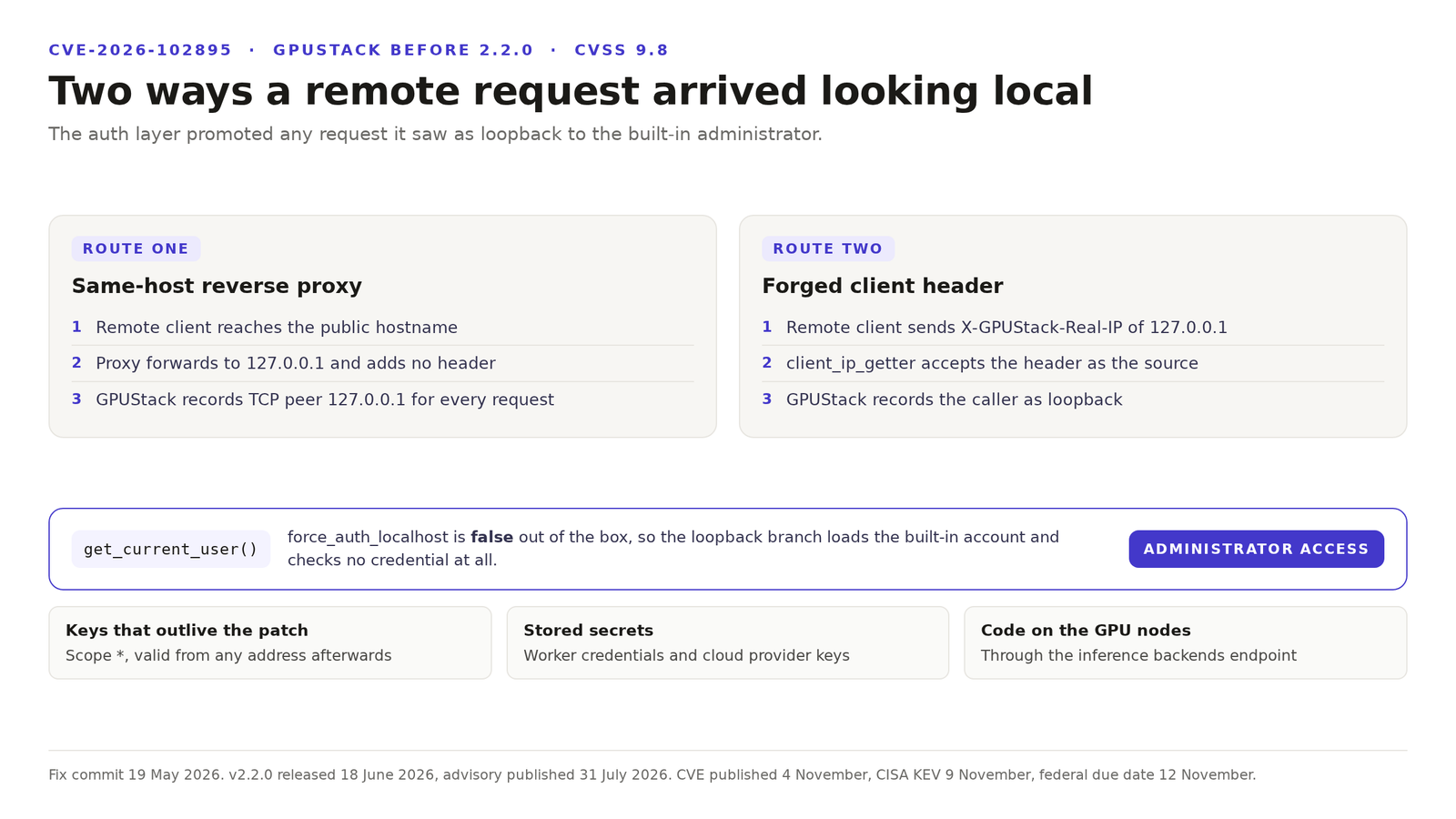
The impact list is where the severity lives. A caller in could change users, models, workers and configuration, mint administrator API keys with unrestricted scope that keep working from any address, read the credentials GPUStack held for workers and cloud providers, and run code on the worker hosts through the endpoint that registers an inference backend from YAML.
A GPU cluster manager holds the keys to the machines that hold the models. Administrator on that control plane is a foothold on the thing serving your inference traffic. The advisory records exploitation in the wild against a 2.1.1 deployment, where attacker-created backends ran reverse shells on the workers.
The fix shipped in June and nobody said so until November
Version 2.2.0 went out on 18 June. The advisory followed on 31 July. The CVE record was published on 4 November, and CISA listed it as exploited on 9 November with a due date three days later. That is 139 days between the release that fixed it and the warning that it needed fixing.
A second flaw is worth knowing. CVE-2026-102894, rated 9.1, sits in the SAML callback endpoint, which minted a login session after decoding the SAML response without verifying the signature, issuer, audience or time conditions. Any network client could submit an identity for an existing user, an administrator included, even where SAML was never configured. It affects 0.7.1 through 2.2.1 and is fixed in 2.2.2, so moving to 2.2.0 closes the loopback hole and leaves this one open.
Patching is the half that takes ten minutes
Upgrade to 2.2.2 rather than 2.2.0. If you cannot move today, set force_auth_localhost to true, strip any client-supplied X-GPUStack-Real-IP header at the edge, and keep the admin API off networks your model traffic can reach.
Then do the part a version number does not cover. Review administrator API keys and delete any you cannot account for. Check the backend list for entries nobody on your team registered. Rotate every worker credential and cloud secret the cluster stored. Look at the GPU hosts for outbound connections you did not ask for. If the instance answered to the internet before the upgrade, none of that is optional.
The design lesson travels past GPUStack. Deriving identity from network position worked while everything ran on one machine and fails the moment a proxy sits in front and speaks for somebody else.
Three questions for every AI platform you run. Does anything in front of it pass a client-supplied header to the auth layer? Does the admin plane accept connections from anywhere the model endpoint does? And if a key nobody on your team created sat in that cluster now, would you find it?
Related reading. A vendor rating that disagreed with CISA’s in the Outlook flaw rated moderate while it was being exploited, and at why a hypervisor behind every pod still leaves admission policy to you in AWS Nitro sandboxes on EKS.
Sources. CVE-2026-102895 in the NVD, GitHub advisory GHSA-gj9m-f8ph-pmhr, CISA’s 9 November alert, CVE-2026-102894 and the v2.2.0 release.
Get the next one before it is old news
Independent analysis of cloud-native infrastructure, Kubernetes and data center economics. No vendor spin.