


Executive Summary
Alibaba opened the top of its Qwen family on 11 November without a price list. Qwen4-Max-Preview runs behind a Token Plan subscription with no per-token rate, no published parameter count and no benchmark table. The documentation sets the gate to close at midnight Beijing time on 25 November, after which Alibaba retires the model and the endpoint goes with it.
The gate is the interesting part. Capacity planning needs a rate, and Alibaba replaced the rate with a pool of credits sold in four tiers from 6 dollars to 43 dollars a month. Tencent did something similar on 4 November when it shipped Hy4 with its weights still promised rather than posted. Moonshot and DeepSeek are now the two Chinese labs that let a buyer run the arithmetic, so evaluate Qwen 4 hard, then check whether the thing you would actually deploy is available at all.
The preview opened on the morning of 11 November in Beijing. The Qwen team announced it on X, and the Alibaba Cloud documentation carried the terms. No walkthrough post, no benchmark slide, no parameter count.
What Alibaba published is a fence.
Alibaba replaced the rate card with a credit meter
Qwen4-Max-Preview is not sold per token, and the documentation says so plainly. It is available through Token Plan only, and pay-as-you-go access is not supported. You buy a monthly subscription and get a pool of credits shared by every model and tool in the plan.
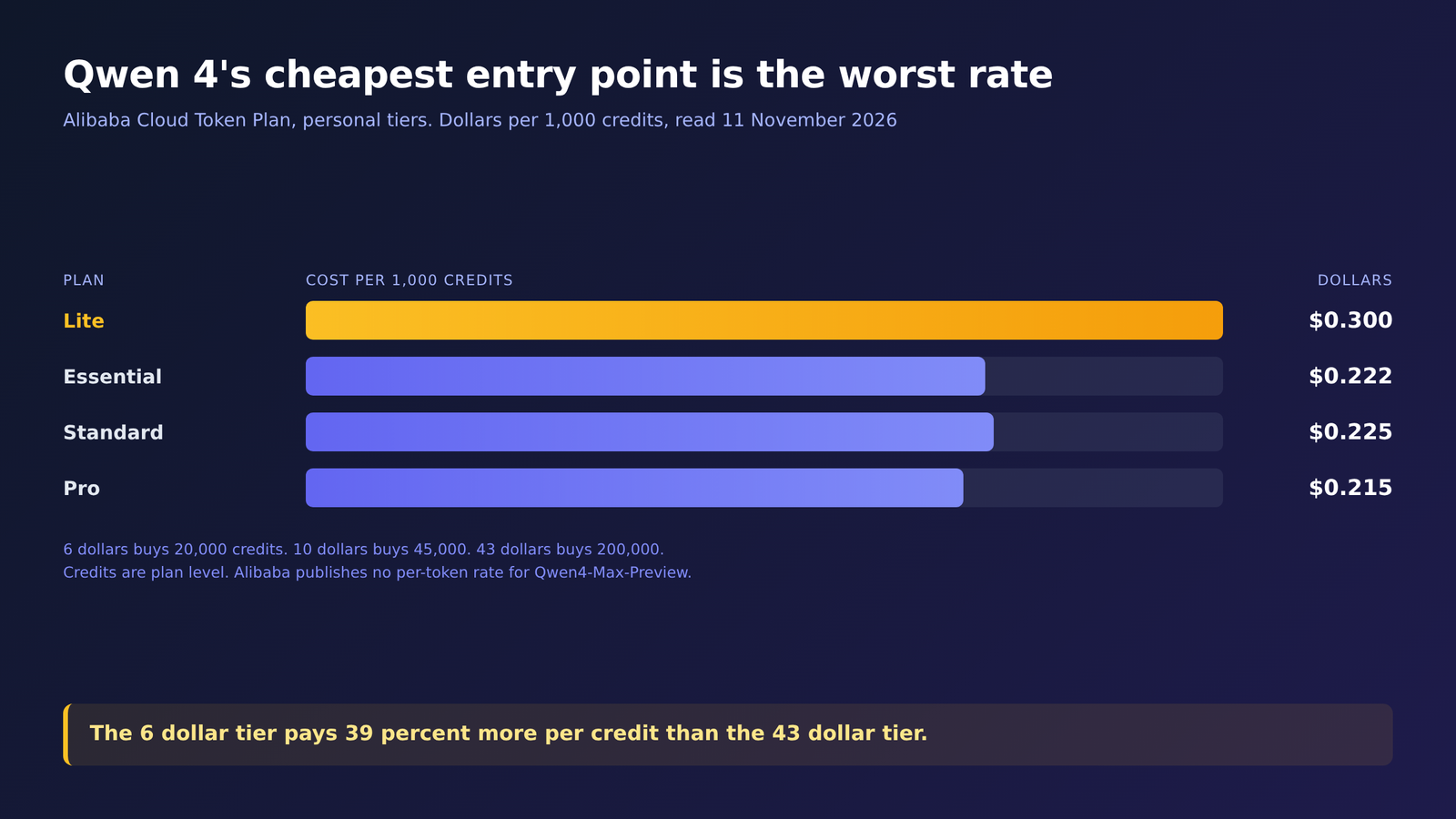
The four personal tiers cost 6, 10, 18 and 43 dollars a month, for 20,000, 45,000, 80,000 and 200,000 credits. Divide one into the other and the shape appears. The entry tier charges 30 cents per 1,000 credits. The top tier charges about 21.5 cents. The 10 dollar plan sits near 22 cents, which makes the 18 dollar plan the worse buy of the two.
Credit pools are not prices. Without a rate per million tokens, a team cannot answer the question that decides adoption, which is what a finished task costs. They can buy credits and burn them.
Context is one million tokens. Output tops out at 393,216 tokens, shared between thinking and the final answer, because Alibaba changed max_tokens to behave like max_completion_tokens starting with this model. Thinking is on by default.
The files you can host went out from Moonshot instead
Compare the same week on Hugging Face. Moonshot posted Kimi K3.1 Pro weights on 2 November, a 2.8 trillion parameter mixture of experts with 104 billion active. The repository reports 33,617 downloads last month. It carries a custom license rather than Apache, so read it before you resell, but the files exist and disk space is the only gate.
DeepSeek stays the cheapest thing a team can hold. The model behind the deepseek-flash name is V4.1-Flash-1017, MIT licensed, one million token context, 384,000 token maximum output, and 15 cents per million input tokens off peak against 60 cents per million output. Peak rates are double, and DeepSeek publishes the hours. That is a rate card a planner can use.
Tencent is the cautionary case. Hy4 shipped on 4 November with good numbers and a promise that the weights would follow. Tencent’s own research page still describes that as a plan. As of this evening the tencent organization on Hugging Face carries no Hy4 release, only the August preview.
Fifteen days is a test window, not a release
The preview retires on 25 November. That date decides how much a company can build on it. Engineering against a model name that disappears is a demonstration, not a deployment.
Then the region. Token Plan has one available region, Singapore, with global inference and cross-border transfer of prompts and outputs. For a bank or a health system in Europe, that turns a model evaluation into a data transfer review, and the documentation puts the compliance obligation on the customer.
None of this makes Qwen 4 a bad model. It makes this launch a subscription trial with an unpublished price per token, published limits on what it will answer, and an end date. Alibaba may follow the pattern it set with Qwen3.8-Max, where a preview ran for two weeks before the full model arrived with a public rate. This time it has not said so, and a buyer cannot plan against a guess.
The takeaway is narrow. Run the evaluation if the capability is what you need, and put 25 November in the calendar. Keep a fallback you can actually download, because that is the only part of this week’s Chinese releases whose price and lifespan you control.
Three questions for your own stack. What does one completed task cost on the model you are evaluating, and could you prove it to a finance team? If your primary model’s weights stopped being reachable, what would you run next week? And who signs off on a cross-border transfer of prompts, not just data at rest?
Related reading. We covered Tencent shipping Hy4 while its weights stayed missing, and the Qwen Flash-Next rebuilds that never reached the trending board.
Sources. Alibaba Cloud documentation for Qwen4-Max-Preview, Token Plan personal edition terms, Moonshot’s Kimi K3.1 Pro model card, DeepSeek’s published prices, and Tencent’s Hy4 research page.
Get the next one before it is old news
Independent analysis of cloud-native infrastructure, Kubernetes and data center economics. No vendor spin.