


Executive Summary
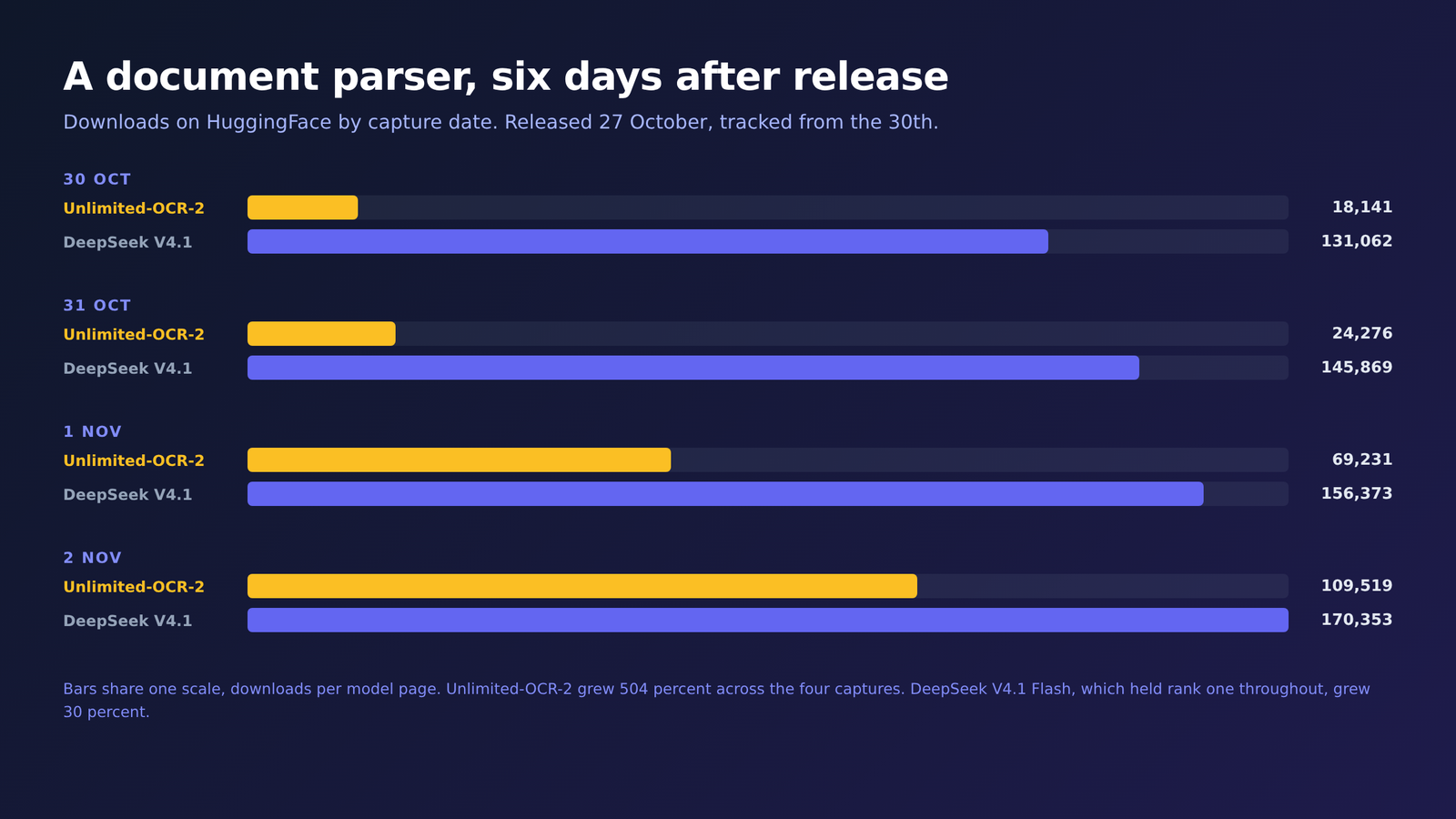
Baidu’s Unlimited-OCR-2 added 504 percent to its download count between 30 October and 2 November, the fastest growth of any model on the HuggingFace trending board that already had more than ten thousand downloads. It rose from rank nine to rank five and passed 109,000 downloads six days after release. The model at rank one, DeepSeek V4.1 Flash, grew 30 percent.
The reason is a compute property, not a benchmark score. Unlimited-OCR-2 pins attention to a fixed working set of about 512 references, so latency and memory stay roughly flat as page count climbs, which turns a long archive into a predictable bill. NVIDIA’s speech model made the same move into the top three on the same board, on the same logic about streams per node. The established flagships barely moved. Qwen3.8-27B grew five percent and facebook’s sam3 grew less than one, which is what a mature model looks like next to a workload that just became affordable.
Baidu published the weights on 27 October. The first capture in our series, three days later, put the model at rank nine with 18,141 downloads. By the morning of 2 November it held rank five with 109,519, on the model page here Unlimited-OCR-2.
This is not a launch spike that fades. The curve steepened between 31 October and 1 November, when downloads went from 24,276 to 69,231, and it kept climbing the next day.
Document parsing breaks where the page count gets big
Ten pages of invoices fit in any context window. A four hundred page scanned archive does not. Attention across image and text tokens grows with the document, so memory and latency climb with it, and the machine has to be sized for the longest file rather than the median one.
Unlimited-OCR-2 attacks that directly. Its sparse reference sliding window attention compresses the exchange between text and image down to a fixed set of working references, about 512 tokens, so per-step decoding latency and memory stop climbing once the document gets long. Baidu’s write-up puts the goal as unbounded parsing inside a finite window.
Read that as a billing change. Cost per page flattens instead of climbing with length, and per page is the number a document workflow actually budgets. Nobody buys a document pipeline on a leaderboard position.
Audio made the same move into the top three
NVIDIA Nemotron-3.5-Transcribe went from rank seven to rank three, from 4,276 downloads to 29,364. Its percentage gain beats the OCR model, though off a base small enough that the ratio carries less weight than the curve. What matters is the shape. It activates about 4.3B parameters out of 30B total, takes recordings up to an hour, and covers forty languages. Active parameters decide how many streams fit on a node. Streams per node decide the price per hour of audio.
Per page and per hour are units procurement already runs on. Parameter counts are not. That is why growth here looks different from growth at the top of that board.
What the ranking hides, and what to check
HuggingFace sorts by a trending score that tracks how fast attention arrives. DeepSeek V4.1 Flash still holds rank one and still moves more total volume than anything else on the board, at 170,353 downloads. But its trending score fell from 872 to 701 across four days, and its download growth was 30 percent against 504. Liquid AI’s LFM3-1.7B took rank two with 37,568 downloads, up 137 percent.
Two more numbers are worth carrying into a model review. Nanbeige4.3-33B was first on 1 November at a trending score of 804 and sixth a day later at 402, while its downloads rose 14 percent. Attention on that board has a half life measured in hours. Mistral-Large-4-1T-A52B grew 1,546 percent, from 278 downloads to 4,576, which is arithmetic on a small base rather than demand.
So ask three things before adopting anything off this list. Does the model card state a cost per page, per hour or per frame, or only a benchmark score? Can the weights run on hardware you already own, with no provider in the path? And is the workload counted in units you can forecast?
Xiaomi-OCR-0 answers the second question well. It appeared in this morning’s snapshot at rank 29 with 17,143 downloads and 0.8B parameters, a document model that fits on a single card.
Yesterday we covered quantized community builds outrunning their originals on this same board. This is the other half of that shift. Demand is landing in workloads that already carry a unit price, and the labs shipping small specialized models are the ones collecting it. Our read on where buyers actually route traffic is here.
Get the next one before it is old news
Independent analysis of cloud-native infrastructure, Kubernetes and data center economics. No vendor spin.