


Executive Summary
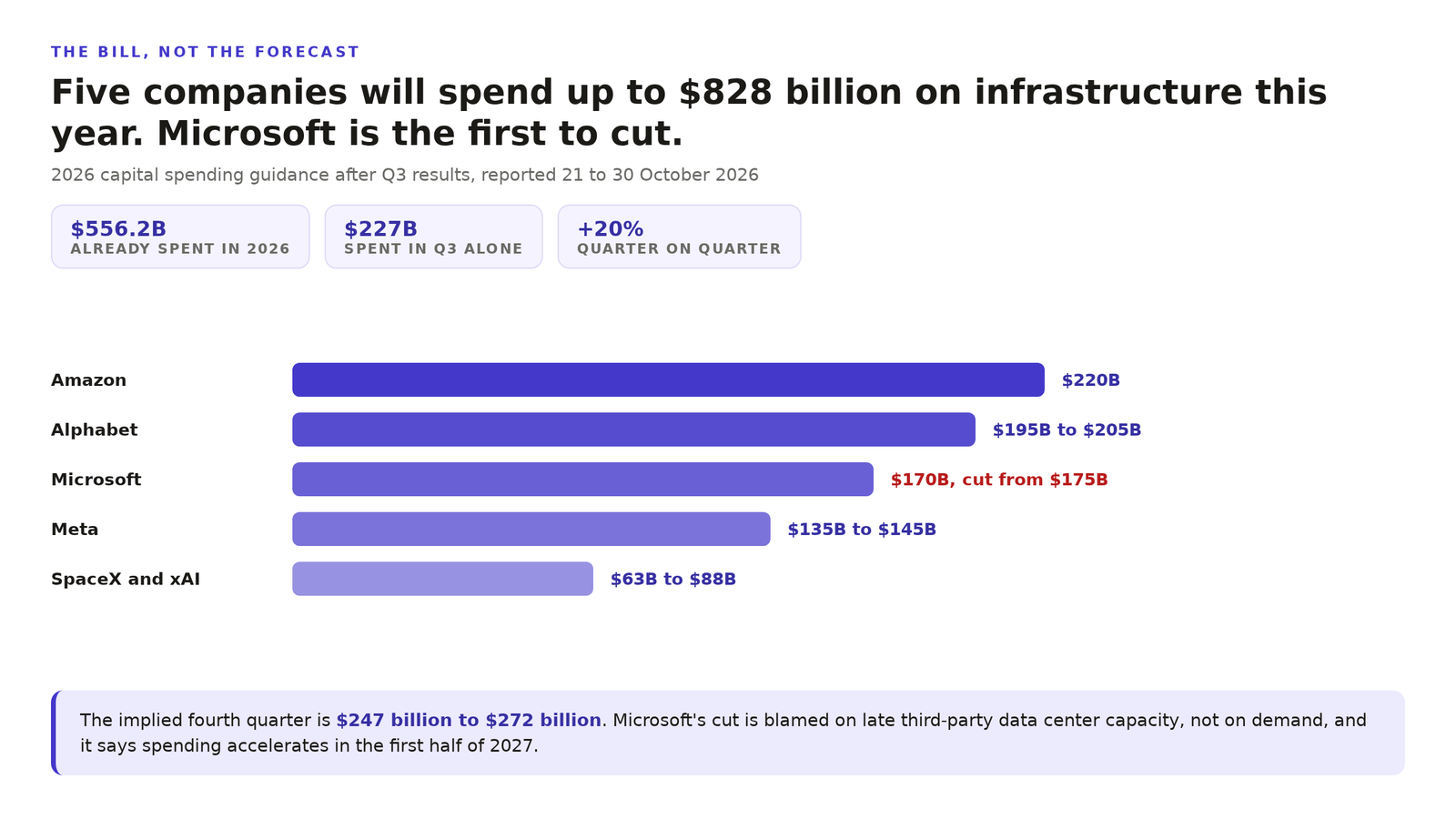
Five companies will spend between $803 billion and $828 billion on infrastructure in calendar 2026. Through three quarters they have spent $556.2 billion, and the implied fourth quarter runs from $247 billion to $272 billion. The finding sits in the one number that moved. Microsoft trimmed full year capital spending to $170 billion from $175 billion and tied the cut to late third party data center capacity, not to softer demand. Amazon held at $220 billion, Alphabet held a range of $195 billion to $205 billion, and Meta raised its floor to $135 billion. Alphabet’s finance chief told investors that capital spending is still expected to rise significantly in 2027. The verdict is that the binding constraint moved from chips to buildings, and capacity that arrives late is capacity buyers pay a premium for.
Two caveats belong with the total. Guidance is a plan, and plans get trimmed twice. The $828 billion top of the range leans on spending by SpaceX and xAI that the tallying sources estimate rather than disclose in a filing. What doesn’t move is the arithmetic underneath. Three of the four hyperscalers now fund the build partly from outside operating cash flow.
The biggest number in AI infrastructure this year isn’t a model. It’s a construction schedule with a dollar sign attached.
The third quarter put roughly $227 billion of capital spending on the table across Amazon, Alphabet, Microsoft, Meta and SpaceX. That’s up about 20 percent from $188.5 billion in the prior quarter. Amazon led with $75.9 billion of cash capex, and its finance chief tied the figure mostly to AWS and AI.
Microsoft’s cut is a delivery problem wearing a demand costume
Microsoft reported $45.2 billion of capital expenditures and finance leases for the quarter, about 30 percent above a year earlier and short of the $50.7 billion analysts expected. Alphabet reported $51.4 billion of property and equipment purchases against an expected $55.09 billion.
Two misses in one week isn’t a demand story. Microsoft’s reduced outlook is tied to delays in third party data center capacity, and its finance chief said spending accelerates in the first half of 2027 on higher component costs and those delayed deliveries. Read that twice. The reason to spend more next year is that the work slipped, not that the work grew more valuable.
Alphabet held its range instead of raising it. Anat Ashkenazi, its finance chief, said on the call that the company “continues to expect our CapEx to increase significantly in 2027”. Holding guidance is not the same as confidence. It’s a company declining to promise more than it has buildings for.
The cash question moved from the income statement to the contract
Alphabet reported negative free cash flow of $9.1 billion for the quarter. Meta reported negative free cash flow too. Microsoft stayed positive. That split is the most useful line in the data, because it separates the companies that can fund a build from the ones that need somebody else’s balance sheet to carry it.
This is where the structured finance we covered this month stops looking like financial engineering and starts looking like capacity procurement. When capex outruns operating cash, the financing becomes part of the delivery schedule, and the terms of that financing become part of your cost of compute.
The market read it that way. Shares in the neoclouds fell when the two misses landed, and that reaction makes sense. A neocloud buys capacity ahead of demand and sells it forward. If the buildings arrive late, it pays for capacity it can’t rent, and the customer who reserved it waits.
A late building means a tight market with a price on it
Anyone planning GPU capacity for 2027 should read capex guidance as a delivery estimate rather than a supply forecast. The money is committed. The buildings are not, and the gap between those two facts is where contract terms get set.
That keeps the rental market tight for longer than the headline spend suggests, and it changes what gets negotiated. Reservations get longer, prepayment asks get bigger, and buyers start paying for delivery guarantees instead of raw accelerator hours. Watch for deal terms that price the schedule rather than the silicon.
None of this means the spending stops. It means spending is no longer the question. With more than $1 trillion of hyperscaler capex projected for 2027, the binding constraint is whether the shell, the power and the interconnection arrive on time. The first company to admit its schedule slipped has told you where the risk actually sits.
Three questions for your own capacity plan. Which of your reservations carries a delivery date you can enforce? If a rack lands two quarters late, what does the contract say? And when your provider trims its guidance, does anyone tell you?
Related reading. Broadcom Just Became the Backstop on Its Own Silicon. Google Capped the Gemini Bill. Provisioned Throughput Keeps Going. NVIDIA Cut AI Factory Build Time to 14 Days.
Get the next one before it is old news
Independent analysis of cloud-native infrastructure, Kubernetes and data center economics. No vendor spin.
[…] Capex guidance is a delivery estimate, not a supply forecast. A late building keeps the rental market tight. Read the full analysis. […]