


Executive Summary
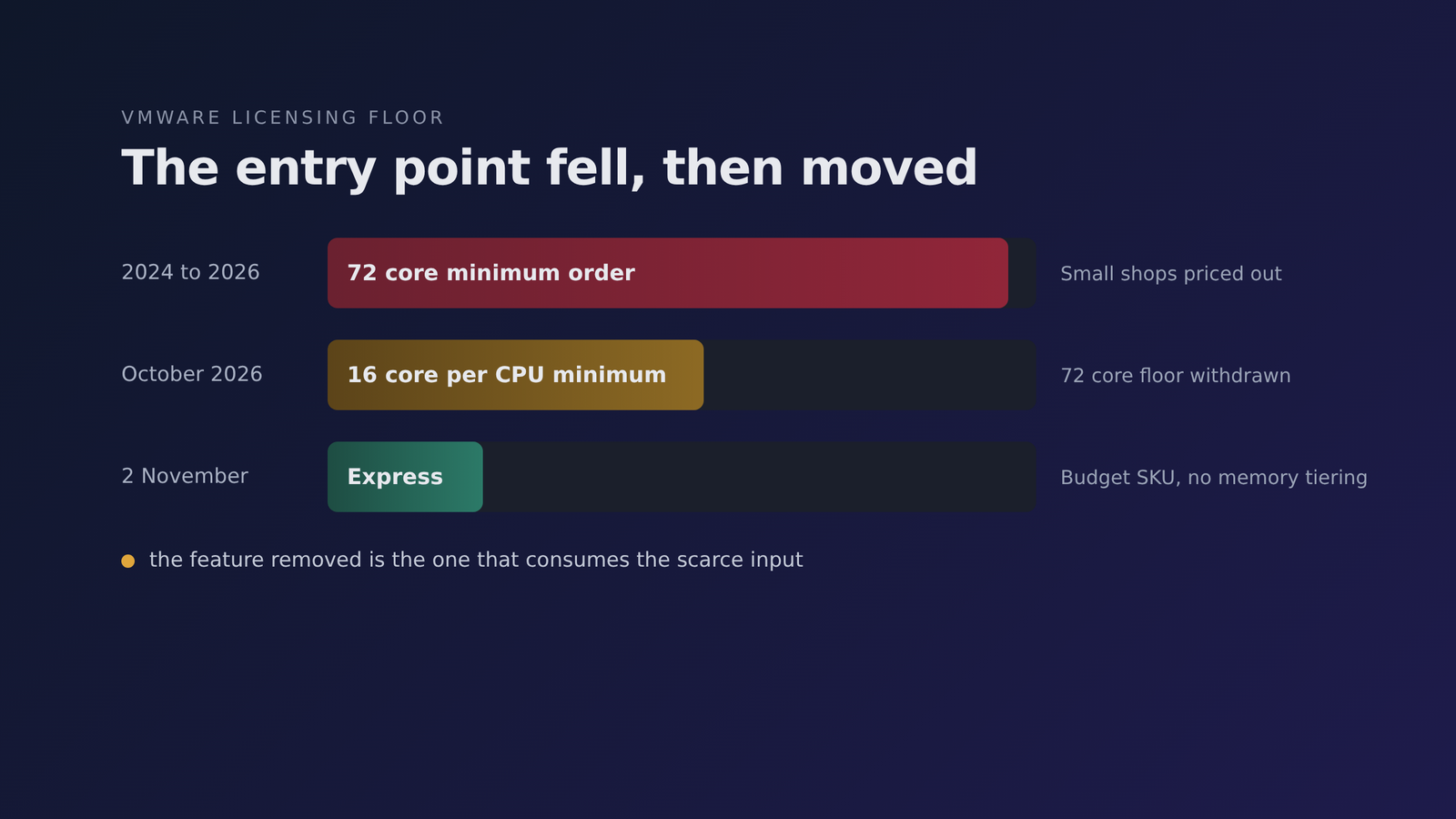
Broadcom spent three years pushing VMware customers up the stack. This month it started selling them a way back down. vSphere Standard 8.x reaches end of sale in October, a replacement v9 edition is due in November, and a reseller listing already shows a cut-down Express edition orderable from 2 November. A reseller listing now says the 72 core order minimum that kept small shops out has been withdrawn.
The budget edition reportedly ships without memory tiering. Given what memory costs this quarter, that omission is the whole story. Broadcom is rebuilding the entry point it demolished, and it is doing it by removing the one feature that would make the product expensive to serve. Small buyers get a price. They do not get the capability that motivated the price in the first place.
Two years ago the smallest sensible VMware purchase was a number nobody could pin down. A 72 core order minimum was reported in 2025, denied within days, and never reconciled in public. Broadcom’s published documentation has only ever specified a 16 core per processor floor, and small buyers have been quoting the 72 figure to each other ever since because a reseller told them it was real.
That ambiguity is what is finally going away. A reseller listing now states the 72 core order minimum has been withdrawn and smaller quantities can be ordered. Whether the floor was official or folklore, the practical barrier small buyers hit is being removed.
The floor came back, and so did a product to sit on it
A German reseller listing dated 27 October, published by Software Express, shows vSphere Standard on 8.x going end of sale this month. Renewals in October can only move to vSphere Foundation, which is a step up in both capability and price. Broadcom has said a new vSphere Standard on 9.x follows, with detail expected in November.
The 16 core per CPU minimum stays, which still catches anyone with older eight core silicon. Our licensing tracker has tracked that figure since it was first published, and has deliberately refused to assert the 72 core order minimum in either direction because the public record never settled it.
Alongside that, the VMware community has found a vSphere Express edition orderable from 2 November. The discovery came from a reseller catalogue rather than a Broadcom announcement, so treat the specifics as unconfirmed until the vendor publishes them.
What the catalogue shows is what matters. Express is advertised without memory tiering and without SR-IOV. It looks like a deliberate price point for the customers the Essentials kits used to serve, and those kits are now legacy.
The missing memory feature is the price signal
Memory tiering is the feature that lets a host stretch its DRAM across a cheaper tier. It was the reason a lot of small operators were interested in newer VMware releases at all, because it directly offsets hardware cost.
Removing it from the budget SKU is not an accident of packaging. It is the mechanism that makes a low price survivable. Memory is the scarcest input in infrastructure this quarter, and a vendor selling a cheap edition has to decide which expensive capability to leave out. Broadcom left out the one that consumes the constraint.
The community reaction was immediate. One commenter called shipping Express without tiering cursed given current memory prices, and said it would have been the only reason to sign up.
SR-IOV is the other omission and that argument was more balanced. Practitioners pointed out that a customer small enough for Express is unlikely to push a hundred gigabit through forty virtual machines. The counterargument is that offloading network work frees CPU you already paid to license.
What small buyers should actually do this month
Anyone on an Essentials subscription should assume the renewal path is now Express, and get that in writing rather than inferring it from a catalogue.
The licensing arithmetic is unforgiving at the entry point. vSphere Foundation was listed around €192.75 per core per year in September, and Cloud Foundation around €362.24. A two socket server with sixteen core processors means thirty two licensed cores, so the jump from a budget edition to Foundation is real money on a small estate.
vSphere 8 carries support into October 2027, which is closer than it sounds because a migration takes most of a year.
The end of perpetual licensing in 2024 forced a decision on every estate. Anyone who left VMware in the last two years now has a genuine question to answer. The 72 core floor is gone, so the maths that drove them to Proxmox or Hyper-V has changed. It has not changed enough, because the product they would come back to is a cut-down one.
Broadcom has previously described the portfolio reset as simplification for customers of all sizes. It has spent three years telling the market it did not want small accounts. Reopening the bottom of the range is an admission that the middle of the market went somewhere else, and that some of it is worth winning back. Whether it comes back depends on a price nobody has published yet.
We track every licensing change on the Broadcom VMware licensing tracker, including the core minimums and the dates they moved.
Get the next one before it is old news
Independent analysis of cloud-native infrastructure, Kubernetes and data center economics. No vendor spin.