


Executive Summary
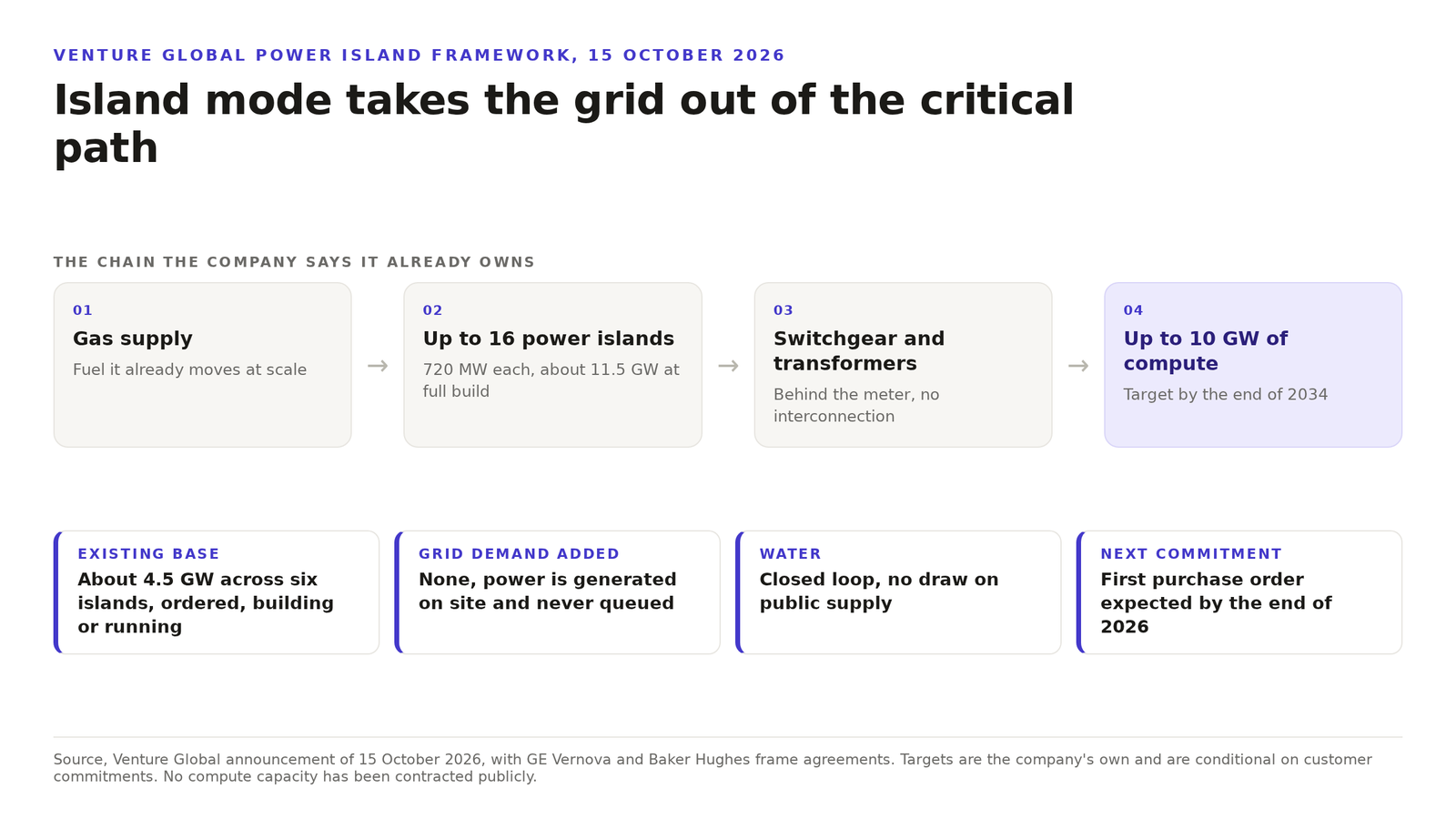
Venture Global, an LNG exporter, signed power and grid frame agreements with GE Vernova and Baker Hughes for up to 16 power island units at 720 MW each. That is roughly 11.5 GW of generation it can point at data centers on land it owns, with a stated pathway to 10 GW of compute by the end of 2034. None of it touches the public grid.
The megawatts are not the story. The deal shape is. A gas producer already holds the three things a data center developer spends years assembling, which are fuel, permitted industrial land with power rights, and a place in the equipment queue. Vertically integrating into compute is now the cheapest route around an interconnection process nobody can speed up. For operators, power procurement is now the product decision.
The company that announced an AI build this week does not sell model tokens. It sells liquefied natural gas, and now it plans to sell the power and the compute behind it.
On 15 October Venture Global said it signed power and grid frame agreements with GE Vernova and Baker Hughes for up to 16 new 720 MW power island units, plus the transformers that move the current. The units feed the company’s own behind-the-meter network, which it calls island mode, so the power is generated on site and never queued. It has about 4.5 GW of the same design across six islands, some running and some on order. The new capacity supports a stated pathway to up to 10 GW of compute capacity by the end of 2034, with the first purchase order expected before the end of 2026.
Eleven gigawatts of generation, ten of compute, and the gap is the point
Run the arithmetic. Sixteen units at 720 MW is about 11.5 GW of generation. The compute target is 10 GW. If that 10 GW is IT load, the 1.5 GW between the two figures is what the plant spends on itself, transformers and cooling, before anything reaches a GPU.
Most capacity announcements blur that difference, and the blur runs one way. Facility load sounds bigger, so it gets quoted. Anyone sizing a deployment needs the IT number, because that is the one the silicon sees. This release gives both, which is more disclosure than the sector usually offers.
A gigawatt of IT load always needs more than a gigawatt of generation. That ratio is the first thing to ask for in any announcement of this shape.
Ownership skips the queue that everyone else stands in
Interconnection is the slowest step in the buildout. A new large load waits on studies, upgrades and a utility that has to fund both. Behind-the-meter generation takes that wait off the schedule entirely, because the load and the supply arrive together on private land. That is why off-grid data center power has moved from a niche design to a first choice for anyone who can permit a turbine.
What makes this different from the usual announcement is that the operator already had the hard parts. An LNG exporter owns gas handling, permitted industrial acreage, water systems and a working relationship with turbine vendors. The company says the design places no additional demand on the public grid or water utilities and adds no cost to consumers, which is the standard defense of a behind-the-meter build and holds as far as the grid is concerned. The constraints simply move. Fuel becomes the supply chain, turbines become the lead time, and the site becomes the permitting question.
The deal is a template, not an outlier. Compare it with the operators paying premium prices for retired factories to inherit a live connection. Both are buying the same thing, a way around a queue. One buys the connection secondhand. The other builds its own generation and skips the concept.
The next movers will be whoever holds a fuel contract
Watch gas midstream, nuclear operators with existing sites, and industrials with large thermal footprints and spare land. They own the three inputs, and the marginal value of a spare gigawatt is now set by what it can run, not what it can sell.
For the platform teams who inherit this capacity, the questions get technical fast. Insist on IT load in megawatts, not facility load. Ask who carries the fuel price, and what happens at the first winter spike. Ask whether the power is islanded for real, with its own switchgear and no tie to the local utility. EIA tracks the regional context that makes those answers checkable.
One caveat for the record. Nothing here is contracted compute. The 10 GW is a company target, conditional on customer commitments, and the announcement is a framework for ordering equipment. Our earlier look at PJM’s review of a ten gigawatt campus made the same point from the utility side. Announced gigawatts and energized gigawatts are different animals.
Three questions for the next conversation. Is the gigawatt figure IT load or facility load? Who holds the fuel contract behind it? And if the demand does not arrive on schedule, who eats the turbines?
Related reading. AI campuses are buying dead factories to skip the power queue, and PJM wants to review a ten gigawatt campus as one project. Same bottleneck, three different ways of getting around it.
Get the next one before it is old news
Independent analysis of cloud-native infrastructure, Kubernetes and data center economics. No vendor spin.