

Executive Summary
Modal raised 750 million dollars at a 15.75 billion dollar post-money valuation led by Accel, and crossed 1 billion dollars in annualized run rate on the way. The number inside that number is the one to keep. Sandboxes, the product that runs untrusted code in an isolated environment, is a 300 million dollar run rate business on its own, after close to three billion sandboxes and a stated scale of one million concurrent.
The company says it threw out most of the existing stack and wrote its own file system, container runtime, scheduler and networking over a capacity pool spanning more than 20 clouds. It owns no data centers. Kubernetes was built for services that live for weeks. An agent runtime creates and destroys execution environments by the second. The verdict is that the isolation boundary, not the GPU hour, is the defensible asset in inference cloud today.
Erik Bernhardsson, Modal’s chief executive, describes the problem with a phrase worth quoting. On the old stack, he writes, you end up in YAML hell and GPU procurement purgatory (Bernhardsson’s post). Anyone who has tried to give a coding agent a disposable place to run generated code recognizes both halves of that sentence.
The growth behind the pitch is not in dispute. Usage tripled in the five months since the Series C, growth ran above 15 times year over year, and the round priced the company at 15.75 billion dollars against a 1 billion dollar run rate. The Series C was 355 million dollars at a 4.65 billion dollar valuation (DatacenterDynamics). Compute the ratio and the company is worth about 3.4 times what it was in the spring, while usage roughly tripled. The argument is not about the growth. It is about which part of it compounds.
A third of the business sells isolation, not GPU time
Sandboxes started in 2023 as a way to execute code a language model had just written. Modal now reports it as a 300 million dollar run rate product, on close to three billion sandboxes created and a stated scale of one million concurrent (the announcement). Against a 1 billion dollar total, roughly a third of the revenue is neither model serving nor training. It is the act of containing something you do not trust.
That is the least commoditized layer in the stack. GPU hours carry a price every buyer can see and every seller competes on. A runtime that starts an isolated environment inside the time a token takes, a million at once, does not compete that way. It also has to be correct, because the failure mode is an agent outside its box.
Background agents, video generation, robotics training and drug discovery all run on the same primitive, and in each case the buyer is paying to stop worrying about what the generated code does next.
You cannot run a million sandboxes on a scheduler built for services
Kubernetes gives a pod an identity, a network namespace and a life measured in minutes or months. That design is why it works for web services and why it fights an agent workload. An execution environment is created, runs a model’s output, returns a result and dies, and the platform may do that a million times in parallel. The control plane, the image path and the storage layer all push back.
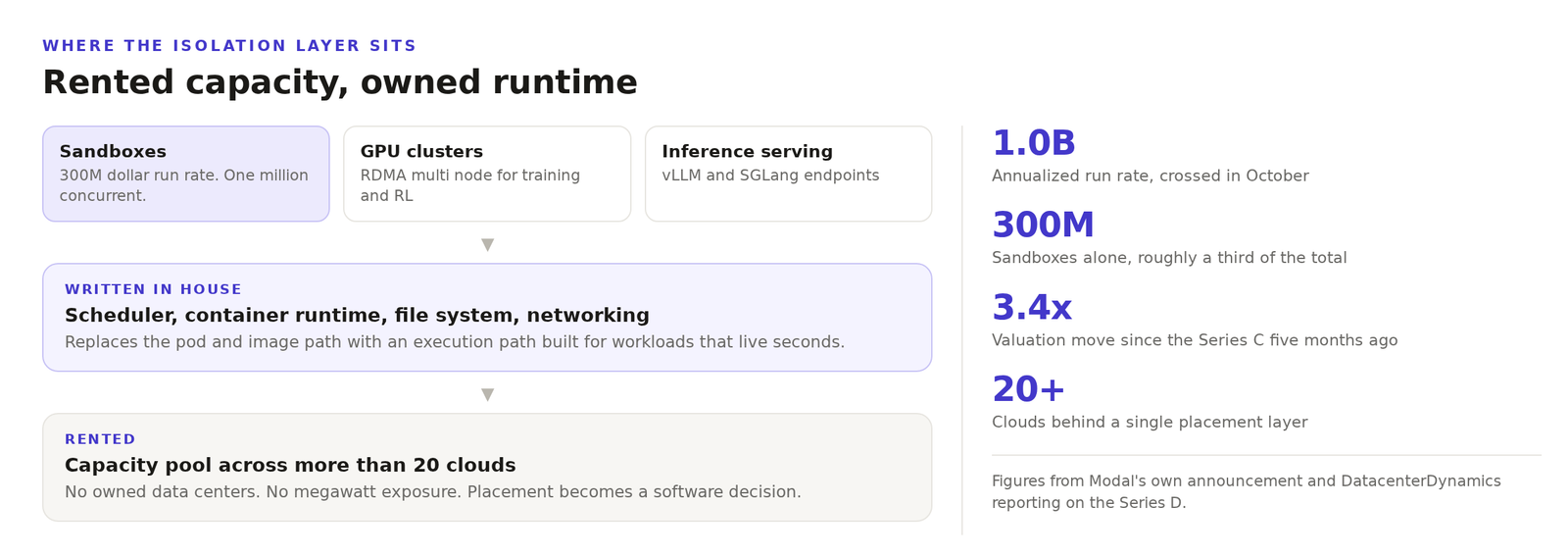
Modal’s response was to replace them. Its own file system, its own container runtime, its own scheduler, its own networking, over capacity it rents from more than 20 clouds (Modal’s description). It does not operate data centers of its own (the same report). The trade is deliberate. No real estate risk and no megawatt exposure, in exchange for owning the software that decides where every execution lands.
The same layer shows on the training side, where one decorator produces an RDMA-connected multi-node cluster with no capacity commitment. That reads like convenience. It is a scheduling claim that only holds if you control placement end to end.
The rented rack is the risk and the runtime is the hedge
Modal does not own the buildings, so its cost of goods is somebody else’s price list. If GPU supply loosens and inference prices fall, a reseller gets squeezed from both ends. The hedge is that customers cannot swap out a sandbox the way they swap a GPU vendor.
Ask three questions of any platform you buy on this model. What happens to my workloads when one of the partner clouds has a bad week, and do I learn about it before my users do. Can I see in my own telemetry which region my sandbox actually ran in. And when the price of the underlying GPU halves, does my bill fall with it or does only the margin move.
The pitch is that AI needs new building blocks. Fair. The test is whether a customer can leave, and right now the sandbox is what holds them. That is a better moat than a rack, and harder for a hyperscaler to copy, because it is not capacity. It is years of rewriting the boring parts.
Related reading. Nine models tried to break an agent sandbox. Seven megawatts of contracted AI capacity.
Get the next one before it is old news
Independent analysis of cloud-native infrastructure, Kubernetes and data center economics. No vendor spin.