

Executive Summary
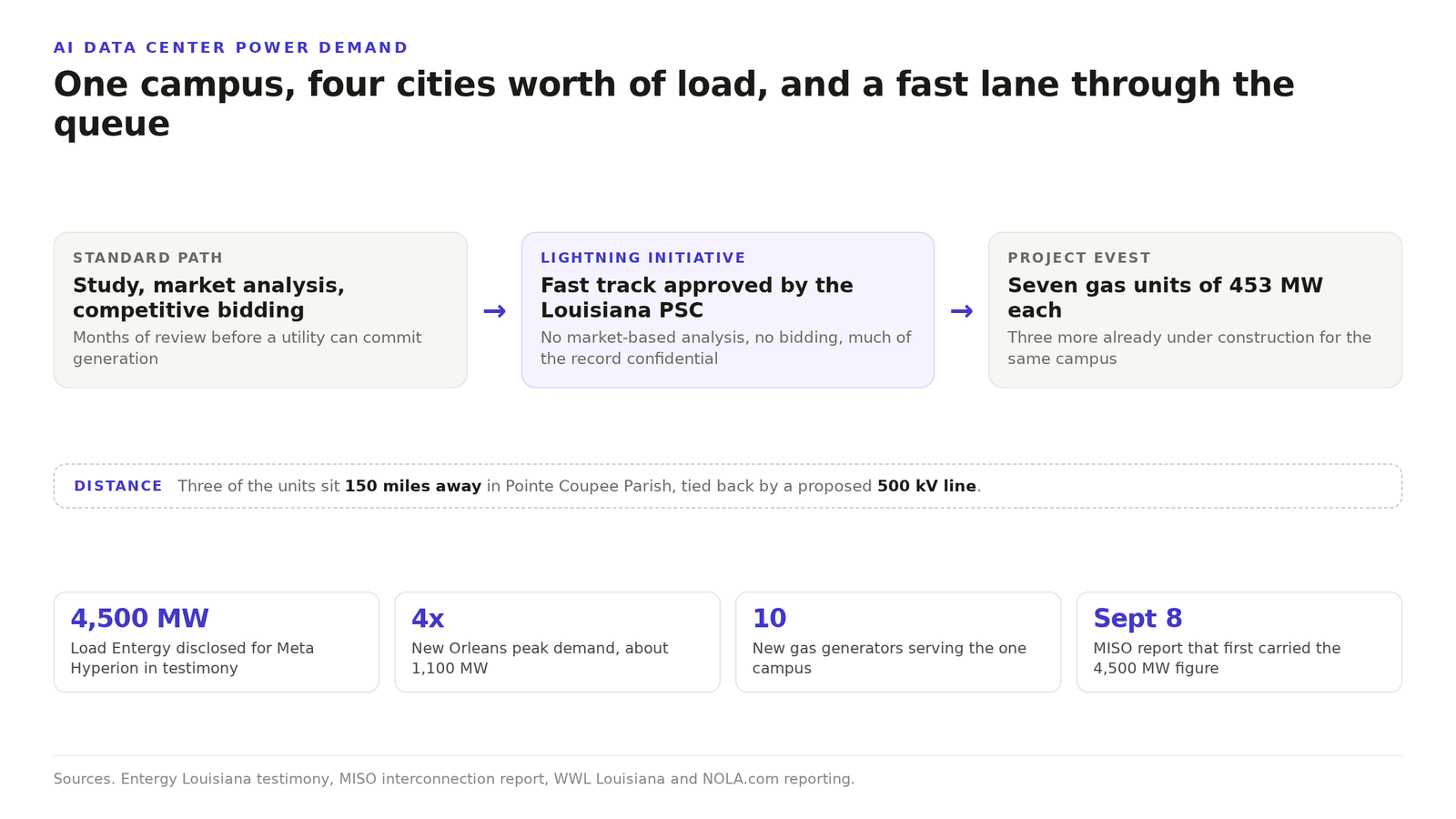
Meta’s Hyperion campus in Richland Parish will draw 4,500 megawatts, and the number became public only when the chief executive of Entergy Louisiana said it under questioning at a Louisiana Public Service Commission hearing on 7 October. That is more than four times the peak demand of New Orleans at around 1,100 megawatts, and about twice what every other Entergy Louisiana customer in the state uses. The same figure had been sitting in a MISO interconnection report since 8 September. Nobody outside the docket had connected it to a specific campus.
The finding is that the binding constraint on AI capacity has moved from silicon to the grid, and the grid is now being allocated politically rather than competitively. Entergy wants approval for seven gas units of 453 megawatts each under a fast track that skips market analysis and competitive bidding, with much of the record confidential. For anyone planning capacity, the question is no longer whether a site can get power. It is who approved it, on what record, and who pays for the wire.
Power numbers usually arrive in a filing. This one arrived in testimony, in a case where the judge had already cleared a reporter from the room several times.
Entergy Louisiana chief executive Phillip May was answering questions from an attorney for consumer and science groups when he put the figure on the record. Meta’s data center expansion in Richland Parish, known as Hyperion, needs 4,500 megawatts. This is how data center power demand is now decided in practice, in testimony, late, and under confidentiality. His utility already expected that load. A MISO report dated 8 September described a proposed West Fork Creek substation next to the campus as adding 4,500 megawatts of new load to the regional grid.
The load is the size of a city, and it does not cycle
New Orleans peaks just above 1,100 megawatts on its hottest day. The Hyperion load is four times that. According to the attorney who drew the number out, it is twice the demand of all of Entergy Louisiana’s other customers combined. May also said Meta expects to run close to that level almost continuously, which matters more than the peak. A grid can serve a huge load that shows up for a few hours. A flat 4,500 megawatts must be generated, transmitted and paid for every hour of every day.
Entergy is asking the commission to approve seven additional gas turbines of 453 megawatts each for a project it calls Evest, which doubles Meta’s original site from about 1,400 acres to roughly 2,800. Three more units are already under construction for a separate Meta subsidiary on the Franklin Farms site. That brings the new gas fleet serving one campus to ten generating units.
The fast track is the part operators should study
The additional units are moving through a process the commission approved last December under an executive order from Governor Jeff Landry. Entergy calls it the Lightning Initiative. It lets the utility fast-track approval without the market-based analysis and competitive bidding that normally applies, and it allows large parts of the record to stay confidential. Much of the case material is marked Attorneys’ Eyes Only.
The geography tells the rest. Three of the units sit in Pointe Coupee Parish about 150 miles south of the campus, connected by a proposed 500 kilovolt transmission line. That is a transmission project rather than a behind-the-meter arrangement, which means the wires serving a single customer’s load will sit on the shared system. The commission is expected to vote later this year.
Three questions to carry into your own capacity plan
Does the site hold an approved interconnection, or a queue position that still depends on a utility vote? Who carries the cost of the transmission the load requires, the developer or the existing ratepayers? And is the load firm or interruptible, because a campus that can curtail is a different asset to the grid than one that cannot. A capacity number that answers all three is worth more than a headline figure.
Related reading. Why builders are buying dead factories for their grid connections, and the 32 gigawatt power gap the AI supply chain is not pricing.
Sources. NOLA.com and the Louisiana Illuminator on the hearing and the record, Entergy filings, the MISO interconnection report of 8 September, and EIA load data.
Get the next one before it is old news
Independent analysis of cloud-native infrastructure, Kubernetes and data center economics. No vendor spin.
[…] when Entergy Louisiana’s chief executive confirmed it under questioning. We walked through the hearing record and the confidential filings, and separately through what the Texas fee does to project […]
[…] reading. We tracked the Louisiana figure when it first surfaced, in the 4,500 megawatt disclosure, and the Texas decision to charge large loads for their place in the […]