
Executive Summary
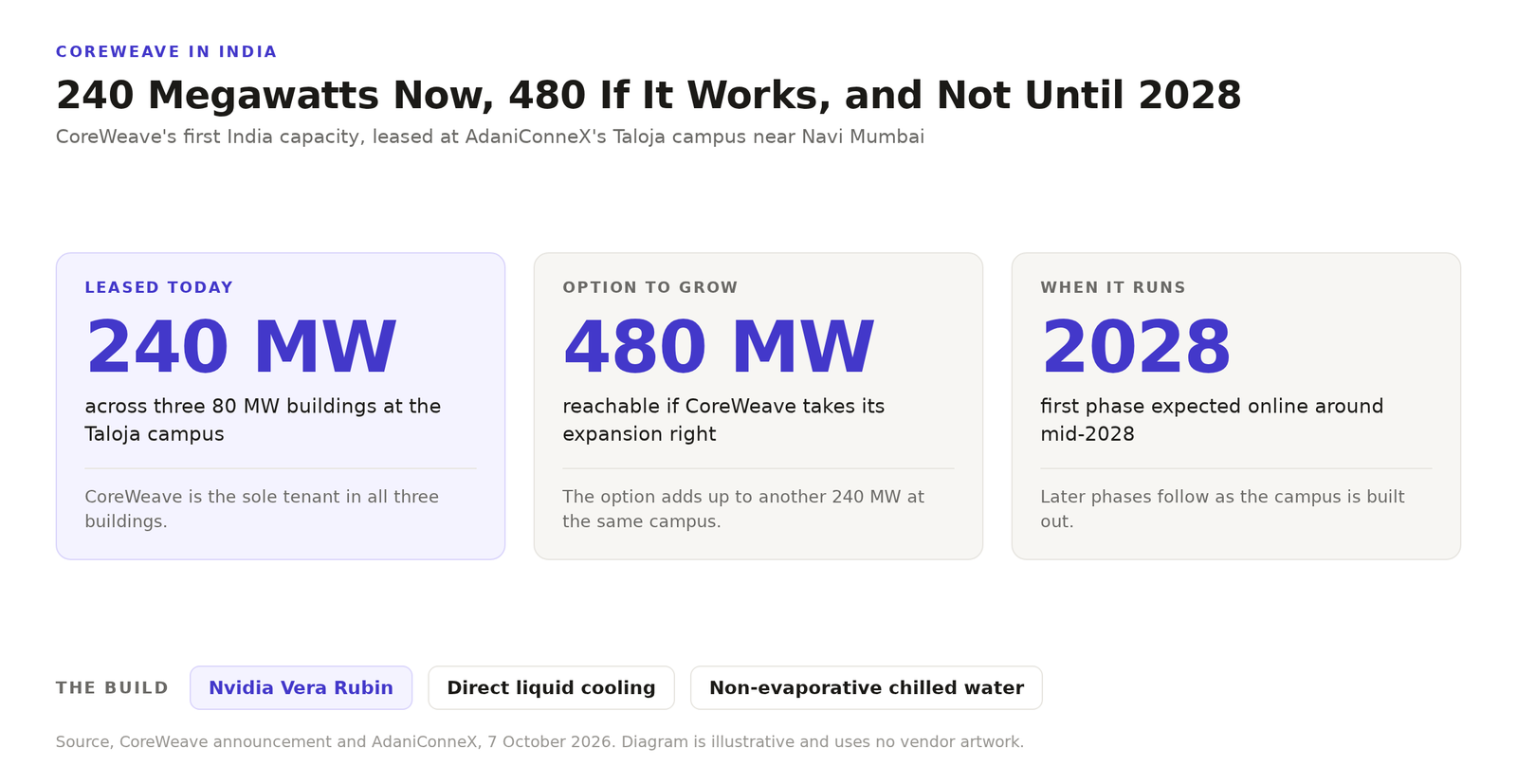
CoreWeave will take 240 megawatts of data center capacity at AdaniConneX’s Taloja campus near Navi Mumbai, its first footprint in India. The deal covers three 80 megawatt buildings where CoreWeave is the sole tenant, with an option to add another 240 megawatts at the same site. The buildings will run Nvidia’s Vera Rubin platform with direct liquid cooling and a chilled water system that does not evaporate.
The megawatts are the headline. The 2028 date is the substance. Announced AI capacity in a new market is now a multi-year option rather than near-term supply, and CoreWeave is buying access to land and power instead of pouring its own concrete. That is the neocloud model exported, and it tells buyers in every new region that capacity is being pre-sold years before a single rack accepts a job.
CoreWeave is one of the largest AI clouds in the world, and it just entered India without committing to build anything. The 240 megawatts it took in Navi Mumbai sit on a campus it does not own, in buildings it will lease, on a timeline that runs to 2028.
That structure is the story. The AI capacity race has become a fight over power and land, and the neoclouds are learning to share the risk on both.
It took 240 megawatts and will not pour the concrete
The capacity sits at AdaniConneX’s Taloja campus near Navi Mumbai, spread across three 80 megawatt buildings. CoreWeave is the sole tenant in all three, and it holds an option to add up to another 240 megawatts, which would take the site to 480. AdaniConneX is a joint venture split evenly between Adani Group and EdgeConneX. It brings what a foreign cloud cannot build quickly in a new country, which is land, grid power and a construction team that already knows the market.
The build will run Nvidia’s Vera Rubin platform, with direct liquid cooling in the GPU halls and a chilled water system that does not rely on evaporation. Both choices point at the same constraint that shapes every new AI campus. Rack density and water use.
The 2028 date is the substance, not the megawatts
First capacity is expected online around mid-2028, and later phases follow after that. Read that against the framing of the announcement, which is written to sound like an arrival, and the gap is the whole point. For the next two years this is a construction project and a power contract, not a place to run a training job.
The scale of the partner explains the choice. AdaniConneX says it has more than a gigawatt of capacity deployed or under deployment across India, with a longer ambition of 3 gigawatts by 2031. It is also among the partners on a large India data center project for Google, per reporting on the venture. For a neocloud entering a new country, buying into an existing campus beats starting from a greenfield survey and a queue for a substation.
The neocloud model travels as a lease
CoreWeave has been expanding across Asia and Europe, and the pattern repeats. It buys and operates the GPUs, and it rents the shell, the power and the land from specialists. That keeps its balance sheet pointed at silicon, where its margin comes from, and pushes the real estate risk onto a partner with local reach and local patience.
The CoreWeave India entry is the clearest recent example of that model exporting itself. The trade is simple. Less control over the building and the schedule, in return for a footprint without a decade of construction. What it does not do is produce capacity any faster. The 2028 date is set by the campus, not by the tenant.
For anyone buying AI capacity, the signal is that demand is now booked against buildings that do not exist yet. CoreWeave is not paying for 240 megawatts it can use today. It is reserving the right to use them in 2028, and paying for that option now. That is how scarce the good sites have become.
Three questions worth putting to your own capacity plan. If your provider’s new region depends on a partner’s campus, what happens to your contract when the build slips. Are you reserving megawatts you cannot use for two years because every other option is worse. And when a vendor announces a country, do you check the date or the number.
Related reading. CoreWeave already runs Vera Rubin racks in production. Regional AI capacity now costs about 60 million dollars a megawatt. And the rack, not the GPU, is now the unit of purchase.
Get the next one before it is old news
Independent analysis of cloud-native infrastructure, Kubernetes and data center economics. No vendor spin.