


Executive Summary
The useful life of a GPU has stopped being an accounting footnote and become a financing term. The debate over GPU residual value, whether a processor holds its worth for three or four years or closer to ten, now decides how much debt can sit against an AI cluster and what each hour of that cluster has to earn. A $500 billion lending program built on GPU collateral assumes the longer number, and that assumption is what makes long-dated debt affordable.
Reuters reported on 1 October that banks and credit managers want stronger guarantees before they accept it. If lenders price the collateral over four years instead, the cost of capital rises for every AI cluster, borrowed or self-funded, because the same assumption flows into rent, token pricing and published depreciation schedules.
Chip-backed lending works much like aircraft leasing. A lender takes a claim on a piece of hardware, estimates what it will still be worth when the loan matures, and advances cash against the gap between price and that estimate. That estimate is the residual value, and it is what turns a server into collateral. It is also the term that decides what a GPU hour has to earn before the cluster pays for itself.
The Useful Life of a Chip Is Now a Financing Term
Nvidia announced the $500 billion initiative in August 2026 with Blackstone, Apollo and KKR, to let AI developers finance compute against GPUs as collateral. Some deals were envisioned to carry no more than a 25 percent residual value guarantee, according to the company’s own account of the structure in a post explaining AI factory compute. Reuters reported on 1 October that banks and credit managers now want materially more. Three banking sources told the news organization that Nvidia may need to guarantee all of its deals, or back them with revenue from investment-grade customers.
Nvidia Is Asking Lenders to Bet a Decade on a Chip
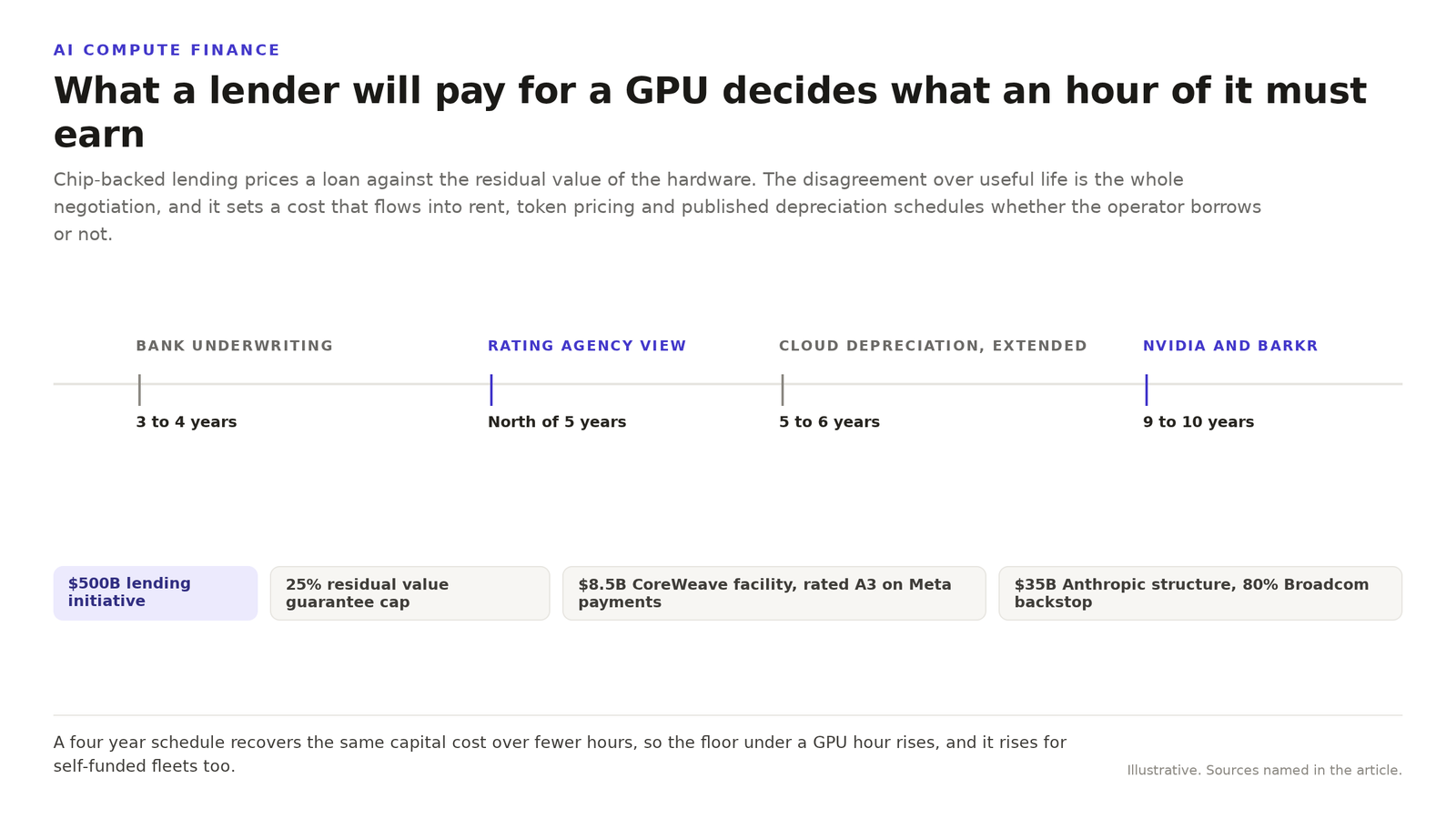
Nvidia defends the longer number. It describes its compute as a productive, durable and fungible asset that can support long-term financing, and says partners independently assess customer commitments, expected cash flow and residual value. Chief executive Jensen Huang has said some GPUs last up to a decade, and the company points to Barkr, a firm that values AI collateral, which found that GB300 NVL72 systems could have a useful life of 9 to 10 years. Cloud companies, it notes, are extending server depreciation to five or six years from three or four.
Wall Street is not there yet. Tony Trzcinka, a senior portfolio manager at Impax Asset Management, said Wall Street is much more conservative about the decade claim, and that banks typically underwrite GPUs over a three to four year depreciation schedule. Andrew Chang, a director at S&P Global Ratings, said Nvidia would imply the GPUs work well north of five years and that this has been proven true so far, while his firm takes a conservative view of chip value. Brian Gelfand, co-head of global credit at TCW, said the precedent transactions suggest the creditor community does not subscribe to long average lives for these assets.
So Far the Deals Have Been Paid For by Customers, Not Chips
Precedent deals leaned on a customer’s balance sheet rather than on the resale value of silicon. CoreWeave, a specialist GPU cloud, closed an $8.5 billion facility earlier in 2026, the first investment-grade GPU-backed loan, rated A3 largely because lenders rely on Meta’s contractual payments. The company set out the detail when it confirmed the facility. Broadcom backstopped more than 80 percent of a $35 billion financing structure for Anthropic. Nvidia itself previously gave a residual value guarantee for SB Energy’s Ohio data center project, according to Moody’s and S&P Global Ratings.
Morningstar analysts have questioned private credit, vendor financing and circular deals, the last two of which also played a role in the dot-com boom. Sources said tens of billions of dollars of loan deals in the pipeline are likely to carry strong guarantees and contracts.
A lender underwriting GPUs over three to four years is pricing a real asset cost that has to be recovered in rent or in tokens. That recovery lands on every operator’s profit and loss whether or not the operator borrows. Loren Moran, a fixed income portfolio manager at Wellington Management, which manages about $1.3 trillion, said investors will demand to be paid for the incremental risk. If lenders settle on four years, the decade claim is the assumption that has to give, and the cost of debt rises at the moment the buildout needs it most. Watch the guarantee structure in the next round of deals, and the depreciation schedule cloud operators publish.
Three questions apply to almost any environment. How many years does your finance team assume an accelerator holds value, and was that number chosen or inherited? If your main supplier had to guarantee every deal it backs, would the cost of the compute you buy change? When you renew a cluster, are you underwriting the hardware, the customer contract behind it, or both?
Related reading. Akamai and Anthropic’s CPU capacity deal and Anthropic and Akamai’s CPU workloads for AI agents.
Get the next one before it is old news
Independent analysis of cloud-native infrastructure, Kubernetes and data center economics. No vendor spin.