
Executive Summary
Four GPU cluster announcements landed in Asia in the last week of September, and they share one trait. The silicon is specified and the commercial terms are not. The Philippines plan from YCO Cloud and Aolani names more than 10,000 Nvidia GB300 GPUs and a first phase from the first quarter of 2027, and discloses no investment value, no megawatts, no site and no customers. Gorilla Technology put hard numbers on its India, Indonesia and Thailand programmes, including a B300 contract it valued at USD 2.5 billion to USD 2.6 billion, and warned that pipeline does not convert to revenue on cue.
The finding is that sovereign AI infrastructure is being announced faster than it is being financed. Power, not silicon, sets the delivery date for every one of these clusters, and that is the number the announcements leave out. A GPU cluster is a power project with a compute order stapled to it. Until the megawatts and the interconnection milestones are published, a rack count is a statement of intent. Treat the offtake contract, not the GPU generation, as the proof.
Sovereign AI has a disclosure problem, and it is not the GPU count. The rack numbers travel. The rack numbers are also the cheapest thing to publish, because they come from a purchase order rather than a construction schedule.
The Philippines announced 10,000 GPUs and nothing else
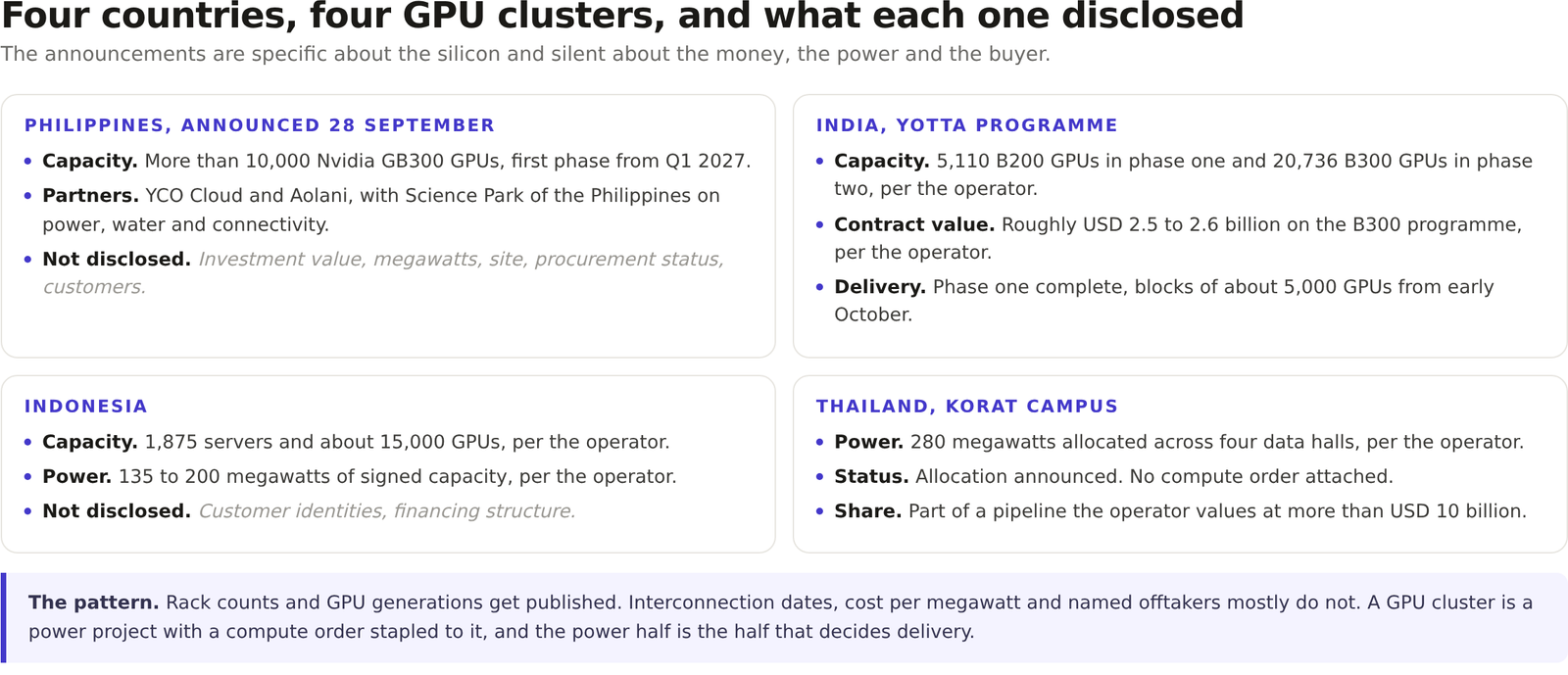
Philippine infrastructure company YCO Cloud and Singapore-based Aolani said on 28 September that they will deploy more than 10,000 Nvidia Blackwell Ultra GPUs, using GB300 NVL72 rack-scale systems, with a first phase from the first quarter of 2027. Science Park of the Philippines will supply power, water and connectivity.
The joint announcement did not include the investment value, the megawatt capacity, the site, the procurement status or a single named customer. Ten thousand GB300 GPUs is at least 139 fully populated NVL72 racks, on Nvidia’s published configuration of 72 Blackwell Ultra GPUs and 36 Grace CPUs per rack. That is a serious building. Where it goes, who pays for the substation and who consumes the tokens are all open.
That is not a reason to dismiss it. It is a reason to file it correctly. Aolani supplies GPU financing and operations. YCO supplies the local site. Both describe the result as sovereign AI, meaning compute and data that stay in the country. Neither has published a reservation agreement.
Rack counts travel faster than interconnection dates
The same pattern shows up across the rest of the region’s September announcements. Gorilla Technology told investors in September that its Yotta program in India covers roughly 5,110 B200 GPUs in phase one and 20,736 B300 GPUs in phase two, at a contract value the company put between USD 2.5 billion and USD 2.6 billion for the B300 phase. It also described an Indonesian deployment of about 1,875 servers and 15,000 GPUs, 135 to 200 megawatts of signed Indonesian capacity, and 280 megawatts allocated across four data halls at a campus in Thailand.
Every one of those figures is a company statement, and the company is a listed small cap talking to investors. Gorilla was explicit that pipeline does not convert to revenue on schedule, which is the most useful sentence in the material. It put its total opportunity pipeline above USD 10 billion and next-year revenue guidance at USD 450 million to USD 500 million. Those two numbers describe very different businesses, and the gap between them is the honest measure of sovereign AI right now.
Compare that with how the same countries describe their own plans. The Philippines has set a national target of 1.5 gigawatts of AI-oriented data center capacity by 2033 from a baseline near 50 megawatts, as reported by TNGlobal. A target that large is a grid and water program wearing a compute costume.
A GPU cluster is a power project with a compute order stapled to it
This is the pattern worth naming. Announce a GPU generation, a rack count and a start quarter. Omit the megawatts, the interconnection milestone, the cost per megawatt and the offtaker. The GPU is the photogenic half. The power half decides whether the quarter is real.
Our coverage of the 23 gigawatts Washington is buying out of existing wires makes the same point from the other direction, and the battery-before-chip shift shows what happens when operators price the power chain early. The regions publishing rack counts now will publish megawatts later, or they will quietly move the date.
Three questions to apply to any sovereign AI announcement, including one from your own government. Which transmission or distribution upgrade does the site depend on, and has it been approved. Who has signed a take-or-pay agreement for the tokens. And what happens to the hardware if the national champion funding it changes strategy in eighteen months.
Related reading. Anthropic leased 2.16 gigawatts in Australia, and it is inference only is the clearest example of a sovereign-adjacent deal that published its power number first.
Get the next one before it is old news
Independent analysis of cloud-native infrastructure, Kubernetes and data center economics. No vendor spin.
[…] For where AI workloads physically run and who can audit that, see our workload sovereignty reference and the gap in how countries disclose AI compute. […]