
Executive Summary
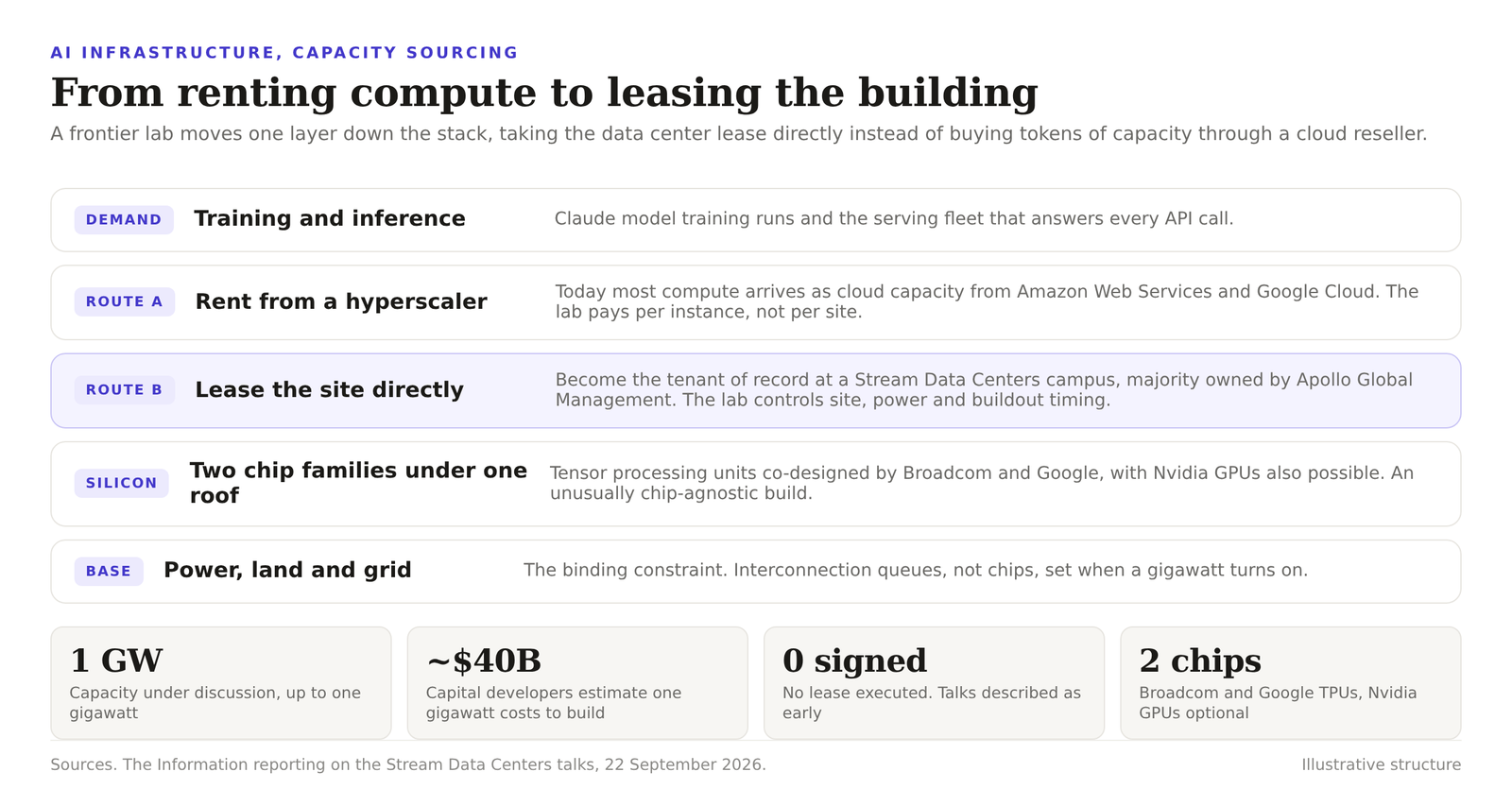
Anthropic is in early talks to take a data center lease of up to a gigawatt of capacity directly from Stream Data Centers, a developer majority owned by Apollo Global Management, according to reporting by The Information on September 22. No lease is signed and both companies declined to confirm terms. If it closes it would be the company’s largest direct property commitment, and the clearest sign yet that frontier labs want to own the ground their models sit on.
The finding is structural before it is financial. Renting compute through Google Cloud and Amazon keeps a lab on someone else’s lease and someone else’s buildout schedule. Leasing the site flips that. The reported silicon mix, Broadcom and Google tensor processing units with Nvidia GPUs still in play, shows the lab is buying optionality rather than one vendor. One gigawatt is roughly forty billion dollars of construction. The watch item is not the number. It is who carries the power contract and whether the chips arrive before the grid connection does.
Anthropic does not own a data center. It rents compute. That arrangement works until the tenant wants control over cost, location or timing, and the reported talks suggest the company now wants all three.
Most of its capacity today arrives as cloud capacity. Amazon and Google own the buildings, the silicon and the interconnection queue behind every instance. The bill is variable, the hardware is shared, and the roadmap belongs to someone else.
Renting capacity and owning the site are different businesses
The reported data center lease moves one layer down the stack. Stream Data Centers would build and hold the facility. Anthropic would be the tenant of record, which means it negotiates power procurement, site selection and buildout timing directly instead of waiting for a cloud partner to add capacity.
That is a different business with a different balance sheet. A cloud bill is cancellable. A multi-year lease tied to a physical asset is not. Developers estimate one gigawatt needs at least forty billion dollars of capital, and the obligation sits on the tenant even if demand for inference softens.
The chip mix is the tell
The reported plan puts tensor processing units co-designed by Broadcom and Google into the facilities, with Nvidia graphics processors or other accelerators possible. That is an unusually chip-agnostic build for a single lease. Anthropic already runs on Amazon’s Trainium and Google’s TPUs, so the mix reflects a dual dependency that already exists rather than a fresh bet on one architecture.
The talks have reportedly touched on whether Google would extend credit support to the project. The scope is unclear. If a guarantee lands, the arrangement starts to look less like an independent infrastructure bet and more like a three-way structure wearing the appearance of one. That distinction matters to anyone tracking how much of the buildout is demand-led and how much is vendor-financed.
A gigawatt is a power deal before it is a chip order
One gigawatt is not a rack count. It is a grid connection, a substation and a queue position that can run two years or longer. The constraint that sets the schedule is power delivery, not silicon. A lab can order accelerators faster than it can energize a site.
That is why the talks matter beyond one company. OpenAI has pursued the same move through Stargate. Meta and Microsoft have each committed to their own campuses. When model makers stop renting and start leasing, they join the same queue as every hyperscaler and every large power buyer. The price of land near a substation rises for everyone in that line.
Nothing here is signed. The reporting describes the talks as early and preliminary, and a deal this size can shrink or collapse before a lease exists. Treat one gigawatt as a signal of intent rather than a booking.
Before you copy the move, three questions are worth writing down. Where does your capacity physically sit, and who holds the power contract underneath it? If you signed a direct lease tomorrow, could you carry the multi-year obligation through a soft quarter? And when a vendor offers to backstop the deal, what does that guarantee actually cover?
Related reading. The enterprise AI infrastructure report covers the four layers under the model, and our earlier piece on Anthropic capacity in Australia shows the same lab buying inference rather than training.
Get the next one before it is old news
Independent analysis of cloud-native infrastructure, Kubernetes and data center economics. No vendor spin.
[…] reading. Anthropic is negotiating a gigawatt lease of its own, and the same power question sits underneath it. Our weekly roundup traced the four limits AI […]
[…] reading. Anthropic would rather lease the building than rent the cloud covers the gigawatt lease. Enterprise AI Infrastructure Runs on Four Layers explains the stack this […]
[…] Nvidia has underwritten the residual value of OpenAI tenanted data center leases in Ohio. Anthropic has signed direct gigawatt scale leases of its own. The contract, not the chip order, is what […]