


Executive Summary
WhiteFiber began selling WhiteFiber Continuum on September 23, a networking fabric that joins separate data centers into what the company calls one logical GPU supercluster. The first deployment links two QTS facilities 83 kilometers apart over 12 Zayo dark fiber strands, delivering 136 terabits per second at a guaranteed round-trip latency of 0.9 milliseconds. The company says it is the first commercially available distributed GPU supercluster and has filed patent applications on the design.
The finding is about where inference can run. Spreading training across distant sites has always stalled on bandwidth and latency. A fabric this wide changes the calculus for inference and overflow work, because it lets two smaller sites behave like one larger campus. That unlocks power and fiber in metro and telco buildings that were too small to matter on their own. The caveat is that a guaranteed latency figure is a contractual promise, not an application benchmark. Test it against your own workload before you plan around it.
Every GPU cluster runs into a ceiling, and it is usually the building. You run out of power, cooling or floor space long before you run out of demand.
The answer from WhiteFiber, shipped on September 23, is to stop treating a cluster as a single site. Its Continuum product pools accelerators across two campuses and presents them to the scheduler as one machine.
Distance was the wall, and the wall moved
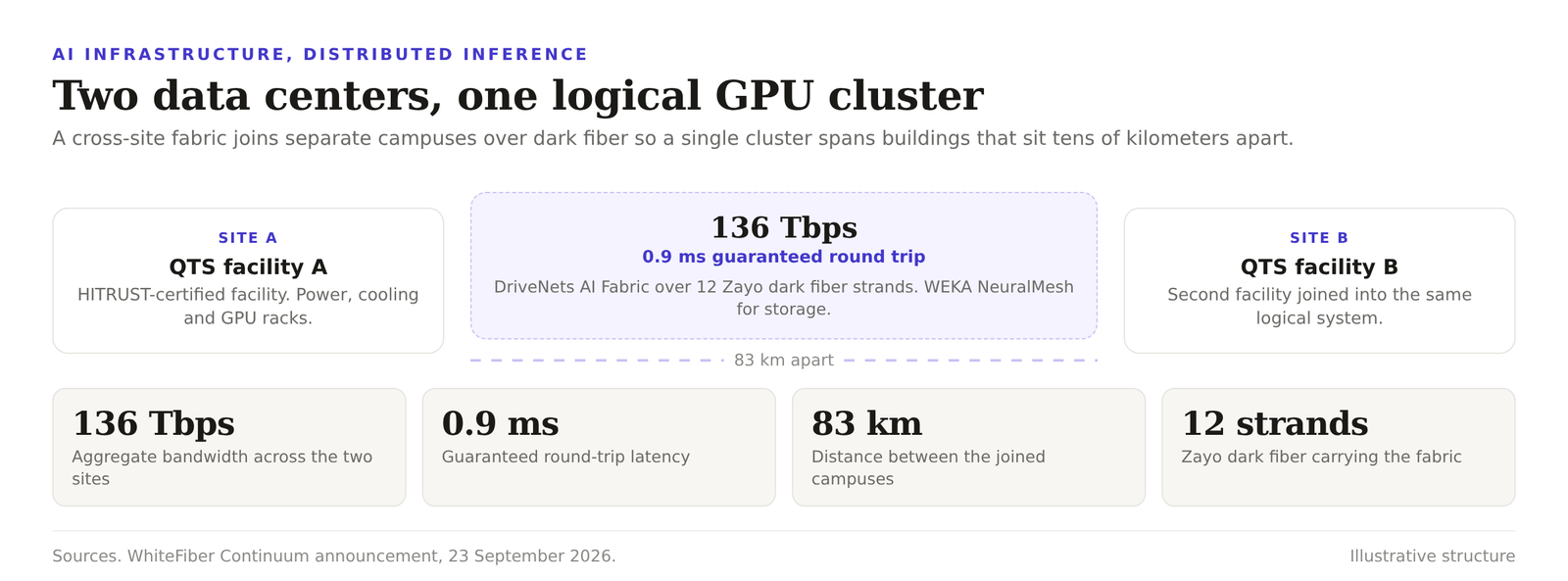
The mechanics take two sentences. Two QTS facilities sit 83 kilometers apart. Twelve Zayo dark fiber strands join them through the DriveNets AI Fabric, with WEKA NeuralMesh carrying storage and memory traffic. The claimed aggregate is 136 terabits per second at a guaranteed 0.9 millisecond round trip.
For training, that is still not enough. A frontier training run synchronizes gradients across the whole cluster on every step, so latency between stages sets the pace, and nothing here changes that. For inference and overflow work the bar is far lower. A request that lands on the second site and returns inside a millisecond or two is invisible to most users.
Stranded capacity is the real target
The interesting part is what the fabric lets you use. Many metro and telco buildings already sit on power and dark fiber they cannot fill with traditional colocation tenants. Continuum turns those sites into nodes of one logical cluster rather than isolated capacity. A company that has maxed out a single campus can add overflow inference without greenfield construction.
That is the same pressure we covered in the piece on data center power procurement. Power, not silicon, sets the ceiling. If a fabric lets you borrow headroom from a building down the road, the ceiling moves without a new substation.
A latency guarantee is not a benchmark
Read the claim carefully. Nine tenths of a millisecond is a guaranteed round trip over the fabric, which is a network promise. It is not time to first token for a real model, and it is not throughput under production load. Vendor latency numbers age badly once real traffic arrives, so the figure to test is your own p50 and p99 on your own model.
Before you plan around a cross-site cluster, three questions are worth asking. Does your workload tolerate a network round trip on every request, or does it stay inside one site? What happens when a single dark fiber strand is cut, and who owns the failover? And is the second site close enough that a synchronous call still fits your latency budget?
Related reading. Our analysis of the scheduler rebuilt for accelerators covers how placement works once hardware is the scarce resource, and the enterprise AI infrastructure report maps the layers underneath.
Get the next one before it is old news
Independent analysis of cloud-native infrastructure, Kubernetes and data center economics. No vendor spin.
[…] reading. The GPU cluster now spans two data centers, not one, and NVIDIA open sourced the cluster map Kubernetes schedulers never […]