


Executive Summary
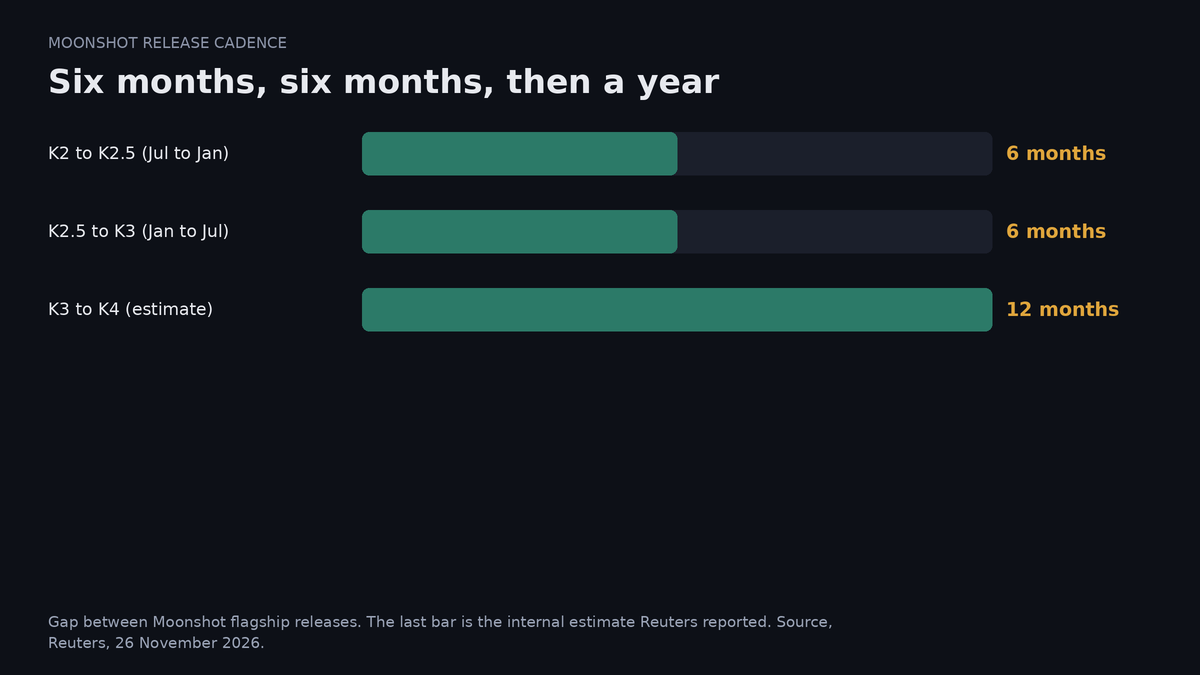
Z.AI planned to ship GLM-5.5 this month. The model was designed at roughly 3 trillion parameters. It has not appeared, and two people told Reuters it could land in the first quarter of 2027 or later. Moonshot expects the gap between its own flagships to stretch from six months to twelve if it loses the compute it rents abroad.
The GLM-5.5 delay is the clearest evidence yet that the controls reached the model and not only the chip shipment. A rule that took effect on 19 November puts a license in front of any data center that rents enough compute to a China-headquartered company. Anti-distillation work at Anthropic and OpenAI closed the other cheap route in the same window. Watch release cadence from here. When a lab’s clock doubles, the model you standardized on is a generation old before your rollout finishes.
Z.AI shipped a model on Monday and skipped the one it promised. GLM-5.4 runs a 750 billion parameter base and reuses 28 of its layers twice. In its own post, Z.AI says the design reaches intelligence comparable to models of 2 to 3 trillion parameters. The 3 trillion parameter model those words describe has no ship date.
That gap is wider than one release slipping a quarter. A lab that cannot assemble the cluster for a 3 trillion parameter run ships whatever its best smaller base can be pushed to. The options are architectural tricks, longer post-training, and rented time elsewhere. All three are now metered, licensed, or watched.
The rule that bit is about distance, not imports
The Commerce Department’s interim final rule took effect on 19 November. Its new section 744.24 requires a license to send advanced chips and servers to any data center that supplies more than 12 million aggregate total processing performance to a company headquartered in China, Macau, or another Country Group D:5 destination. Sidley Austin reads that threshold as about the output of 300 of the most advanced commercial GPUs. Four racks of 72 would trip it.
That catches the lab which never takes delivery of a chip. Renting became importing. The rule also added license requirements for Indonesia, Malaysia, Singapore, Thailand and Brazil, where the rental market had moved. Data centers already serving affected customers got 90 days, until 17 February, to obtain a license or stop.
The calendar reads like a response. GLM-5.4 landed on 23 November, four days after the rule took effect. The larger model Z.AI had planned for this month sits on no schedule a customer can plan against.
Copying the frontier got metered at the same time
Anthropic said in February that it had caught DeepSeek, Moonshot and MiniMax running distillation campaigns through about 24,000 fraudulent accounts and more than 16 million exchanges with Claude. By September, per the Reuters report, exchanges tied to suspected distillation were near 200 million. Moonshot has since turned to distilling from Google and Meta models, a person familiar with its operations told the wire service, and it denies that its K3 gains came from distillation at all.
The first route to parity was a bigger cluster. The second was a smaller model learning from a better one. Neither closed, and both got slower and dearer in the same month.
Z.ai answered with depth, because depth fits a smaller cluster
GLM-5.4 is the most interesting engineering in this story. Z.AI converted an existing pre-trained base into a looped transformer instead of pre-training a larger one. The technical post is candid that looped models trained from scratch still trail unshared models at equal compute. Continued training of a strong base buys most of the gain for a fraction of the run.
The systems work is where it turns practical. Z.AI’s hybrid cache lets the second pass reuse the sparse KV the first pass selected, so an extra loop costs one sliding window rather than a second full context cache. At a million tokens that is the difference between deployable and not. Throughput runs up to 200 tokens a second off peak, 70 to 80 at peak.
The evidence is thinner than the claim. Z.AI published no flagship benchmark table. What it published is an iso-parameter ablation on a 30 billion model with the same architecture, where looping bought 11.3 points on AIME25 and 8.7 on GPQA-Diamond for about 10 percent more training compute. Output length on GPQA fell 11.7 percent. The reasoning moved off the token stream and into the depth of the pass.
GLM-5.4 is also not downloadable. The API is listed as coming soon, and Z.AI says it will open the weights after safety hardening. Until then the model is reachable through a subscription on Z.AI’s hardware. That is the third cost, and an architect feels it first. You cannot build a 2027 capacity plan around a model you can only rent.
Three questions for your own roadmap. If a vendor’s flagship slipped two quarters, would your architecture notice? Which production models are pinned to an open-weight release that will not be refreshed on the old cadence? And what does that do to the cost per token in next year’s plan?
Related reading. The weights that never shipped are already a pattern, from Tencent’s Hy4 gate to the subscription meter under Qwen. The domestic alternative is moving too, and China Telecom trained 285B parameters on Ascend without Nvidia.
Get the next one before it is old news
Independent analysis of cloud-native infrastructure, Kubernetes and data center economics. No vendor spin.