
Executive Summary
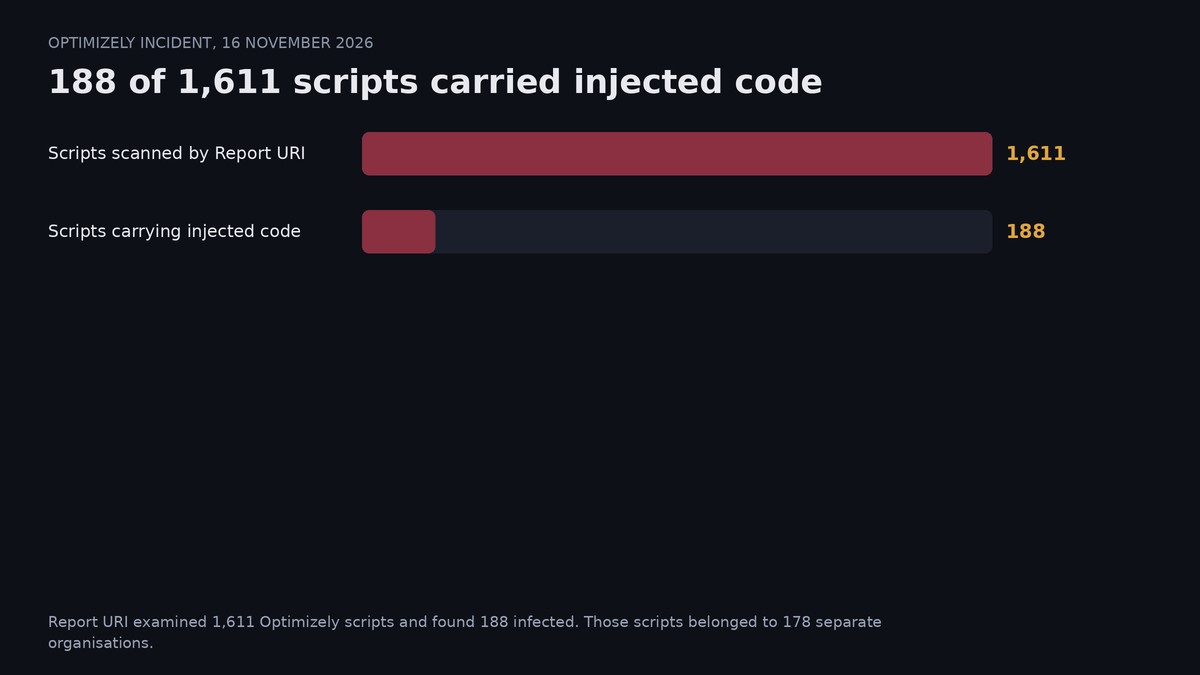
On 16 November an unauthorised party exploited a flaw in Optimizely’s Web Experimentation signup flow and injected malicious JavaScript into customer projects. Report URI examined 1,611 Optimizely scripts and found 188 infected, belonging to 178 organisations including the BBC, CNN, Zoom and Ikea. Customers served the malware from their own domains without changing a line of their own code.
Optimizely detected it, blocked delivery and closed the vulnerability within three hours, which is genuinely fast work and deserves to be said plainly. The incident still matters because of its shape. A flaw in an account signup flow, which sounds like a billing problem rather than a security one, reached 178 websites. That is the structural cost of letting third party script run in your visitors browsers.
Every company that adds a tag manager or an experimentation platform makes the same trade. A third party gets to run code in your visitors’ browsers, and in exchange you get to ship changes without a deploy.
On 16 November that trade went wrong at scale.
Optimizely’s own advisory is specific about the mechanism. An unauthorised third party exploited a flaw in the Web Experimentation account signup flow, then used that access to add malicious JavaScript to customer projects. No other Optimizely product was affected.
Three hours is a genuinely good response
Credit where it is due. Optimizely detected the activity the day it began, blocked delivery of the malicious code and closed the vulnerability within three hours of detection. It confirmed the incident publicly on its status page the next morning.
Three hours is fast for this class of incident, and it is worth saying so plainly because the alternative reading, that vendors hide these things, is not what happened here.
It is also worth noting that three hours was still long enough to serve malicious script to visitors of 178 organisations. Speed of detection and speed of impact are not the same clock.
What was actually delivered
Report URI did the measurement, examining 1,611 Optimizely scripts and finding 188 infected ones across 178 organisations. Attackers inserted their own code into each customer’s Project JavaScript, a pattern Report URI has documented repeatedly while leaving the rest of the snippet untouched, which is why it survived casual inspection.
The payload was a stealer. Reuters reported it was aimed at cryptocurrency and at iPhone users specifically.
The customer response is the part worth copying. Zoom said it was aware and had disabled Optimizely across its production environments as a precaution, and had not identified impact on customer data. Salesforce and Ikea said they were investigating. Disabling the vendor first and asking questions second is the correct order when the vendor’s code is the vector.
The lesson is about blast radius, not about this vendor
No individual customer did anything wrong. They installed a reputable platform, paid for it, and their reward was serving malware from their own domain.
That is the structural problem with third-party script. Your domain’s reputation, your certificate and your visitors’ trust all sit behind code you did not write and cannot audit. A vulnerability in a signup flow, which sounds like an account management issue rather than a security one, turned into 178 compromised websites. We have argued before that enforcement has to sit outside the component you are trying to contain, and this is the same failure in a different place.
What helps, in rough order of value. Keep an inventory of every third party executing script on your pages, because most organisations cannot produce that list accurately. Set a content security policy that names the domains you actually allow, since that at least constrains what an injected script can reach. Subscribe to your vendors’ status pages directly rather than waiting to read about it in the press. And have a decision already made about whether you can turn a vendor off in production, because Zoom could and most cannot.
Note what this incident was not. There is no public evidence that AI played any part, despite it being reported alongside genuinely AI-driven intrusions. A vulnerability in a signup flow and a well-timed scan is an ordinary attack that worked.
Get the next one before it is old news
Independent analysis of cloud-native infrastructure, Kubernetes and data center economics. No vendor spin.