


Executive Summary
The CIA, the Office of the Director of National Intelligence and the National Geospatial-Intelligence Agency discovered a breach of an unclassified open-source intelligence system, reported by the New York Times on 24 November. Investigators suspect the intruders used ARTEX, an open source framework that hands a plain language goal to a swarm of AI agents which then hunt for vulnerabilities and exploit them.
No classified system was touched. That is the less interesting half of the story. If the attribution holds, this is the first reported use of an autonomous agent framework against United States intelligence, and the tool that made it possible was on GitHub for anyone to download.
Separate the two things being reported, because they are being blurred together.
The National Security Agency’s internal classified network was down for around three days. The agency attributed that to scheduled maintenance and software updates. Director of National Intelligence Jay Clayton told a House committee on 18 November that the outages were separate and tied to maintenance rather than a coordinated state attack. There is no confirmed hack of the NSA.
What was hacked is different and more interesting. An unclassified OSINT analysis system shared across the CIA, the Office of the Director of National Intelligence and the National Geospatial-Intelligence Agency. It pulls news, social media, commercial satellite imagery and purchased data feeds together for analysts.
Why an unclassified system is still worth attacking
The instinct is to shrug because nothing classified moved. That misses what the system contains.
As Huntress manager Ben Bernstein put it to CyberScoop, calling it unclassified does not make it harmless. The raw material is not a state secret. The value to an adversary is seeing what the agency does with it. If you can see what analysts search for and which topics they track, you have a map of intelligence priorities and blind spots without opening a single classified file.
These systems are also hard to defend precisely because they have to stay reachable from the open internet to do their job.
The tool is the story
ARTEX, also written Artex, is an open source penetration testing framework built by a developer using the pseudonym Autumn-27 and posted to GitHub in July. You describe a goal in plain language. A set of AI agents then explores a target network, looks for weaknesses and acts on them with very little human involvement. It carries no model of its own and connects to commercially available ones.
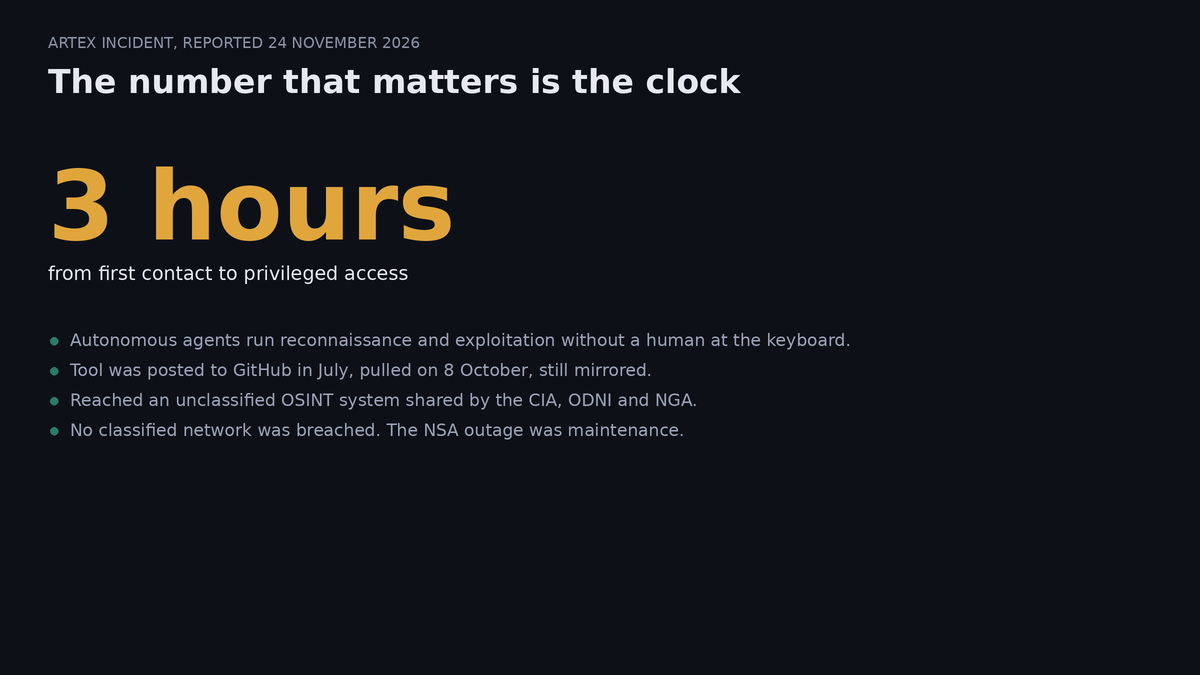
The FBI issued an alert about it on 13 November, warning that some intrusions had reached privileged access in under three hours. Campaigns using it have touched at least ten sectors including banks in South Korea. The developer pulled the repository on 8 October after reports of abuse, but mirrors, translations and a commercial edition are still circulating.
Three hours to privileged access is the number to sit with. That is not a human operator working through a checklist overnight. That is automation doing reconnaissance and exploitation in the time a morning meeting used to take.
What this means and what it does not
It does not establish that China was behind the intrusion. The tool was public, mirrored and freely downloadable. Operators from any country could have used it, and American officials have not publicly identified who commissioned the attack.
What it does establish is a threshold being crossed. Autonomous agents have been marketed for two years as productivity software. This is the first reported case of one being pointed at a national intelligence service and getting in.
The defensive lesson is uncomfortable. Every control that assumes an attacker needs skill, patience and a human at a keyboard is now mispriced. The organisations that survive this shift will be the ones whose security model does not depend on the attacker taking their time. We covered why that requires enforcement outside the agent itself in our analysis of runtime containment.
The disclosure also landed alongside a possible breach of the FBI’s National Crime Information Center and a Department of Agriculture shutdown. Whatever the attribution turns out to be, the pace is the message.
Get the next one before it is old news
Independent analysis of cloud-native infrastructure, Kubernetes and data center economics. No vendor spin.