
Executive Summary
Tencent open-sourced DFly2 on 26 November, a speculative decoding drafter that keeps no KV cache of its own. It reads the target model’s sparse index instead, at the positions that model already selected. That one design choice is why three layer drafters now ship for three different models, Tencent’s own Hy4 flash plus DeepSeek-V4.1-Flash and GLM-5.3-Flash from two rivals.
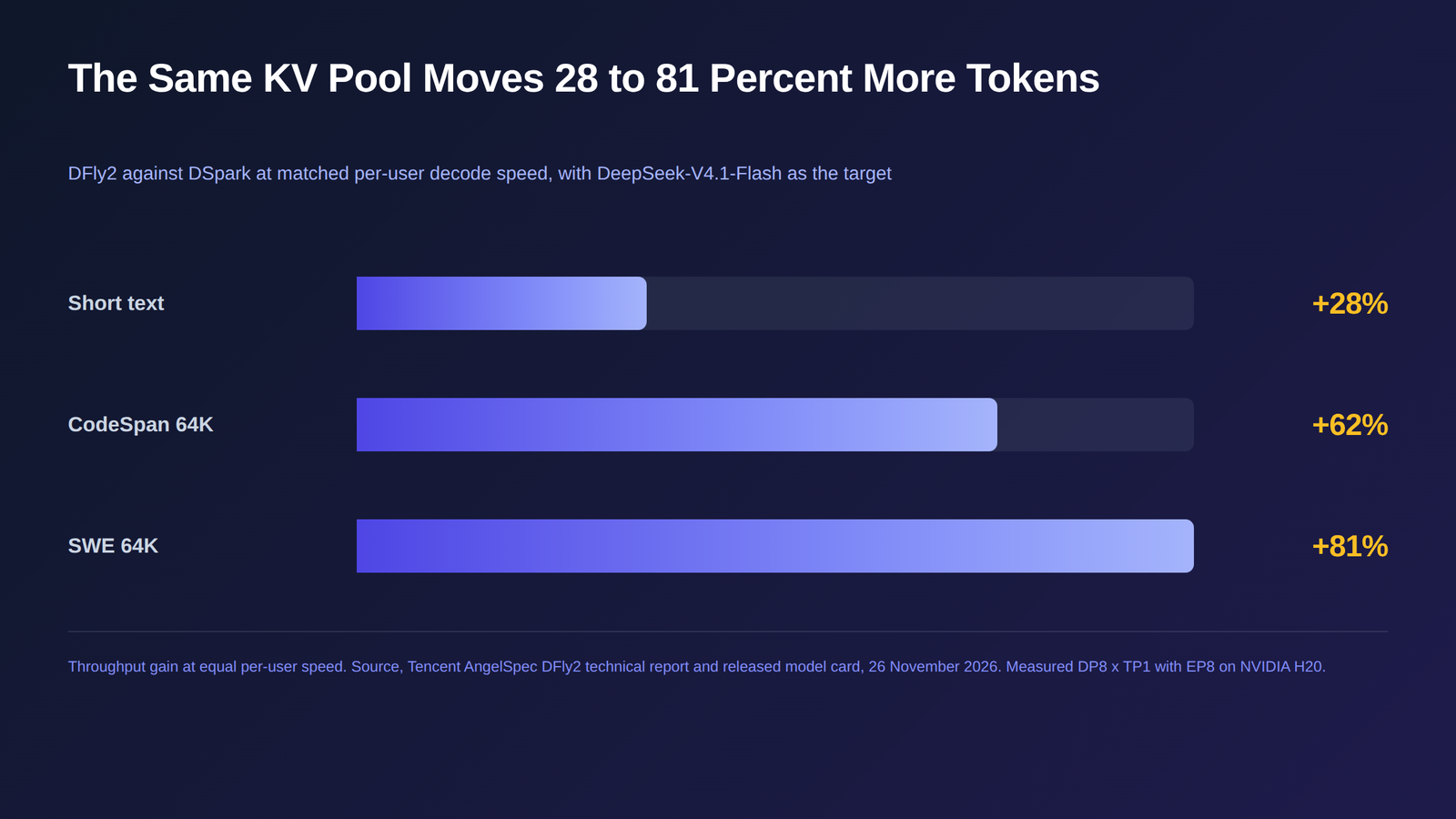
The numbers here are capacity numbers. A full cache drafter would add 3.4 KiB per token on top of DeepSeek’s 4.4, pushing per-token KV to 1.76 times. DFly2 adds nothing, so the same pool holds 1.73 times as many requests at 32K. At matched per-user speed it moves 28 to 81 percent more throughput than the strongest baseline. Tencent’s headline is up to 4.2 times, which is one best cell and not the average.
The draft model sits on top of an inference server and guesses the next few tokens. Years of work went into making those guesses accurate. Almost none went into what the guesses cost to store.
The Target Already Chose, So the Drafter Only Reads
Tencent’s AngelSpec team released a drafter family called DFly2 on 26 November, with the weights, the training code and a technical report in the same drop. The mechanism is narrow and worth following, because it explains why one release covers models Tencent does not own.
DeepSeek-V4.1-Flash, Hy4 flash and GLM-5.3-Flash all run natively sparse attention. For every query the target’s own indexer picks a fixed number of keys to read out of a long history. That selection gets made anyway, and paid for anyway, on every decode step. DFly2’s three draft layers each latch onto one of those target layers, read the KV that layer already cached, and read it at the positions that layer’s indexer already chose.
The consequence is arithmetic. On DeepSeek-V4.1-Flash the draft step touches 646 keys no matter how long the prompt runs. On Hy4 flash and GLM-5.3-Flash it touches 2,054. Reading that fixed set costs 4 to 6 percent of a decode step at any context length. A drafter carrying a cache of its own climbs to 14 to 23 percent by 128K.
The Drafter With Its Own Cache Can Lose to No Drafter
Tencent trained the baselines itself, on the same data and the same number of steps, so the comparison is at least symmetric. DFlash keeps a cache over the whole prompt. DSpark bounds its cache to a sliding window. Both are real designs with real followings.
Both break down at length. On Hy4 flash, DFlash falls to 1.08 accepted tokens per step once prompts pass 32K, which is barely better than guessing nothing. On DeepSeek-V4.1-Flash the full cache variant spends up to twice the time to the first token building that cache, and two of its agentic sets finish slower than plain decoding, at 0.83 and 0.69 times end to end.
That is the trap for anyone sizing a deployment. A drafter gets sold as a speedup on one benchmark, and the cost lands somewhere else, in prefix cache hit rate and in how many concurrent requests the same GPU pool will hold. DFly2 adds no KV at all, so the pool takes 1.73 times the requests at 32K on DeepSeek and 1.19 times on Hy4 flash. Every prefix cache hit the target scores is also a drafter hit.
The Rivals Published the Weights, and That Made It Possible
This release exists because DeepSeek and Zhipu published weights a competitor could read. Training recomputes the selection with a frozen copy of each paired layer’s indexer, so the target has to be in hand. Tencent then published its own drafters under Apache 2.0, the DeepSeek one and the Hy4 flash one, plus the framework behind them.
That is a serving stack, not a model. AngelSpec trains seven drafter architectures through one pipeline, and switching between them is a config change. Tencent shipped a drafter for Alibaba’s Qwen3.8-27B earlier this month on a different approach, one that had to rewind recurrent state on a hybrid attention model. The Hy4 weights themselves carry a revenue gate above 50 million dollars. The drafters carry no such clause.
Be careful with the headline. Tencent’s 4.2 times is the best single cell. Across the seven agentic sets, end to end, DFly2 lands at 1.50 times on DeepSeek-V4.1-Flash and 1.67 times on Hy4 flash. End to end is what a capacity plan actually buys. Serving support in vLLM is described as in progress, so the weights run in a research configuration today. If you hold a DeepSeek or GLM-5.3-Flash endpoint, the honest next step is a measurement on your own prompt distribution.
Three questions to run first. Does your target expose a sparse indexer, since a dense model gets nothing here? What is your per-token KV today, because the drafter’s value scales with memory you were already spending? And how much of your traffic runs past 32K, where the gains are largest?
Related reading on this beat. Tencent opened the Hy4 weights and the license stopped at fifty million dollars. Two labs cut the cached context and only one published the weights. Tencent shipped Qwen a 3.8 times speedup.
Get the next one before it is old news
Independent analysis of cloud-native infrastructure, Kubernetes and data center economics. No vendor spin.