Executive Summary
Alibaba closed the metered preview of its top model at midnight Beijing time on 25 November and left two paid routes behind. One is a per-token API at $1.50 input and $4.50 output per million tokens. The other is a subscription starting at $6 a month that, by its own terms, may only be used interactively inside a coding or agent tool. Chinese AI model pricing now turns on that split. The number that circulates in every comparison table is a personal seat, not a procurement option.
DeepSeek makes the same split from the other direction. Its free app is being rationed for want of compute, with conversations idle for 72 hours no longer processed and documents cut at 10,000 tokens. Its API is genuinely cheap off-peak and exactly double during two weekday windows. Across both labs the pattern holds. The headline price belongs to a constrained tier, while the tier that scales carries a rate card, a clock and a concurrency cap. Price per token is no longer the number that decides a bill.
At midnight Beijing time on 25 November, Alibaba retired Qwen4-Max-Preview. For fifteen days the strongest Qwen model had run behind a discounted credit meter. What replaced it is a price list, and the price list is not the number that gets quoted. Chinese AI model pricing now runs on clocks and caps. We flagged that fifteen day gate when it opened in our read of the launch.
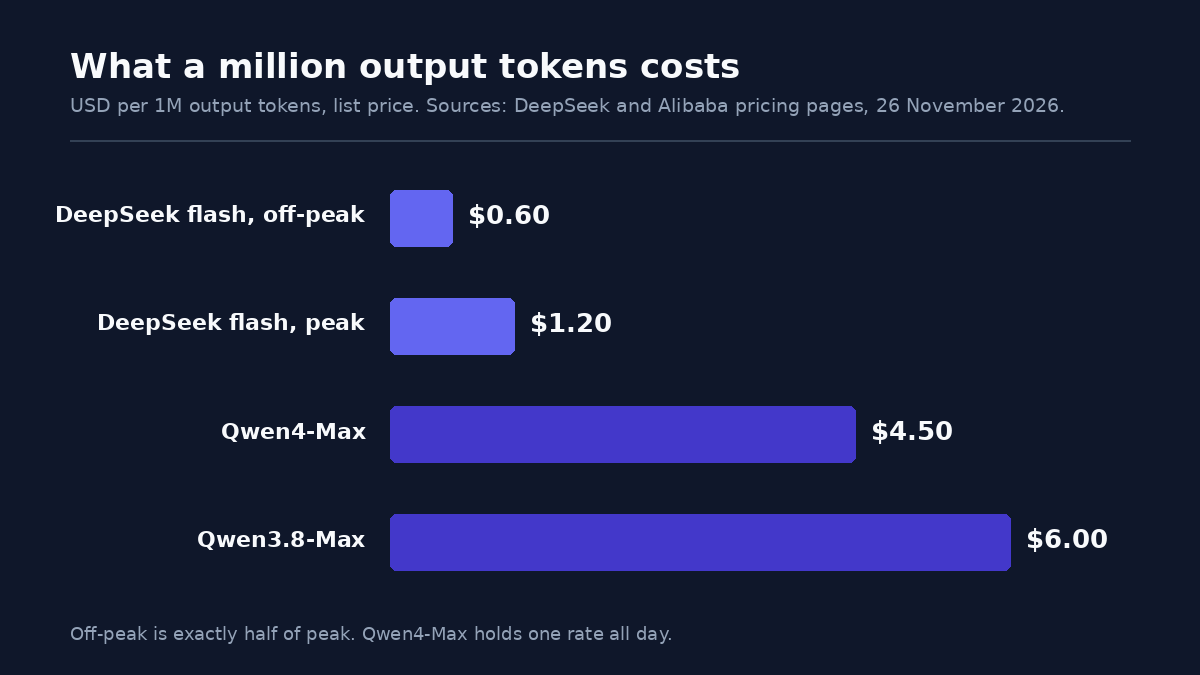
Qwen4-Max now costs $1.50 per million input tokens and $4.50 per million output tokens in Singapore. Cached input is $0.075. That is 25 percent below Qwen3.8-Max, the flagship it supersedes, which still sells at $2.00 and $6.00. The cut is real.
Next to it sits the Token Plan, where the comparison tables go wrong. Individual plans run from $6 a month for 20,000 credits to $43 a month for 200,000. A credit pack adds 20,000 credits for $15, up to five. Six dollars is a fraction of a modest API bill, so the plan gets quoted as proof that Chinese inference is nearly free.
The Six Dollar Seat Is One Person and Eight Agents
Read the use scope and the plan stops being an API. The terms limit it to interactive use inside programming and agent tools, which the documentation names as Claude Code, Cursor, Qwen Code, Qoder and OpenClaw. It may not be used for automation scripts, custom application backends or non-interactive batch calls. The same page states that calls outside that scope are treated as abuse and can bring suspension or an API key ban.
The concurrency column finishes the argument. The $6 tier allows one to two concurrent agents. The $43 tier allows six to eight. One subscription per account, personal use only, sharing prohibited, and inference routed through Singapore. An operator running a fleet does not buy a seat. A seat is a chair with a name on it.
That leaves the meter. DeepSeek flash, the model the coding tools actually call, carries a concurrency limit of 2,500 requests. Qwen’s seat carries eight. The two numbers describe different products.
DeepSeek Rations the Free Door and Doubles the Paid One
DeepSeek runs the split in reverse. Since 15 November it has told users that long conversations idle for 72 hours can no longer be processed, and that documents are read only to the first 20 pages or 10,000 tokens. Both notices cite a shortage of computing capacity, as Caixin reported. DeepSeek sells no consumer subscription, so the free app is the only consumer door and the company is narrowing it.
The paid door is priced by the clock. DeepSeek charges half price off-peak. Peak runs 1am to 4am and 6am to 10am UTC on weekdays, excluding Chinese public holidays. DeepSeek flash costs $0.15 per million input tokens on a cache miss off-peak and $0.30 at peak, with output at $0.60 and $1.20. Cache hits fall to $0.003 and $0.006. Nothing about the model changes between those windows.
A California team buys at off-peak rates. A team in India pays peak for about half its working day. A batch job scheduled carelessly costs double, and no comparison table shows it.
The Meter Is the Product Now
This is not a pricing mistake by two labs. It is a response to arithmetic. Token prices across the market fell 47 percent in nine months, and spending rose anyway. On Vercel’s gateway, open-weight models carried more than seven of every ten tokens in September and took in less than a quarter of the money. DeepSeek-V4.1-Flash alone carried about half that gateway’s tokens and collected roughly $2.60 of every $100 spent.
A model that wins on volume and loses on revenue needs a second meter. DeepSeek found the clock and the ration. Alibaba found the seat and the credit pack. The near-free tier is built not to scale, which is the point. What scales is priced.
So the question is not which Chinese model is cheapest. It is which one you are permitted to run the way you actually need to run it. Three questions are worth answering. Does the workload run interactively inside a tool, or unattended? What share of it lands in your provider’s peak window? And if the cheap tier vanished tomorrow, what would you pay?
Get the next one before it is old news
Independent analysis of cloud-native infrastructure, Kubernetes and data center economics. No vendor spin.