
Executive Summary
Prism ML published Ternary Bonsai 2.5 27B on 24 November. Ternary quantization holds each weight in one of three states, and the card reports 1.76 bits per weight. The weight files measure between 5.99 GB and 7.91 GB, against 53.8 GB for the FP16 model. Thirty five hours after the upload, the 26 November capture of HuggingFace’s trending board placed it sixth, on a score of 307 and 59,366 downloads.
The same capture shows text generation models holding 7 of the 30 slots, up from 2 on 23 November. All seven arrived within the week. None of them leads on adoption, and the highest ranked of them has 59,366 downloads while Qwen 3.8 27B, the base these builds compress, sits at rank 14 with 6,047,011. The board is ranking interest, not installs, and the interest has moved toward models that fit in less memory.
A 27B model that asks for a ninth of the memory just landed sixth on HuggingFace’s trending board. It got there in 35 hours.
Prism ML uploaded Ternary Bonsai 2.5 27B on 24 November at 16.32 UTC. The board capture on 26 November, the one this column reads each morning, puts it at rank six on a trending score of 307. Only three Inkling 2 Mini builds, one audio model and one finetune sit above it. No general text model does.
Ternary weights keep three states, minus one, zero and one. That sets a floor near 1.58 bits per weight, because log base two of three is 1.585. The card reports 1.76, so part of the model stays at higher precision. It ships as GGUF files for llama.cpp on CUDA, Metal and plain CPU.
The arithmetic holds. At 27 billion parameters and 1.76 bits the weights come to roughly 5.94 GB. The smallest file measures 5,993,834,848 bytes and the Q2 build measures 7,673,194,848. The FP16 original is 53.8 GB, which the card puts at roughly nine times the size.
Text generation came back with nobody’s old name
Text generation held 2 of the 30 slots on 23 November. It holds 7 today. That is 3.5 times in three days, and the sharpest turn this series has recorded.
Not one of the seven was on the board on 19 November. The list runs from Prism ML at rank 6 to MemTensor’s MemT 1.0 Pro at 26, with Aleph-Alpha’s Kolibri 1.1, Baidu’s ERNIE 5.5 Flash Preview, KRAFTON’s Raon 1 mini and a community rebuild of Inkling 2 Mini scattered between.
MemT 1.0 Pro declares NVIDIA’s Nemotron 3 Ultra 550B as its base and carries 806 downloads. KRAFTON’s entry carries 264. A model no longer needs a crowd to reach the top 30. It needs a score.
The compression is real and the trade is small, on paper
The card makes three claims worth separating. Roughly nine times smaller than FP16. FP16 level agentic tool calling. Ninety percent of FP16 on agentic coding. The first is arithmetic anyone can check against the file listing. The other two are the lab’s own numbers on its own benchmark, with a demo repository and a whitepaper behind them.
So the honest reading is narrow. A 27B agent model now costs 5.99 GB of weights instead of 53.8 GB, and the lab prices that at a tenth of agentic coding performance. The card aims the model at long running tool driven work, where a small memory floor matters most because you want many copies in flight rather than one large one.
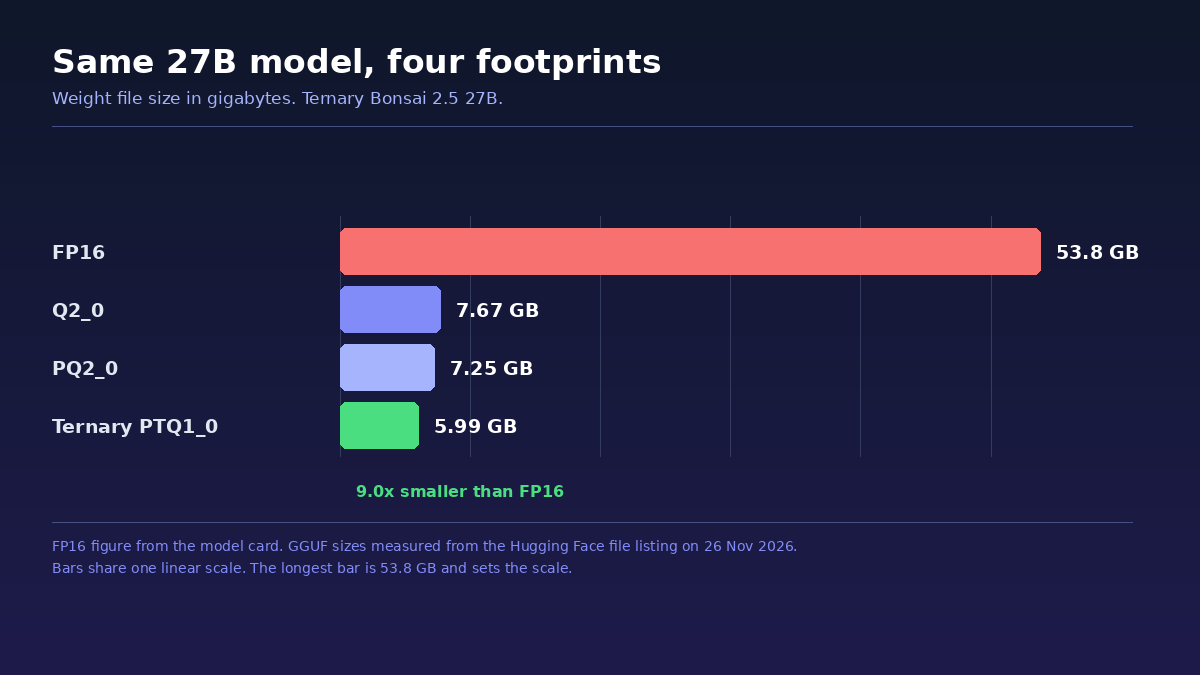
Weights are not the whole bill. The KV cache grows with context and lands in the same memory pool. The repository also ships a multimodal projector, 629 MB in the Q8 build. A 5.99 GB file is the floor of the deployment, never the total.
The board is pricing memory, not downloads
Ternary Bonsai sits at rank 6 with 59,366 downloads. Qwen 3.8 27B, the model it compresses, sits at rank 14 with 6,047,011. The lower ranked model has 102 times the downloads of the higher ranked one.
That gap is the story. The trending score moves on attention, and attention is going to whatever gets smaller or cheaper to run. The unsloth build at rank 2 has 25 times the downloads of the original beside it, and Inkling 2 Mini holds five slots, four of them built by another hand.
Read the board as a leading indicator of what operators will try, not what they run. The signal this week is a 27B model that fits where it used to not fit.
The 27B class has been the awkward middle of local inference, too big for one card and unremarkable next to a 70B. A 1.76 bit build changes that arithmetic, and the test is cheap.
Three questions for your own stack. Does anything you serve today need more than 6 GB of weights for work a 27B ternary build already handles? What does your context length add on top of that 6 GB? And what is the smallest box you could test it on this week?
Related reading. Our 24 November report on the four slots Inkling 2 Mini held, and the earlier piece on why community rebuilds keep outranking the models they compress.
Get the next one before it is old news
Independent analysis of cloud-native infrastructure, Kubernetes and data center economics. No vendor spin.