
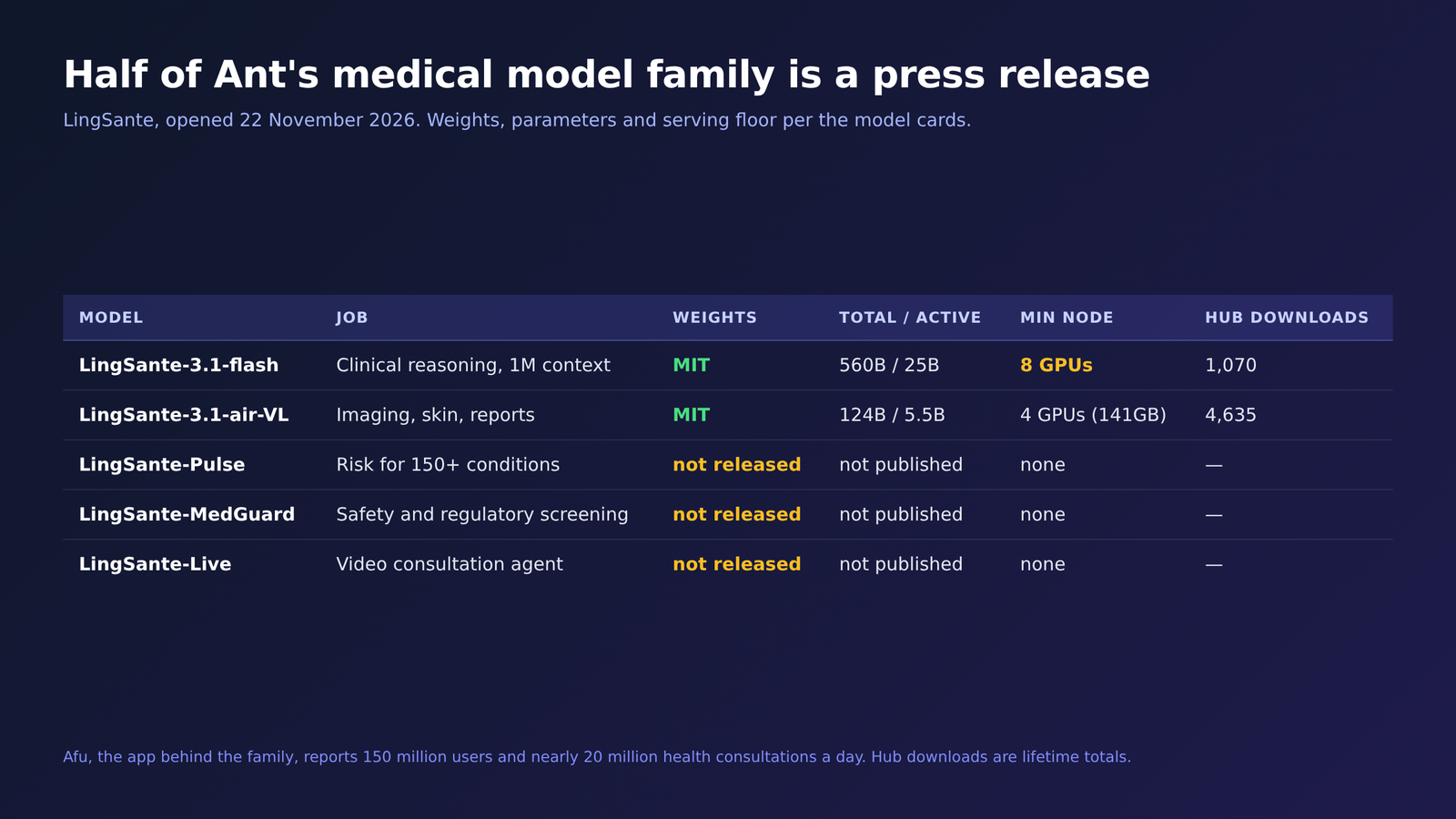
Ant Group opened the weights of two models from its LingSante medical family this week under the MIT license, the loosest terms any large Chinese release has carried. The flagship is an open-weight medical model with 560 billion parameters, 25 billion active per token, and a one million token context window. The license clears every legal claim on it.
The hardware does not. Ant’s own quickstart runs the flagship at tensor parallel 8 and expert parallel 8, and the Hugging Face page lists no inference provider serving it. The 124 billion parameter sibling needs four GPUs and has pulled 4,635 downloads against 1,070 for the flagship. Ant says the app behind the family handles nearly 20 million health consultations a day. The compute exists. It sits on one side of the fence.
Medical AI has been locked behind two doors. One is the license, because the useful models sit inside vendor agreements and hospital procurement. The other is compute, because a clinical model is worthless if the only place it runs is a cloud region nobody will put patient records in. Ant Group opened the first door this week. The second door has a new padlock, and the manufacturer printed its size on the box.
LingSante-3.1-flash is a hybrid linear mixture of experts. Sixty three of its layers use KDA attention and nine use a gated variant, with 512 experts routed eight at a time and a vocabulary of 157,184 tokens. It keeps the shape of Ling-3.1-flash, so the new work is training rather than architecture. The card bills it as a research model and says plainly that it must not be used as an independent basis for diagnosis, prescriptions or treatment. The last Ling model we covered looked strong on a legal benchmark until the hallucination check ran.
MIT Cleared the Legal Bill and Kept the Rack
Read the deployment block on the model card and the shape of the constraint appears. The SGLang command asks for tensor parallel 8 plus expert parallel 8. The vLLM command asks for tensor parallel size 8. Either way the smallest unit that serves this thing is a full eight way node, and that is before anyone sizes a KV cache for a million token context.
An eight GPU node is a capital project. It brings power, cooling, a support contract and a GPU supply agreement, and none of that fits a hospital procurement cycle built around software licenses. What MIT changed here is which department gets to decide. The question used to go to legal. Now it goes to finance.
Nor can a buyer defer the decision to someone else’s infrastructure. The Hub lists no inference provider for either open model in the family, so the choice is to run the weights yourself or find a cloud willing to put a clinical workload behind them.
The Same Stack Already Serves 20 Million Consultations a Day
Afu, the health app that Ant built the family for, reports 150 million users and nearly 20 million consultations a day in Ant’s release. The models were trained on that traffic and the flagship runs behind it now. So this is not a model nobody uses. It is a model that is used at a volume only its owner can reach, which turns a permissive license into a promise about a file rather than a promise about a service.
Three of the five models stay closed, with weights promised in phases and no dates attached. They are the three that touch a patient in the moment. LingSante-Pulse scores risk across more than 150 conditions, MedGuard screens for safety and bioethics problems, and Live runs a video consultation inside the app. The family opened the reasoning model first and kept the rest.
The Model That Fits on Four GPUs Took Four Times the Downloads
LingSante-3.1-air-VL carries 124 billion parameters and activates 5.5 billion, with a 256,000 token context and text, image and video input. Its card runs it at tensor parallel 4 on 141 GB cards, or eight H100s at 80 GB. It has 4,635 downloads on the Hub. The flagship has 1,070. The model a smaller institution can actually stand up is the one being taken.
The pattern shows up outside Ant. Baidu’s ERNIE 5.5 Flash Preview, Apache 2.0 at 280 billion parameters, collected 1,193 downloads in its first two days, and we wrote this week about what it does to the cache an inference server has to hold. When the license stops being the binding constraint, the download counter starts measuring racks.
Ant also published a scoreboard, and it is worth reading against the headline. InclusionMed, built with researchers from 29 institutions, places the flagship fifth of the 23 configurations it scored, at 45.064 overall, and the card describes that as sitting on the performance to cost frontier. Fifth of 23 on the lab’s own platform is a credible result. It is also not the number a hospital buys on.
Three questions settle whether this release changes anything for your organization. Can you stand up eight GPUs inside the boundary where the patient data lives. If not, which cloud region holds both the model and the records. And if the answer to both is no today, what does a permissive license on a file you cannot serve actually buy.
Get the next one before it is old news
Independent analysis of cloud-native infrastructure, Kubernetes and data center economics. No vendor spin.

By Ivan Tarin
Ivan Tarin is a Principal Product Marketing Manager at SUSE, where he owns go-to-market strategy and positioning for a seven-product cloud-native portfolio spanning Kubernetes, virtualization, storage, security, and observability. A former full-stack developer who shipped production code for enterprise and public-sector clients including U.S. national laboratories, Ivan translates complex infrastructure and AI technology into messaging that lands with developers, platform teams, and enterprise buyers. He has presented at KubeCon, SUSECON, and AWS Developer Week, and is currently pursuing an MS in Artificial Intelligence at the University of Colorado Boulder.



[…] Ant Group hit the same wall with a 560 billion parameter medical model under MIT and an eight GPU floor in its own quickstart. For Ant, the hardware was the paywall. […]