Executive Summary
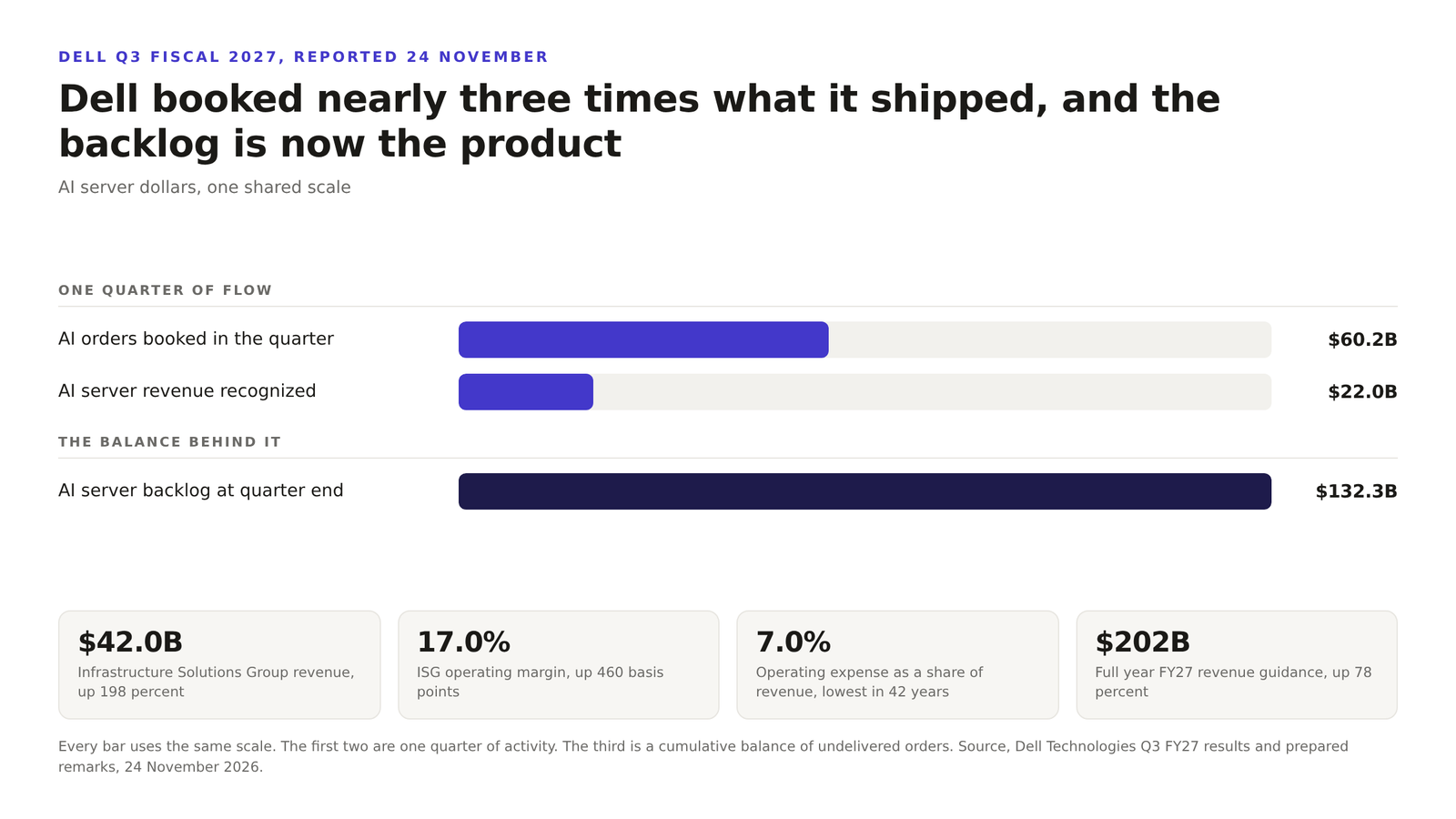
Dell is now selling capacity it cannot deliver inside the same quarter, and that changes what kind of company it is. It booked $60.2 billion of AI orders, recognized $22.0 billion of AI server revenue, and closed with $132.3 billion in backlog. Against its own full year AI server guidance of $78 billion, the Dell AI backlog runs 1.7 years deep.
The surprising part is the margin. A mix shift this heavy usually costs a hardware maker money, and Dell’s infrastructure margin instead expanded 460 basis points to 17.0 percent, because operating expense fell to 7.0 percent of revenue. That is the real result of the quarter, and it is also the one with a clock on it, since Dell told investors margins moderate sequentially from here. The verdict is that demand is settled and execution is not. The next four quarters test delivery, not orders.
Dell’s revenue doubled in a single quarter, and the argument has moved off demand. It sits on delivery. The company reported $54.9 billion of revenue, up 103 percent, with an infrastructure business that nearly tripled underneath it.
The infrastructure group holds servers, networking and storage. It delivered $42.0 billion of revenue, up 198 percent, and $7.1 billion of operating income, up 308 percent. That is 76 percent of company revenue. The PC side grew 3 percent and its operating income fell 6 percent. Jeff Clarke, the vice chairman and chief operating officer, put it plainly in the release. “We are now a different company, with Infrastructure Solutions Group driving the vast majority of our profit and growth.”
The order book is now 1.7 years of guided revenue
Run the flow against the balance. Dell booked $60.2 billion of AI orders and recognized $22.0 billion of AI server revenue, so the backlog grew by roughly $38 billion net in ninety days. The Dell AI backlog ended the quarter at $132.3 billion.
Dell expects $78 billion of AI server revenue for the full fiscal year, which makes the backlog 1.7 times a full year of shipments. Orders over the past four quarters reached $180 billion, and Dell says a majority of new orders now ride on NVIDIA’s Vera Rubin NVL72. Customers number more than 7,500 AI Factory deployments, spread across neoclouds, sovereign projects and enterprises.
The line worth reading twice is the vetting. Dell says every order is screened for customer quality, access to capital, trade and export compliance, and access to land and power. A hardware vendor that checks whether its buyer can site a building is telling you where its revenue actually stops. The constraint moved off the chip and onto the substation.
The margin held, and operating expense is why
A mix shift toward AI servers is supposed to be margin poison. Dell’s infrastructure margin expanded 460 basis points to 17.0 percent anyway, on $7.1 billion of operating income. Gross margin came in at 21.2 percent, up 10 basis points. Company operating expense landed at 7.0 percent of revenue, the lowest in its 42 year history.
That is where the gain came from, and it is finite. Dell guided fourth quarter revenue to $56.25 billion, up 69 percent, which is a deceleration from 103 percent on a much larger base. It also told investors that operating margin rates will moderate sequentially as a stronger North America sales mix normalizes.
Orders are compounding while revenue growth slows, and the company describes a widening gap between component supply and end-user demand. That is a supply ceiling, not a demand problem. For anyone waiting on capacity, the queue is the product now.
The plain server tripled too, and that changes the budget
AI servers grew 291 percent. Traditional servers and networking grew 235 percent to $15.0 billion, a near tie on a smaller base that gets almost no attention. Dell’s own explanation is ordinary and revealing. Customers are refreshing to free power and floor space for AI, buying CPU compute to feed inference, and replacing hardware that no longer meets security requirements through a software patch.
Storage is the laggard at $4.9 billion, up 24 percent. Dell still calls it the profit contributor, with its own intellectual property mix at a record and demand up for a seventh consecutive quarter. Unstructured storage supporting AI workloads grew at a triple digit rate for a third consecutive quarter.
The budget lesson is easy to skip. If the plain server and the storage array both grow while accelerators triple, the marginal rack is not just GPUs. It is CPUs, network cards and disks, and the power to run all of it. Sizing an AI budget on accelerator count alone undersells the electrical bill.
Three questions for anyone planning 2027 capacity. How much of what you need is already ordered by someone else, and does your delivery date assume their backlog clears first. What does your siting plan look like when the vendor screens your order for land and power. And does your hardware line carry the CPU and storage growth that came with the accelerators.
Related reading. Our analysis of on-prem server pricing, the AI lease that missed its closing, and what gigawatt power orders cost.
Get the next one before it is old news
Independent analysis of cloud-native infrastructure, Kubernetes and data center economics. No vendor spin.