


Baidu published the ERNIE 5.5 Flash Preview weights on Hugging Face this week under Apache 2.0. It is a mixture-of-experts model with 280 billion total parameters, 14 billion active on any token, and a context window of one million tokens. Zhipu shipped GLM-5.4 a day earlier with the bigger number on the box, 750 billion parameters and a shared block of 28 layers executed twice, and with no weights, no API and no benchmark table a reader can check.
Both releases are cache engineering wearing the costume of a model launch. Baidu keeps one cache entry per 128 tokens of history across 37 of its 43 layers. Zhipu makes the second pass cost one sliding window of cache instead of a full context. Neither trick makes a model smarter. Both make long context cheaper to hold, which is where the money went once every lab could rent the same GPUs. The split that matters to an operator is distribution. One of these downloads today. The other you reach through a subscription.
Read the two announcements side by side and the interesting part is not the parameter count. It is what each lab did to the memory an inference server has to hold.
Baidu Cached One Entry per 128 Tokens
ERNIE 5.5 Flash Preview is a post-trained checkpoint built on the ERNIE 5.5 Flash Base weights Baidu opened in October. The architecture and tokenizer carry over from the base. The model card describes 43 layers, and 37 of them use Heavily Compressed Attention, which stores one cache entry per 128 tokens of history. The other six keep token-level history but run sparse attention, so each decoding step reads only selected positions. The reported payoff is a KV cache that stays small while the window grows to a million tokens.
That is the problem the llm-d contributors measured on SGLang last week, when they moved evicted blocks into host RAM and cut median time to first token from 174.2 seconds to 20.1. Baidu solves it earlier in the stack by not writing the blocks at all. The card also ships a DSpark draft head for speculative decoding. With seven draft steps it reports an average acceptance length above 5.5 on multi-turn conversations. The KV cache runs in FP8, the sparse indexer in FP4.
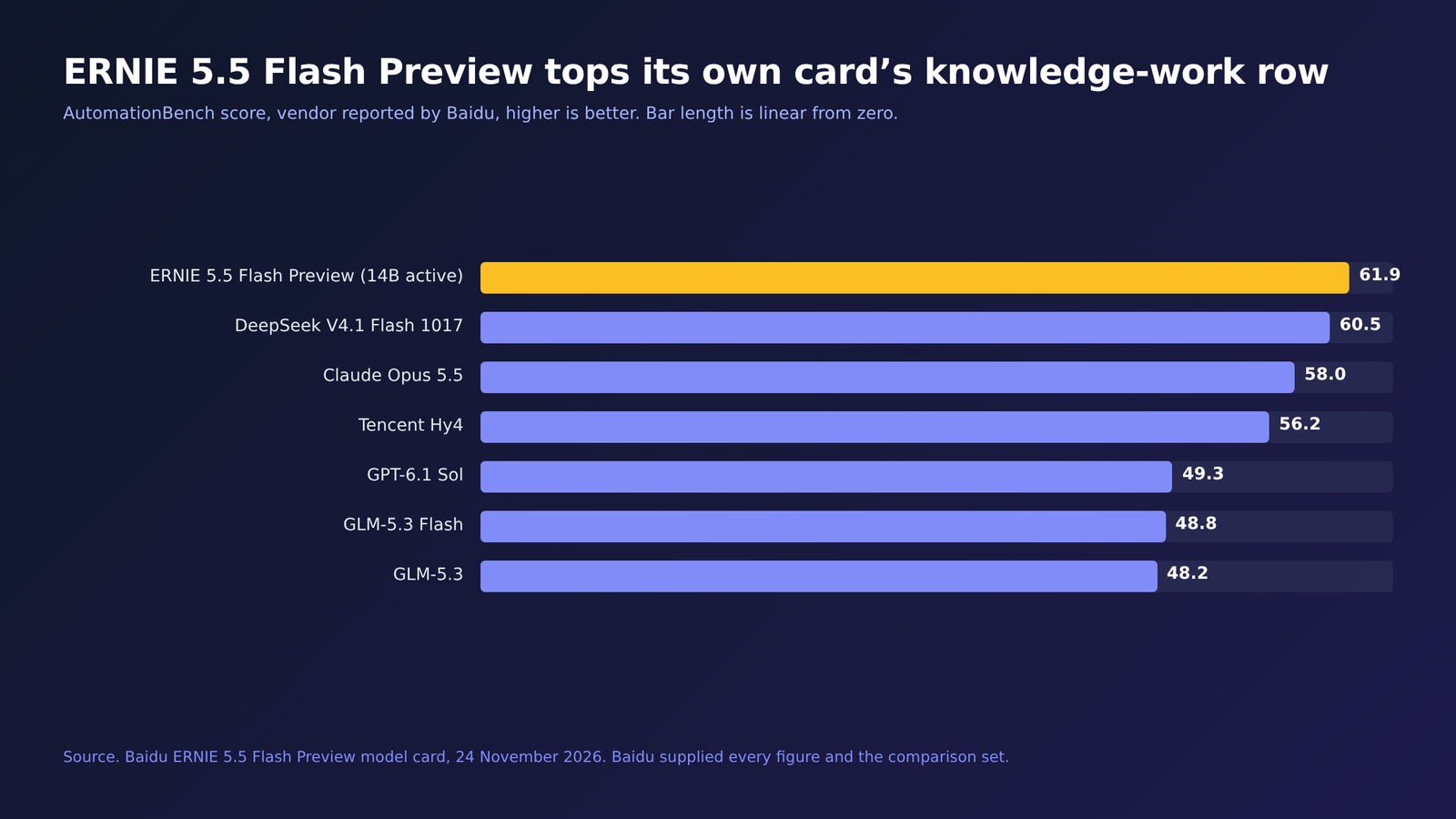
Baidu published its own comparison table, so read it as vendor-reported. On AutomationBench the preview scores 61.9 against 60.5 for DeepSeek V4.1 Flash and 56.2 for Tencent Hy4. On Terminal-Bench 4.0 it takes 46.5 against 42.3 and 44.4. On DeepSWE v1.1 it loses, at 71.2 behind 77.0 and 74.9. A 14 billion active slice now lands in the same band as models several times its active size, and still trails them on the hardest agentic coding set.
Zhipu Bought Depth With a Second Pass
GLM-5.4 takes the other route. Z.ai describes a 750 billion parameter model built on a loop transformer, where a shared block of 28 layers runs twice per forward pass. The network gets deeper without new weights. Per-token gates decide how much each pass writes back into the residual stream. The company says the first pass builds context and the second opens the gates to refine. The claim is intelligence comparable to 2 to 3 trillion parameter models.
The serving section is the one worth reading. Zhipu states that an extra loop costs one sliding window of KV cache rather than a full context cache, and that the second pass reuses the sparse attention indices from the first, so indexing adds no overhead. Their figure is up to 200 tokens per second off peak and 70 to 80 under load. That answers the obvious objection, that doing the work twice should double the bill.
What is missing is equally clear. The post carries no benchmark table. The 2 to 3 trillion comparison rests on the company’s own statement, and Zhipu concedes the model sometimes falls into what it calls marathon thinking loops. Treat the capability claim as unverified until a third party scores it.
The Download Is the Difference Most Teams Will Notice
Search Hugging Face for GLM-5.4 and you get nothing. The lab account tops out at GLM-5.3 from August. The blog links to three ways in, chat, the Coding Plan and ZCode, and none of them is a file. Baidu went the other way. Apache 2.0 weights, a vLLM fork and an SGLang recipe are all live, and the checkpoint is downloadable now.
Tencent‘s Hy4 weights carry a fifty million dollar revenue gate in Section 10 of the license. The pattern is steady now. Chinese labs ship flagships to their own subscription products first and open the weights later, or never. For anyone building an inference service, that decides the question. A model you cannot download is a dependency, not an option, whatever the benchmark row says.
Three questions for your own stack. What is your cache budget per concurrent request at the context length your agents actually use, and does a compression scheme like HCA fit inside it. Would a model that costs one sliding window per extra pass change what you can serve at peak. And for any evaluation you run this month, could you keep running the shortlisted model if the vendor changed its mind about access.
Get the next one before it is old news
Independent analysis of cloud-native infrastructure, Kubernetes and data center economics. No vendor spin.