

Executive Summary
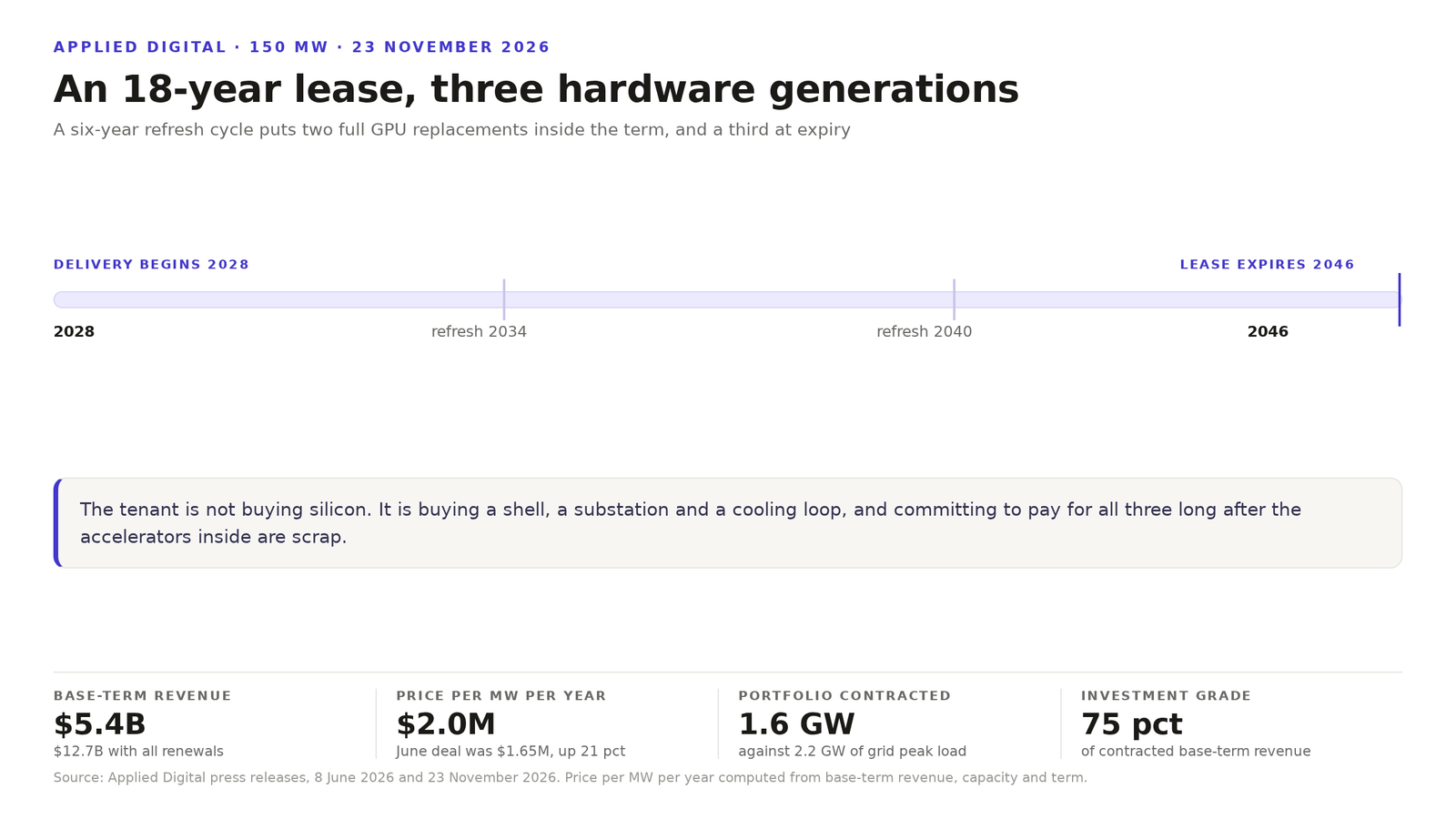
Applied Digital sold 150 megawatts to an unnamed investment-grade hyperscaler for 18 years at roughly $5.4 billion, and the interesting number is not the total. It is $2.0 million per megawatt per year, which is 21 percent above the $1.65 million the same company booked for a 210 megawatt lease in June. Price rose while the term stretched from 15 years to 18.
The portfolio arithmetic matters as much. Contracted IT load grew 200 megawatts to 1.6 gigawatts while grid connected peak load grew 50 megawatts to 2.2, which points to capacity layered onto interconnections the company already holds. Three quarters of contracted base term revenue now sits with investment grade tenants. The verdict is that what got leased is a shell, a substation and a cooling loop, and the term now runs past three accelerator generations.
Applied Digital signed an 18-year lease on power, cooling and a shell, and it got a better price than five months ago. The buyer is an unnamed tier one investment grade hyperscaler. The number to hold onto is $2.0 million per megawatt per year.
The company said on 23 November the lease carries about $5.4 billion in base term revenue, or about $12.7 billion if every renewal is taken across a 33 year term. Capacity delivery starts in the first half of 2028, subject to utility arrangements and regulatory approvals. No campus name, no state, no tenant.
The per-megawatt price rose 21 percent in five months
Run the arithmetic on both deals. The June lease was 210 megawatts for 15 years at about $5.2 billion, which works out to $1.65 million per megawatt per year. This one is 150 megawatts for 18 years at $5.4 billion, or $2.0 million. The company calls it improved commercial terms with higher pricing, and the arithmetic agrees.
The renewal upside got slightly smaller rather than larger. June carried a 2.44 times optional tail over its base term. This one carries 2.35 times. Longer base, higher rate, slightly lower multiple. That is what a tenant pays for certainty of site, and a landlord charges for it.
Both figures are annualised here from base term revenue, capacity and term, because the release does not publish a rate card. Treat $2.0 million as a derived average, not a quoted price.
Two hundred more megawatts of load, fifty more of grid
The portfolio arithmetic is the part to watch. Contracted critical IT load went from 1.4 gigawatts in June to more than 1.6 now. Grid connected peak load went from 2.15 to 2.2. Read literally, 200 megawatts of new contracted load arrived with 50 megawatts of new grid capacity, which implies most of it sits on interconnections already secured.
The company does not break that out campus by campus, so treat the delta as inference rather than disclosure. It fits the story the sector keeps telling. Power is the gate, and the operators holding headroom are the ones still signing.
The ratio moved with it. Grid peak against contracted load fell from about 1.54 to 1.375. For comparison, our record of the Project Star campus put generation at roughly 1.3 gigawatts for every gigawatt of compute. That is the neighbourhood a lender or a utility will ask about.
The risk moved from the tenant credit to the calendar
Three quarters of contracted base term revenue sits with investment grade tenants, which answers the obvious credit question. The less obvious one is time. Delivery in the first half of 2028 plus 18 years runs to 2046. Take a six year accelerator replacement cycle, a planning assumption rather than a rule, and two full generations of hardware get replaced inside the lease while a third lands at expiry.
The tenant is not buying silicon. It is buying a shell, a substation and a cooling loop, and committing to pay for all three long after the accelerators inside are scrap. The landlord’s risk stops being whether the tenant can pay and becomes whether a 2046 building in that location is still the cheapest place to put that workload.
The capital side has the same shape. The build is funded with first in equity already on the balance sheet plus a $5 billion programmatic equity partnership with Macquarie Asset Management, then project finance backed by the lease. Remaining project finance for Delta Forge 1 and Polaris Forge 3 is expected in the first quarter of 2027, and for Delta Forge 2 in the second, which means the money lands before the capacity does.
The company’s investor deck shows the concentration. Polaris Forge 1, 400 megawatts, is leased to CoreWeave. The rest of the table belongs to the unnamed investment grade tenant. A portfolio this long dated and this concentrated is a fixed income product with a construction schedule attached, and it should be priced like one.
Three questions if you sit on the buying side of one of these. How many of the 18 years can you exit early, and at what cost. Who pays if the utility connection slips past 2028. And what does the first renewal look like, when the hardware inside is nothing like what was signed for.
Related reading. Our account of the six gigawatt SpaceX campus and the running record of announced AI power commitments.
Get the next one before it is old news
Independent analysis of cloud-native infrastructure, Kubernetes and data center economics. No vendor spin.