
Executive Summary
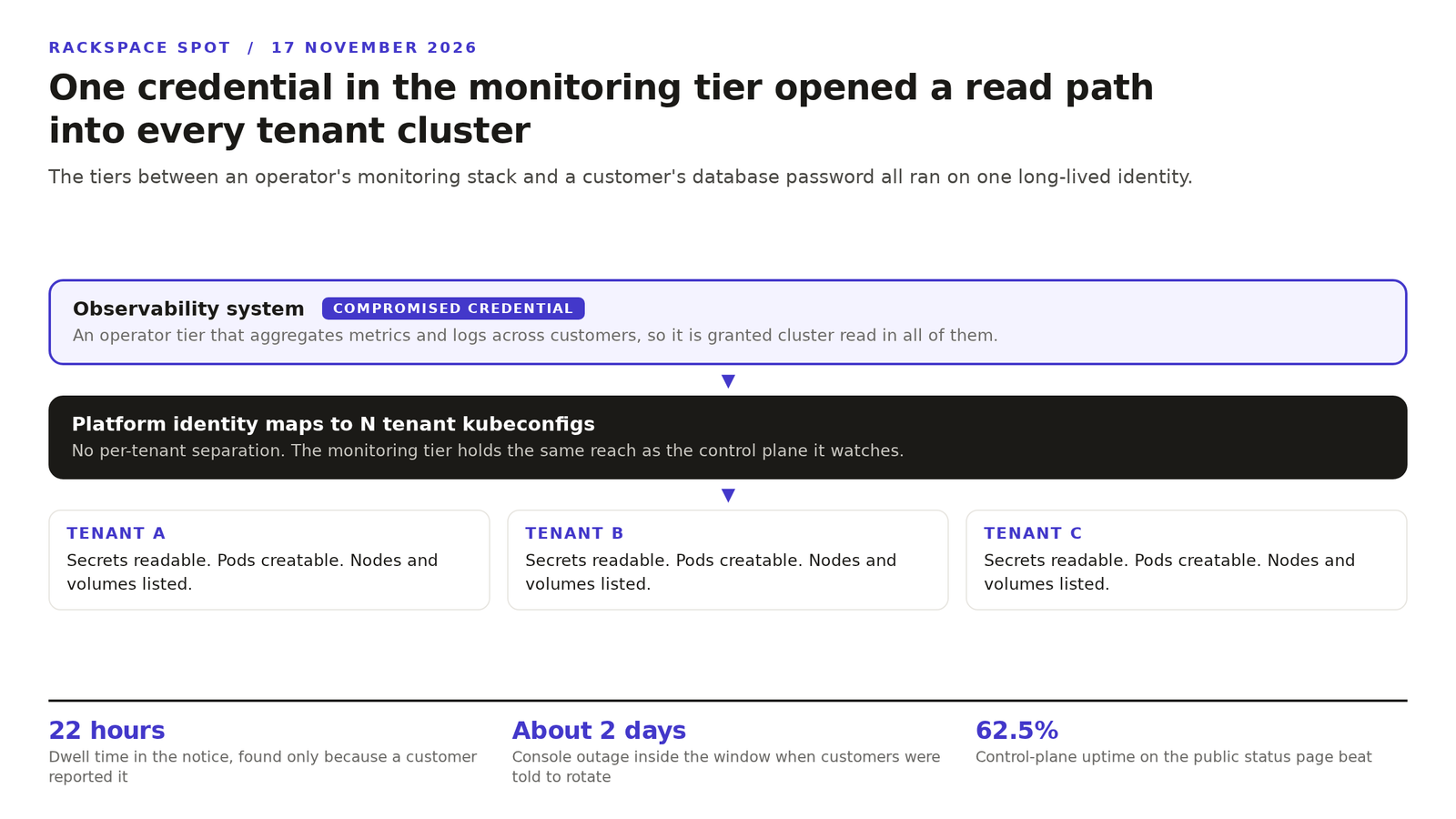
Rackspace told customers that an intruder spent roughly 22 hours inside Rackspace Spot on 17 November, creating pods and reading Kubernetes Secrets in some customer clusters. The cause, stated by the platform’s co-creator on the project’s own GitHub, was a compromised credential in an observability system. The tier built to watch the estate held read access to every tenant, so one leak at the least glamorous layer produced the widest access available.
The response then collided with the timing. Rackspace shut access down to sanitize the environment, which kept the console offline for about two days while customers were being told to rotate every credential in their Secrets. The public status page called the period recent system maintenance operations and has not named a breach since. The verdict is that managed Kubernetes tenancy is only as strong as the weakest identity that spans it, and no customer can audit that identity from outside.
Rackspace Spot sells Kubernetes capacity at auction prices. For teams that need cheap clusters quickly, that is the appeal. On 17 November it was also a route into customer production clusters, and the route started in the monitoring stack.
An unauthorized party used leaked credentials to reach parts of the platform for roughly 22 hours and acted as a legitimate user inside some customer organizations. That bought three things. Creating pods. Reading Secrets. Listing nodes and volumes.
BleepingComputer’s Lawrence Abrams obtained the notification and published it on 21 November. Rackspace has not said how many customers were affected or whether data left the environment.
The tier nobody audits held the widest access
To watch a fleet of customer clusters, an observability system needs read access to all of them. That means an agent, a kubeconfig or a service account with broad get and list permissions, held once and used everywhere. The system that draws dashboards and the system that can reach every password in every tenant share an identity.
Sirish Raghuram, of Platform9, co-developed Spot and named the cause in the project’s GitHub discussion. “An observability system was breached using a compromised credential,” he wrote. “This was obviously a critical error on our part and we are very sorry we let this happen.”
Not a Kubernetes exploit, not a container escape, not a zero day. A credential for a monitoring tool that was never meant to be the security boundary, holding privileges that made it one. External surfaces get scanners. The metrics pipeline gets a service account.
The severity comes from what a Secret is. Kubernetes Secrets are base64 encoded, which is encoding and not encryption, and RBAC grants are per namespace rather than per key. Anyone who reads Secrets in a namespace reads all of them.
The rotation advice arrived while the rotation tool was offline
Rackspace took the environment down to sanitize it. “Because of the nature of the incident, we are having to make several intrusive changes to the underlying infrastructure clusters, which is causing this extended outage window,” Raghuram wrote.
The decision was right and the sequencing was impossible. Customers were told to reissue tokens, replace refresh tokens, download fresh kubeconfigs and rotate every credential in cluster Secrets. The console that issues those tokens was offline for roughly two days.
The public status page did not close the gap. Its notice, still live, reads “Following recent system maintenance operations, we’re prioritizing Spot capacity for existing customers.” No breach, no advisory. A customer checking service health on 19 November would have read maintenance and gone back to work.
Rotation is where the recovery lives
Revoking tokens, removing pods and rotating platform keys closes the operator’s side. It does nothing about the copies. A stolen credential works wherever it is accepted, which is why Rackspace’s list of log sources to check is longer than its list of things it could fix.
The short list if you were affected. Look for pods or objects named i1, glm- or probe, and for traffic to 23.224.79.106 or the 23.224.0.0/15 range. Then treat every Secret in an affected cluster as public and rotate in dependency order, starting with whatever a registry or cloud key opens.
The structural fix belongs to the platform, and it produces the question worth asking any managed Kubernetes service. Can a tenant see who read its Secrets, and when? Most cannot answer, because the operator’s own read path is treated as internal plumbing rather than a privilege the tenant granted.
Cheap capacity at auction prices is a real product. The tenancy boundary is what you are buying, and it lives in the identity that spans clusters, not in the network policy inside them.
Three things to ask this week. Who can read Secrets across more than one namespace, and is that list shorter than the list of people who requested access? If a monitoring tool were compromised tonight, how many clusters would one credential open, and could you say which were read? And can you rotate a production namespace inside a working day, or is the honest answer a project plan?
Related reading. NVIDIA gave every tenant admin in its new Kubernetes control plane, and GPUStack’s patch closed the door while the attacker’s keys stayed valid.
Get the next one before it is old news
Independent analysis of cloud-native infrastructure, Kubernetes and data center economics. No vendor spin.
[…] credential hunting all start with a valid account or a reachable service, not a jailbreak. The Rackspace breach this month showed the same weakness in a monitoring credential. Detection windows are now shorter […]