


Executive Summary
The FBI is investigating an apparent intrusion into the National Crime Information Center, the database that connects federal, state and local police to warrants, criminal histories and background checks. CNN reported it on 20 November, and NBC News, the Associated Press and Fox News confirmed the investigation through their own sources. The bureau has not said how the attacker got in or what was taken.
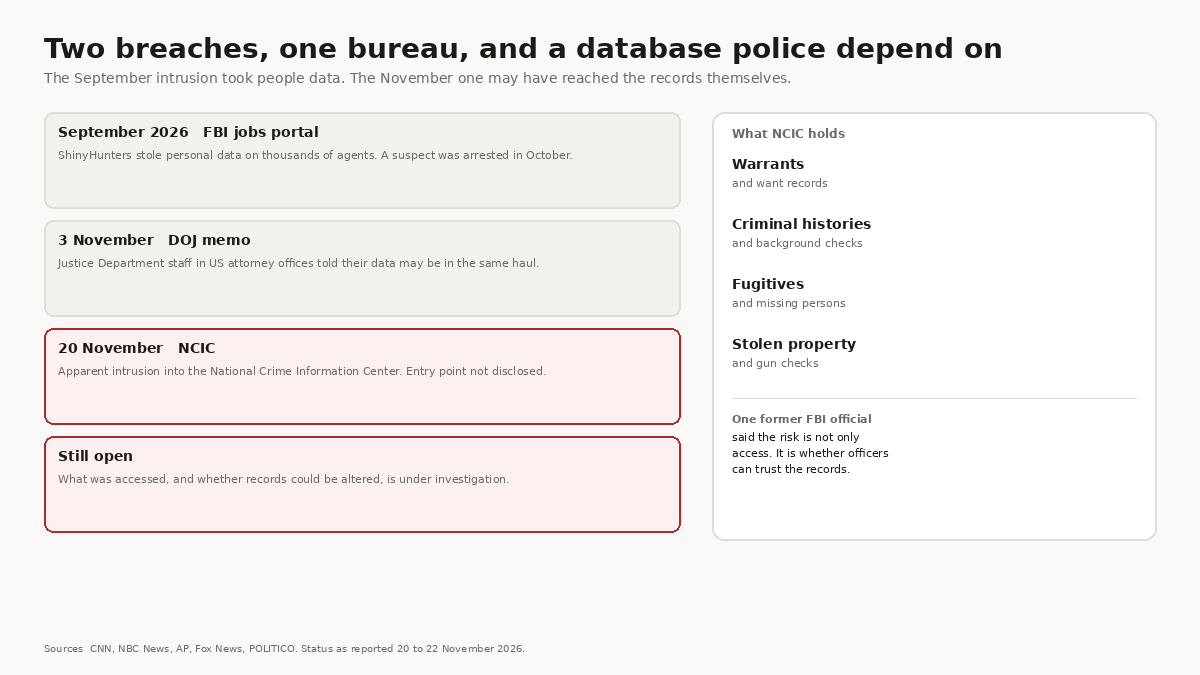
It is the second breach in three months. In September the ShinyHunters group hit an FBI jobs portal and took personal data on thousands of agents, and a Justice Department memo later warned that prosecutors and US attorney staff may be in the same haul. The NCIC case is different in kind. The concern is who can read the records, and whether anyone can change them.
NCIC is not a warehouse of case files. It is the query layer officers hit in the car at 2am, when they run a plate, check a warrant or ask whether a suspect is allowed to buy a gun. It holds records on wanted persons, missing persons, criminal histories, stolen vehicles and property, protective orders and the sex offender registry. It is, by common consent among people who have used it, one of the few systems where a wrong answer changes what happens on the street within minutes.
What is known, and what the bureau has not said
Two people briefed on the investigation told CNN that the bureau learned of the intrusion in the days before 20 November and is investigating. AP confirmed the same through a person familiar with the matter. The FBI declined to comment. Nobody has said whether the attacker reached the records, the query infrastructure, or an account with access to both, and nobody has named a suspect.
What is known is the shape of the target. NCIC sits behind a network that thousands of local agencies connect to, which means the authentication surface is enormous and much of it is run by organisations with small security teams. Attackers do not need to break the FBI to reach a police department’s credentials. The bureau’s own systems are hardened. The endpoints that query them are not always.
Why integrity matters more than confidentiality here
A former FBI official who led cyber investigations told CNN that the worry is not simply access to sensitive data, though that is serious. It is whether an attacker could compromise the accuracy of the information officers rely on. That distinction is the whole story and it is usually lost in breach coverage.
If a warrant record is read, the harm is to privacy and to the safety of the people named in it. If a warrant record is altered or deleted, the harm is operational. An officer who checks a name and gets a clean result when there is an active warrant has been given a false answer by the state. In a country where millions of queries run every day, a small number of manipulated records is a large number of wrong decisions. It is also the kind of access that is worth more to a criminal group than a database dump, because it can be sold as a service rather than data.
That is why the unanswered questions matter more than the confirmed ones. The bureau has not said whether the intrusion was read only, and it has not said when it started. A compromise measured in days is an incident. One measured in months is a integrity problem for every record touched in between.
The pattern, the politics, and what to watch
The September breach was a different attack with a different lesson. ShinyHunters hit a jobs portal and took personal information on agents and applicants. A Canadian cybersecurity researcher was arrested in October in connection with it. The Justice Department then warned that staff in US attorney offices may also have had data taken, because the same portal held background check material. Two breaches in one quarter, at the same agency, through two different doors, is a pattern rather than bad luck.
The political response has been uneven. FBI Director Kash Patel went on Fox News the day after officials learned of the NCIC intrusion to promote Operation Winter Shield, an operation completed months earlier. President Trump, asked about the breach, said it was not good and then linked it to his grievances about the Russia investigation. Neither response addresses the operational question. The National Cyber Director was replaced the same week, in the middle of a run of outages at banks, the FAA and the NSA.
The useful questions for the next thirty days are concrete. Did the attacker have write access, and can the bureau prove the negative. When did the first unauthorised query run. Which agency credentials were used, and were they phished, bought or reused. And does NCIC keep an audit trail good enough to reconstruct every record that changed. The Optimizely supply chain case showed how far a single trusted component can reach. This one asks whether the trust runs the other way, from thousands of endpoints into a system the whole country queries.
Sources, CNN, NBC News, BleepingComputer and Fox News.
Get the next one before it is old news
Independent analysis of cloud-native infrastructure, Kubernetes and data center economics. No vendor spin.