


Executive Summary
Meta’s Cloud Foundation team runs about 100 Kubernetes clusters across multiple cloud providers and accelerator families on a staff of just over 15 engineers. Terraform used to carry infrastructure provisioning and Kubernetes application deployment in the same path, so a routine application update inherited the lead time of an infrastructure release. One stalled rollout could hold unrelated releases, and nothing verified that a deploy had actually worked. Routine deploys took more than four hours.
The rebuild split the two jobs. Terraform keeps infrastructure. Argo CD reconciles application state against configuration held in Git, and Kargo promotes releases between environments with automated health checks and versioned release records. The same routine deploy now takes minutes. Meta describes the result as a foundation and plans a centrally managed Argo CD service next. The transferable lesson is that at fleet scale the binding constraint on AI infrastructure is often release throughput rather than silicon, and release throughput is a design decision you can make this quarter.
Four hours to change one application across roughly 100 Kubernetes clusters. That is the number worth sitting with, not the cluster count. Meta’s Cloud Foundation team published the rebuild through CNCF, which picked it as its end user case study, and the mechanism behind the four hours is the part most platform teams will recognise.
Terraform was doing two jobs. It provisioned infrastructure and it deployed Kubernetes applications, which meant an ordinary application change queued behind the infrastructure release process. The two workloads have completely different risk profiles and completely different frequencies. Coupling them is what turned a routine deploy into an afternoon.
Terraform was doing two jobs, and only one of them was its own
The failure modes that came with the coupling are specific. Because releases shared one path, a stalled rollout could delay unrelated application teams. Because deployment ran through Terraform, there was no automated health check at the end to confirm the application came up. And because everything lived in the infrastructure pipeline, nobody could promote a change to one environment without touching the machinery the other environments depended on.
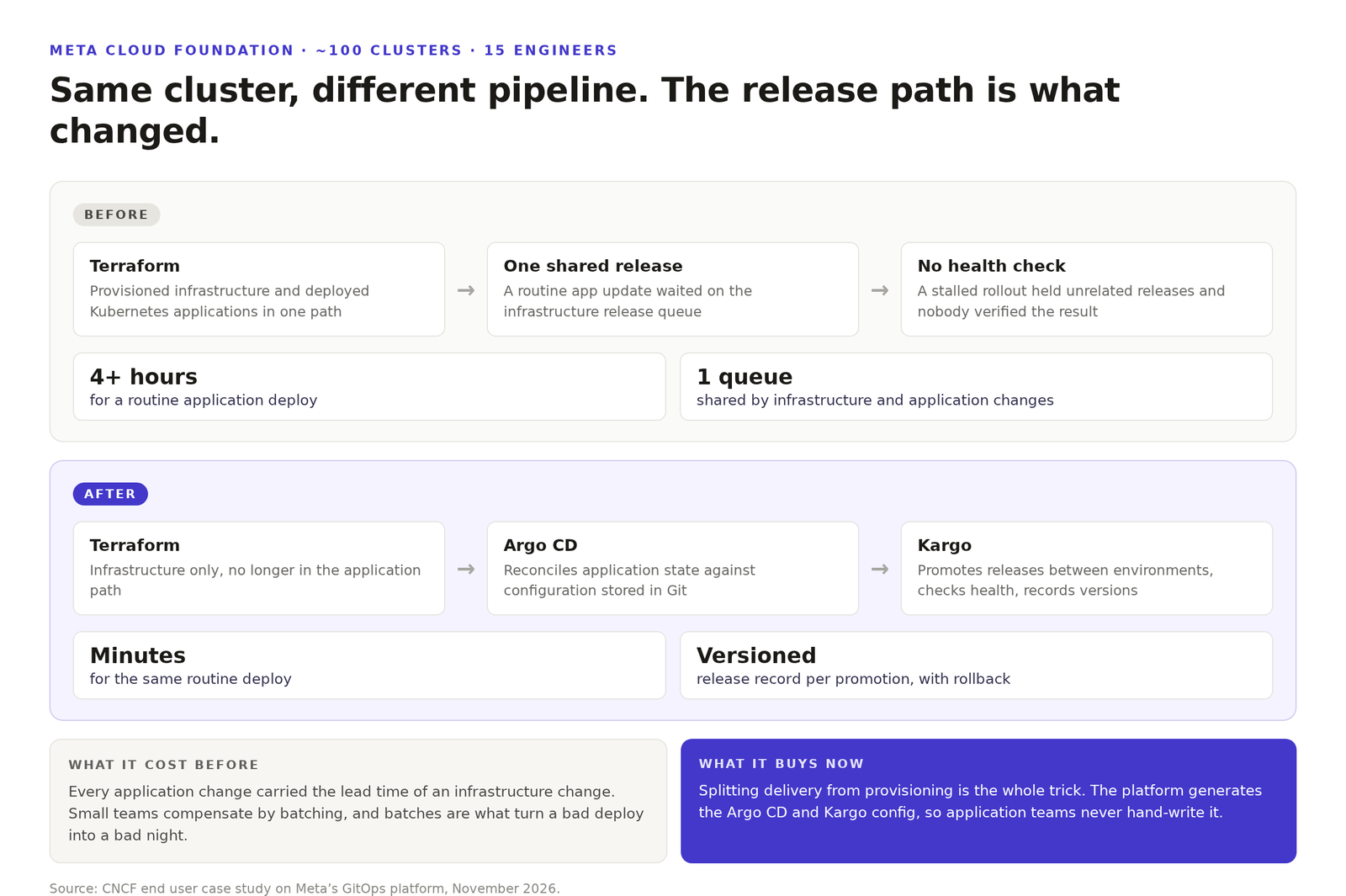
The fix is almost embarrassingly old. Argo CD reconciles a cluster against a desired state stored in Git, which is the definition of Kubernetes GitOps and has been available for years. What changed at Meta is the boundary. Terraform stopped being in the application path, and the application path got its own tool with its own release cadence.
Kargo is the part most teams leave out
Argo CD answers how a cluster converges on a desired state. It does not answer how a version moves from staging to production, who approved it, or what to roll back to. That is Kargo, which orchestrates promotion across environments and produces a versioned release record per promotion. Meta credits it with independent release promotion, automated health verification, and the traceability that makes recovery a lookup rather than an investigation.
Plenty of teams stop at Argo CD and then rebuild promotion by hand with pipeline scripts and a spreadsheet of image tags. The cost shows up months later, on the night a bad build reaches production and nobody can say with confidence which commit is running in which cluster. If your GitOps rollout stalled somewhere between sync and promotion, that gap is usually why.
Fifteen engineers cannot hand-write a hundred cluster configs
The part that makes this work at Meta is a small application definition. Developers state their deployment requirements in a short spec, and the platform generates the Argo CD and Kargo configuration from it. Application teams never hold a config file. That is the difference between a platform team of 15 serving 100 clusters and a platform team of 15 becoming the bottleneck for every release in the company.
Meta also names what is still open. It plans to move to a centrally managed Argo CD service to cut maintenance across the fleet, and it is working upstream on container registry authentication and on Argo CD behaviour in large clusters. Both are signs the fleet is bigger than the model was tested against, which is the ordinary condition of AI infrastructure teams right now.
The honest read is that none of this is novel tooling. Argo CD and Kargo are open source and well documented. What Meta did was refuse to let one pipeline carry two jobs with different clocks. Any team that has watched a routine application fix wait behind a network change has the same problem, and does not need 100 clusters to have it.
Three questions for your own environment
How long does a routine application change take in your clusters today, measured end to end? If Terraform is in that path, what would break if it left? And when a deploy finishes, what checks the result automatically rather than because someone looked?
Related reading. We covered Meta turning a web data center into a gigawatt AI supercluster, NVIDIA putting 268 GPU cluster settings under version control, and what 7.4 billion commits a month does to Git. The case study is at the CNCF announcement page.
Get the next one before it is old news
Independent analysis of cloud-native infrastructure, Kubernetes and data center economics. No vendor spin.