


Executive Summary
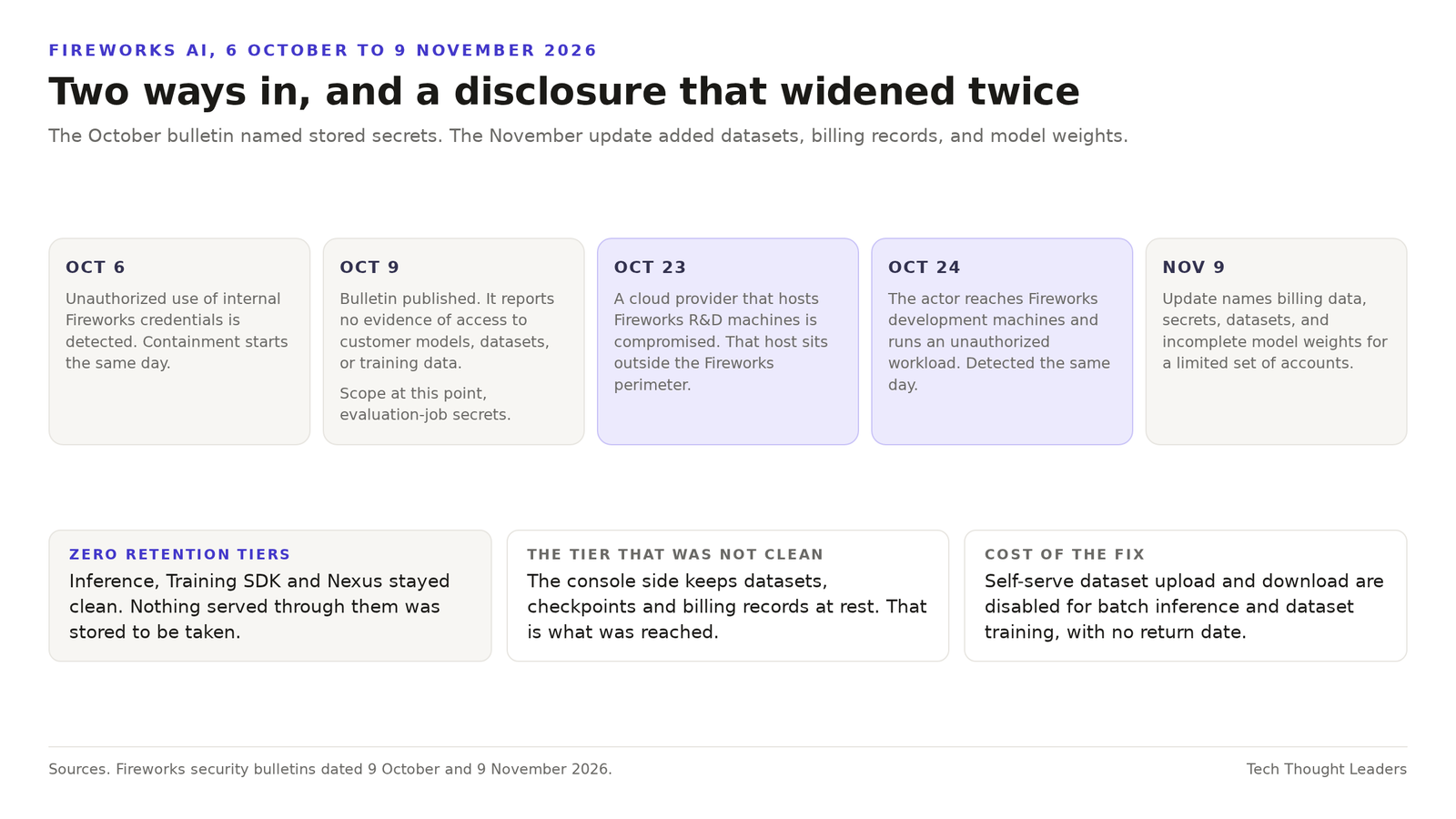
The finding is not that a platform was breached. It is that the assurance operators leaned on covered a different tier from the one that got raided. Fireworks runs inference, its Training SDK and Nexus with zero data retention, so nothing served through them is stored to be taken. The console side keeps what customers upload. That is where the November update found datasets, incomplete model weights and billing records. Zero retention was accurate, and it was never a promise about the artifacts a team stores on purpose.
Two details make this worse than one bad month. The second way in was a cloud provider hosting Fireworks research machines, outside the perimeter the first bulletin described, and the actor used it on 24 October to run an unauthorized workload that reached customer data. Then the remedy costs a feature. Self-serve dataset upload and download are switched off for batch inference and dataset training, with no date for their return. The verdict is that the disclosure worth reading is never the one that lists secrets. It is the one that lists the artifacts your team put there.
On 9 October Fireworks published a security bulletin with a clean line in it. The company had found no evidence that anyone reached customer models, datasets, or training data. On 9 November the same page reads differently. Billing and account records were affected, and for a limited set of accounts a subset of incomplete model weights and datasets was reached, along with secrets.
Most Fireworks AI breach coverage will file this under credential theft. The useful part is what sat behind the credential. The October incident began with internal credentials used in evaluation jobs. The November update attributes the activity to a financially motivated group that sells access to large models through illicit routing gateways, the pattern Google Threat Intelligence Group and Mandiant call LLMJacking.
Zero retention covers the request, not the artifact you stored
Zero data retention is a promise about a path, not a product. At Fireworks it covers Inference, the Training SDK, and Nexus. Send a prompt through those and nothing is held at rest that could be taken. The console is a different path. It holds the datasets you upload, the checkpoints that come out of jobs you run, and the billing record attached to the account.
Operators read ZDR as a wall around their model. It is a wall around their traffic. What got taken is what they deliberately parked there. A partial checkpoint has limited use alone. A dataset does not, because training data is the one artifact a competitor would most want.
The question to put to any platform you buy is narrow. Which tier stores my data, how long does it keep it, and who can read it. When the answer describes one tier, you have been told about one tier.
The second way in came through the hosting layer
The October intrusion ran through Fireworks credentials. The second one ran through somebody else’s estate. A third-party cloud provider that hosted Fireworks research and development machines had its own incident on 23 October. On 24 October, per the bulletin, the actor used that foothold to reach Fireworks development machines and run an unauthorized workload, which reached more customer data.
Fireworks detected the activity the same day and says it closed the path by 25 October. That response is quick. The structure behind it is slower to fix. Development machines sit beside production data in a great many organizations, and a hosting provider’s bad week is not covered by your vendor’s perimeter statement.
This is the supply chain problem in a new place. You can pass your own review and still be breached through a supplier that passed its own in another month.
Revoking a credential does not recall a checkpoint
The mitigation list is competent. Credentials revoked and replaced, elevated privileges removed, network paths closed, logging tightened, and Palo Alto Networks Unit 42 retained for forensics. None of that retrieves a file that was already copied out.
The cost that reaches customers is a product decision. Self-serve dataset uploads and downloads are disabled for batch inference and dataset-based training while the investigation continues, and nobody has published a date for their return. If a pipeline of yours used that path, it broke this week, and the repair is not on your side of the API.
Fireworks says it has not detected impact to inference traffic, prompts or outputs, and its findings rest on the investigation to date. That qualifier is doing real work. The October bulletin used similar language about models and datasets, and a month later it was wrong about both. Assume any scope statement describes a snapshot, and plan for the snapshot to move.
Three questions for your next renewal. Which of my artifacts live on the console tier rather than the zero retention path. Who hosts the machines the vendor’s engineers build on, and what statement exists about their controls. If a self-serve feature disappears tomorrow, which of my pipelines stops.
Related reading. Our account of the October cluster of nine platform breaches explains why stored secrets were the target that month. The LLMJacking economics piece covers what a stolen endpoint is worth, and our breakdown of Fireworks’ own cost model covers the part of the platform that was not touched.
Get the next one before it is old news
Independent analysis of cloud-native infrastructure, Kubernetes and data center economics. No vendor spin.