


Executive Summary
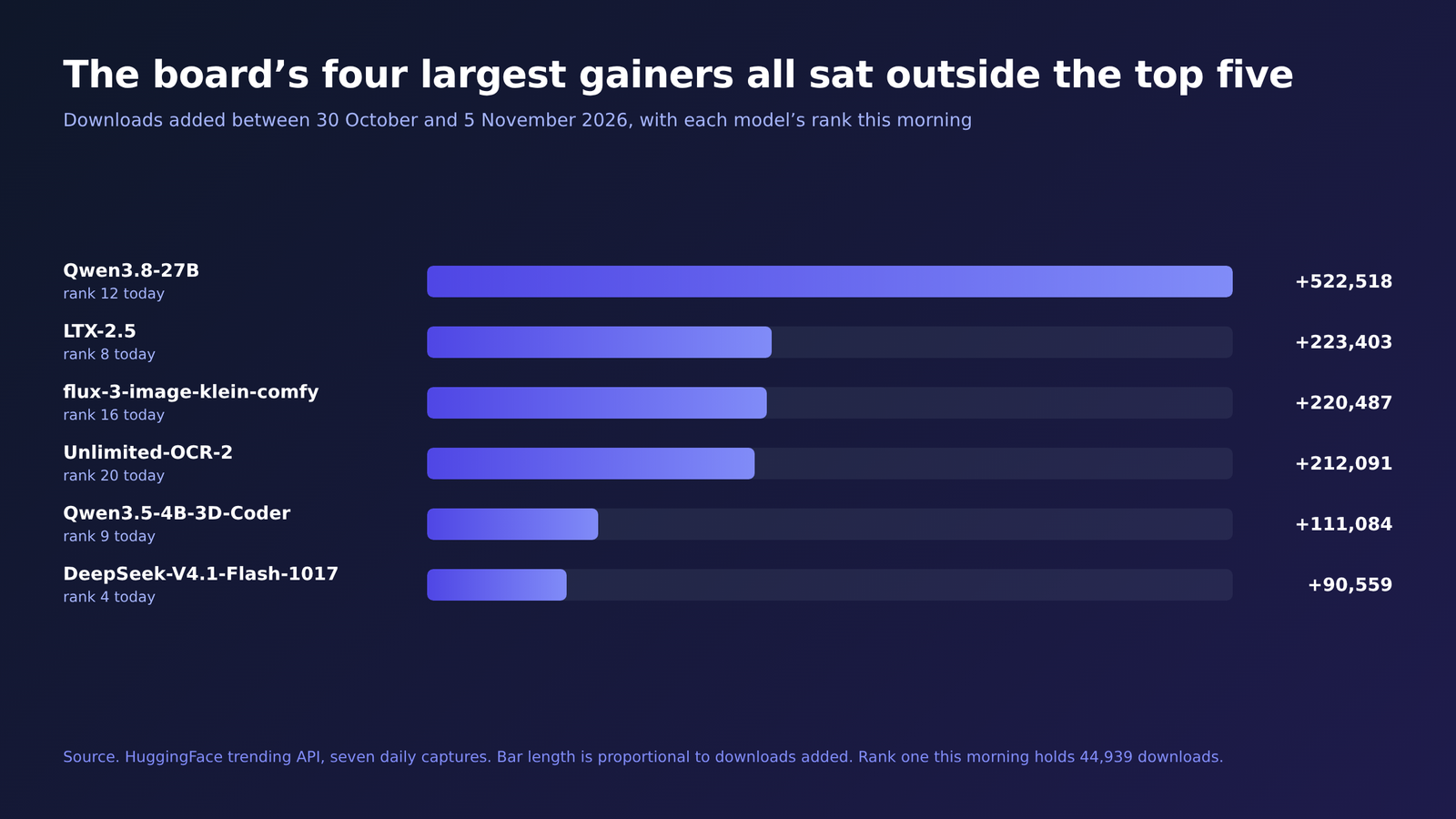
Seven daily captures of the HuggingFace trending board describe a ranking that measures rate of change and a download counter that measures installed base, and this week the two disagreed almost everywhere. Four different models held the top slot. The largest absolute download gainer moved two places, to rank twelve. The four models that added the most downloads all finished outside the top five.
Two patterns sit under that noise. Only two of the twelve models present in every capture rose on the score at every one, and both are sparse designs, a Nemotron speech checkpoint and a Mistral repository whose name advertises 1 trillion total parameters against 52 billion active. Sparse is the only shape that held a rising line on a board built on novelty. And the falling leaders did not lose users. Nanbeige4.3-33B went from rank one to rank 23 while downloads rose 93 percent, and flux-3-image-klein-comfy lost 28 percent of its score while adding 220,487 downloads.
The number one slot on the HuggingFace trending board this morning belongs to a speech recognition model with 44,939 downloads. The model sitting at rank twelve carries 8,032,442.
That is not a malfunction. The score is a velocity measure. It weighs recent downloads, likes and repository activity inside a short window, so a small model that triples outranks a large one holding steady. Rank orders the rate of change. The download counter orders the installed base. This week those two numbers pointed in opposite directions almost everywhere. Rank one this morning holds 0.56 percent of the downloads of the model at rank twelve, and no model in seven captures held the lead for longer than two days.
Rank one changed hands four times and no winner kept it
DeepSeek-V4.1-Flash-1017 opened the week on 872 and led on 30 and 31 October. Nanbeige4.3-33B took it on 1 November. DeepSeek took it back the next day. LiquidAI/LFM3-1.7B held it on 3 and 4 November. This morning NVIDIA-Nemotron-3.5-Transcribe-30B-A4B sits on top at 809.
Read the trailing record instead of the podium. Nanbeige4.3-33B is rank 23 today with 18,657 downloads, up 93 percent from the 9,655 it had when it held the top slot. LFM3-1.7B is rank 6. DeepSeek-V4.1-Flash-1017 is rank 4, and its score has fallen on every capture since 30 October, 872 down to 599. That is one of two unbroken declines on the board. The other is black-forest-labs/flux-3-image-klein-comfy, 352 down to 253, while it added 220,487 downloads.
Only two of the twelve models present in all seven captures rose at every one, and both publish far fewer active parameters than total ones. The Nemotron transcribe checkpoint went 406 to 809 and multiplied its downloads 10.5 times, from 4,276 to 44,939. mistralai/Mistral-Large-4-1T-A52B went 316 to 555 while holding 8,200 downloads at rank five. Two names built to keep most of their weights idle, and the only two that never lost ground.
The biggest download gainer never got near the top
Qwen3.8-27B added 522,518 downloads between 30 October and this morning, the largest absolute gain on the board. Its score fell 6.3 percent over the same stretch and it moved two places, rank 14 to rank 12. It has led nothing.
Three more of the six largest gainers lost ground. flux-3-image-klein-comfy added 220,487 and dropped six places. Unlimited-OCR-2 added 212,091, nearly thirteen times its starting count, and fell from rank 9 to rank 20. LTX-2.5 added 223,403 and held rank 8 without entering the top five once.
One model moved both numbers together. ccore/Qwen3.5-4B-3D-Coder climbed rank 16 to rank 9 while downloads ran from 12,237 to 123,321, a 908 percent gain against a 34 percent score rise. That is what a breakout looks like when it is real. The other five are attention moving one way and installation moving the other.
A rising score on a small base is not a capacity signal
A platform team reads this board with a different question than the board answers. The board answers what people are trying today. The team needs what it will be serving in six weeks. Pika-H3-Flex sits at rank 7 with 749 downloads. Qwen3.8-27B sits at rank 12 with 8,032,442. Both are true numbers from the same morning, and only one of them shows up on a GPU bill.
So track the slope of the download counter on the checkpoints you already support, and treat the ranking as a feed for the evaluation queue. A model that breaks into the top ten has earned an eval slot. Only a model whose download slope beats its own baseline has earned capacity.
Three questions for your own platform. Which of your supported checkpoints gained the most downloads this week, and did you notice before the board did? When the top slot changes four times in seven days, what in your stack would actually break? And if a 1.7B model and a 30B checkpoint can both take the lead inside eight days, is your hardware plan sized for parameters or for concurrent requests?
Related reading. We covered the week video and 3D models took three of the top seven slots, and the day a 1.7B model took the lead from a 33B one.
Get the next one before it is old news
Independent analysis of cloud-native infrastructure, Kubernetes and data center economics. No vendor spin.
[…] capture of this board asked why rank orders momentum rather than installed base, and the answer is a velocity score. The hardware floor for open weights is set by memory, not download count, which Kimi K3.1 Pro made […]
[…] earlier reading of how the board weights momentum over load covers the measurement itself. The ten day view adds […]