

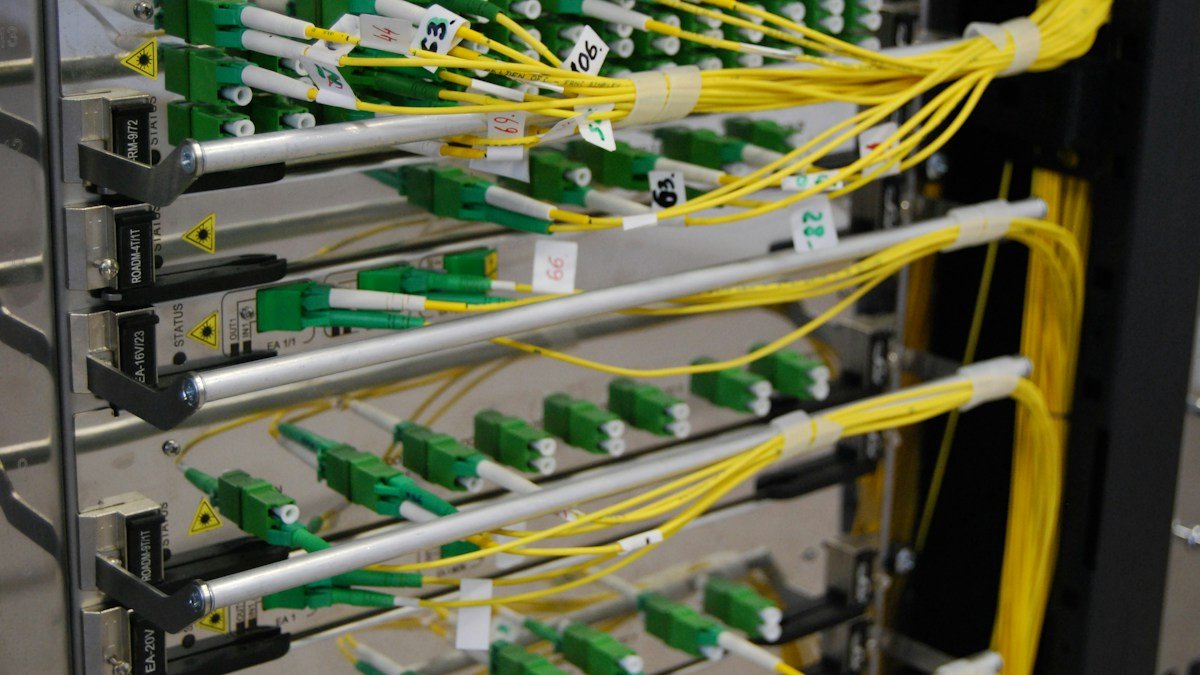
Marvell is paying $115 billion in stock for Lumentum. The reason is a length of cable. Copper carries GPU traffic inside one rack and stops paying off past it, so every accelerator outside that boundary buys a transceiver.
- All-stock deal. Lumentum holders receive 4.500 Marvell shares per share, a 23.9 percent premium to the 28 October close, and 33 percent of the combined company.
- Lumentum brings lasers, transceivers, optical circuit switching and compound semiconductor manufacturing. Marvell brings the electrical side, the switching and custom silicon.
- The pair claims a $550 billion addressable market and more than $1 billion in annual run-rate cost savings.
- Optical circuit switching is the part that changes operations. A fabric you can repatch makes cluster shape a runtime decision, and placement and gang scheduling assume a fixed shape today.
- Marvell revenue went from $3 billion in fiscal 2021 to $8.2 billion in fiscal 2026.
- Both stocks fell between the first reports and the signature, Lumentum about 8 percent and Marvell about 22.
Ask suppliers for ports per rack, not accelerators per rack. Read the full analysis.
Get the next one before it is old news
Independent analysis of cloud-native infrastructure, Kubernetes and data center economics. No vendor spin.