


Executive Summary
Marvell and Lumentum signed a definitive all-stock agreement on 2 November that values Lumentum at $115 billion in enterprise value. Lumentum holders receive a fixed 4.500 Marvell shares per share, a 23.9 percent premium to the 28 October close, and 33 percent of the combined company for a business about half Marvell’s size. The pair claims a $550 billion combined addressable market and more than $1 billion in annual run-rate cost savings.
The finding worth underlining is where the constraint moved. Copper holds the scale-up domain inside one rack and loses its advantage past it, so every GPU outside that rack pays for a transceiver in watts and in failure points. Lumentum’s optical circuit switching is the piece that changes operations, because a fabric you can repatch makes cluster shape a runtime decision instead of a cabling artifact. Both stocks fell between the first reports and the signature, Lumentum about 8 percent and Marvell about 22, so buyers priced this as risk. The verdict is blunt. The 2027 allocation fight is optical ports, not GPU hours.
A GPU rack is a cheap neighborhood. Inside it, accelerators talk over copper traces and short cables, and that works because the distance is short. Move the same conversation a few meters and the signal has to turn into light. Electrical lanes lose too much of themselves over distance at the rates these clusters run.
Marvell just paid for the company that makes that conversion. It paid as if the conversion is now the thing that decides how big a cluster can get.
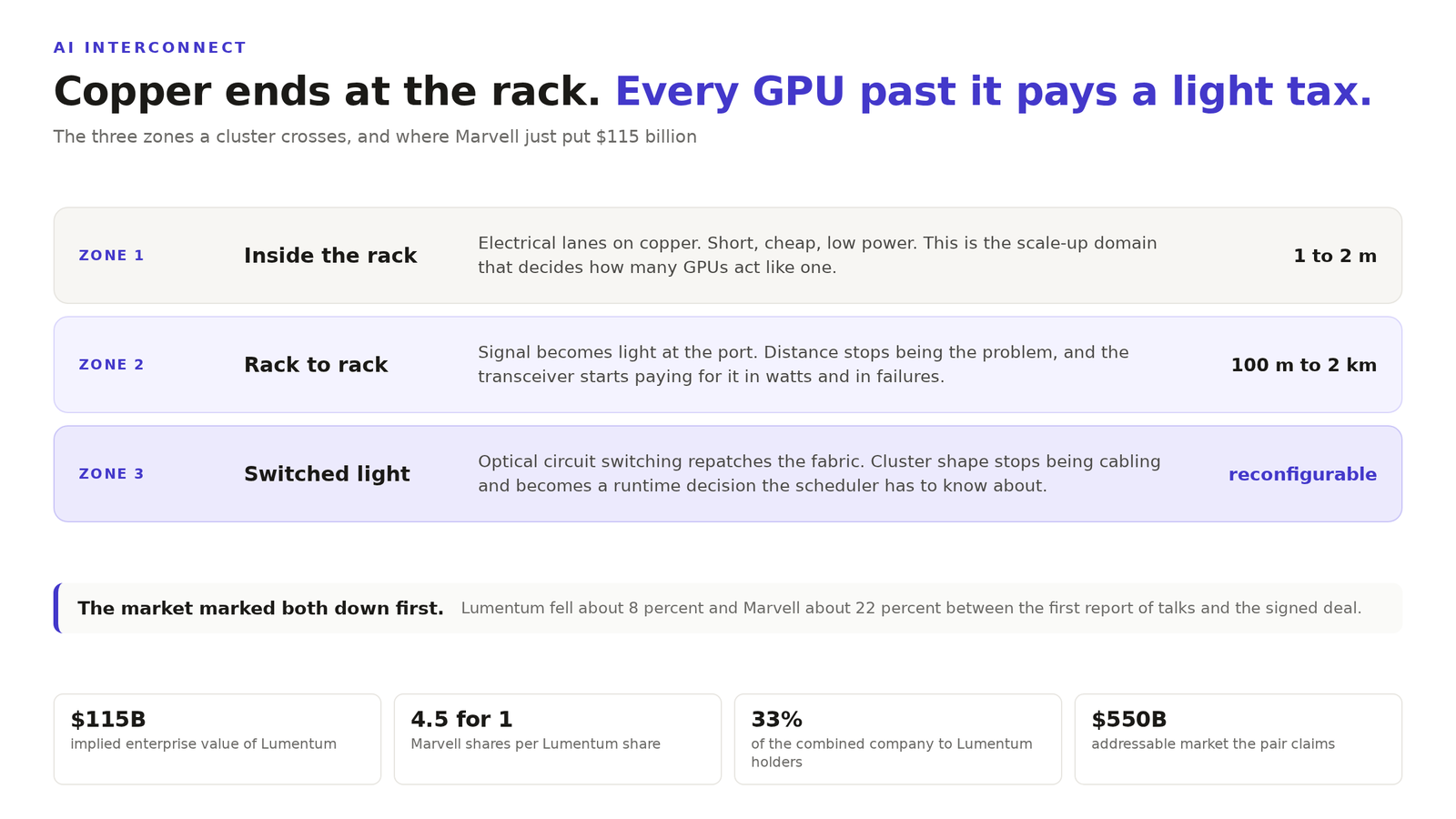
The cheap zone ends at the rack boundary
Every AI cluster crosses three zones and only the first one is cheap. Inside a rack, copper carries the scale-up traffic that lets a group of GPUs behave like one accelerator. Between racks, the signal converts to optics at the port. That conversion costs power at both ends, adds a component that can fail, and lands on a networking team that already owns too much of the incident pager.
Which is why AI optical interconnect is now the line that decides cluster size. With copper, size is a cabling decision. With optics, size is a power and parts decision, and you buy it by the port. Lumentum supplies the lasers, the transceivers and the compound semiconductor manufacturing behind those ports. Marvell brings the electrical side, the switching and the custom accelerator work.
A fabric you can repatch turns cluster shape into a scheduling problem
The part of Lumentum worth the most attention is not the transceiver business. It is optical circuit switching, which moves light paths around the fabric instead of routing every packet through a switch. Connections between groups of accelerators can be rearranged without touching a cable.
If that holds at cluster scale, topology stops being a permanent artifact. It becomes a decision that has an owner at runtime. Placement, gang scheduling and bin-packing all assume a fixed shape today. They would need to be told the shape.
We covered the supply half of this in October, when NVIDIA started prepaying for optics and substrates that ship in 2028. The working assumption then was that optics were a component shortage to wait out. This deal says they are the architecture.
The next allocation fight is lasers and ports
Marvell is not buying a components supplier out of weakness. Revenue went from $3 billion in fiscal 2021 to $8.2 billion in fiscal 2026. It closed a $3.5 billion purchase of Celestial AI in February, and it signed a custom silicon deal with Google worth up to $120 billion in sales through fiscal 2033, with Google holding the right to buy a $12.2 billion stake.
It is buying because the optical layer has its own supply chain, running through laser fabrication and compound semiconductors, and that chain is narrower than demand. Lumentum competes with Coherent and with China’s Zhongji Innolight. A proposed US ban on new Chinese optical transceivers would push demand toward exactly the domestic capacity Marvell is now inside.
Broadcom sells the same stack under one roof, fiber optics included, which is why Marvell frames this as a race rather than a purchase.
The consequence for anyone planning a 2027 or 2028 cluster is a procurement one. Ask about ports per rack, not accelerators per rack. Ask which optics sit under allocation, whether the fabric can change shape without a maintenance window, and who is allowed to change it.
Three questions worth applying to your own cluster. Can the fabric change shape while jobs are running, and would the scheduler notice if it did? What share of 2028 interconnect spend is optics, and is any of it contracted? When a transceiver fails at 3am, does the workload route around it, or does the job restart from the last checkpoint?
Related reading. NVIDIA Shipped Vera Rubin With 13 Percent Less Bandwidth Than It Advertised covers what actually moved inside the rack this year. NVIDIA Is Prepaying for Capacity That Ships in 2028 covers the optics and substrate queue this deal now sits inside.
Get the next one before it is old news
Independent analysis of cloud-native infrastructure, Kubernetes and data center economics. No vendor spin.