

Executive Summary
OpenRouter’s own usage table for 31 October puts four DeepSeek variants at 44.4 percent of all tokens routed through the platform. Claude Opus 5.5, at four dollars per million input tokens, holds 4.4 percent. DeepSeek V4.1 Flash costs about four and a half cents for the same million tokens, roughly one ninety-first of the price.
This is not a story about model quality. It is a story about what people are actually willing to pay for work they have already decided is routine. The frontier labs are selling capability that most requests never touch, and the bill for that capability is now visible to every buyer who looks at a usage dashboard. The pattern holds across the board. The models with the largest share are the cheapest ones with credible capability, and the most expensive models among the majors carry the least traffic. Nobody is running a benchmark and then choosing. They are reading a cost per request and clearing it, which puts a hard floor under what any vendor can charge for work a buyer thinks is routine.
There is a table on OpenRouter that most people in this industry have not looked at closely. It ranks models by tokens actually routed through the platform, using the same catalogue every buyer sees when they pick a model, not by benchmark, not by award, not by announcement. On 31 October it looked like this.
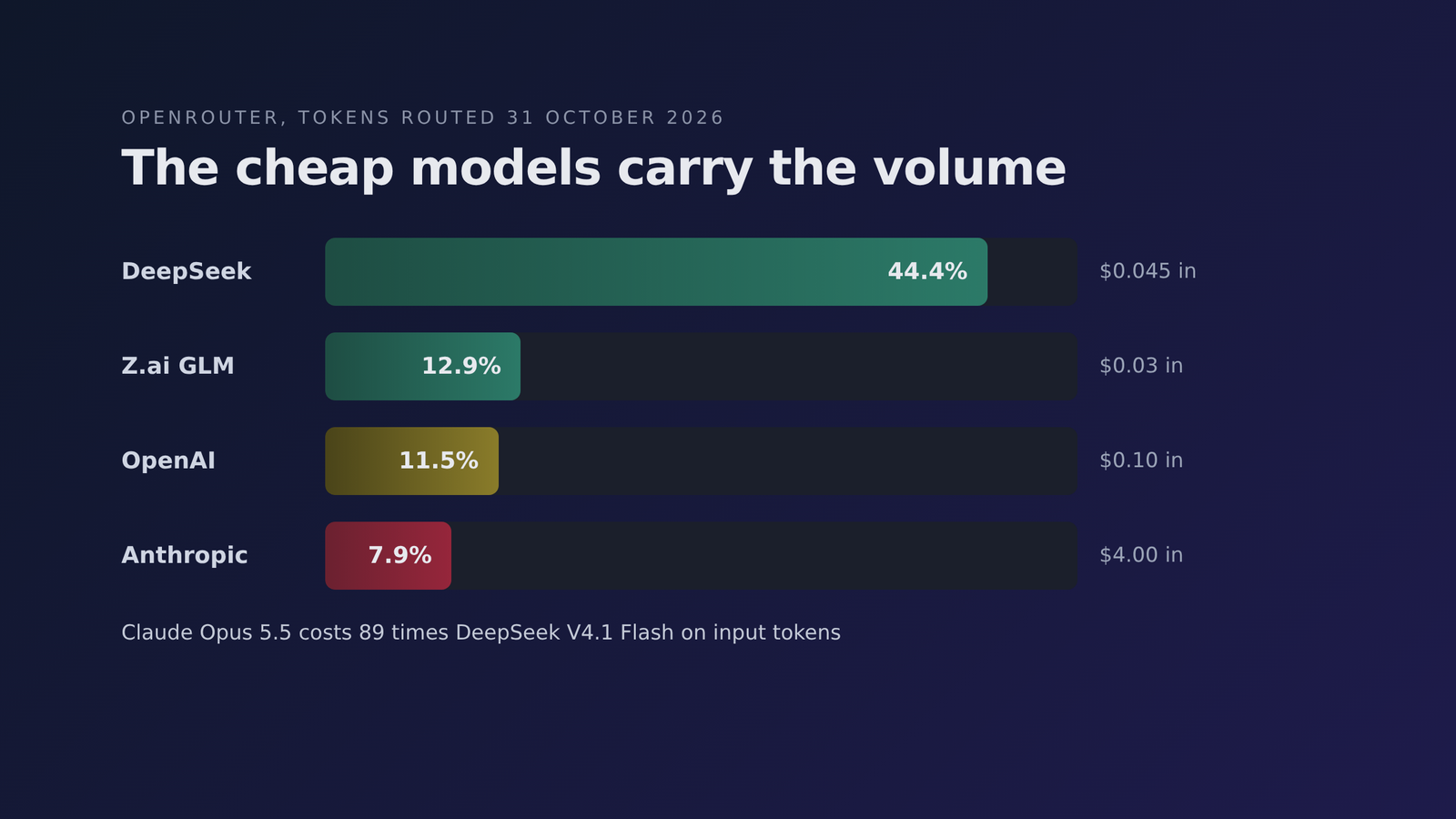
DeepSeek V4.1 Flash alone carries 30.7 percent. Add the older variants and the DeepSeek family holds 44.4 percent of everything moving through OpenRouter. Z.ai’s GLM-5.3 Flash takes another 12.9 percent. OpenAI as a family sits at 11.5 percent. Anthropic sits at 7.9 percent.
The price gap is not marginal, it is categorical
V4.1 Flash is listed at four and a half cents per million input tokens and fifty cents per million output. Claude Opus 5.5 is listed at four dollars and twenty dollars. That is eighty nine times the input price for the same volume of text.
GLM-5.3 Flash is cheaper again, at three cents in and nine cents out. It holds ten percent of traffic while being the least expensive model of any significance on the board.
Read those two facts together and the market behaviour stops looking mysterious. The models with the largest share are the cheapest ones with credible capability. The models with the smallest share among the majors are the most expensive. They are choosing on a dashboard that shows cost per request, and the cheap models clear it.
What this actually says about Claude and GPT
It does not say they are worse. It says the work most people send to an inference endpoint is not the work that needs them.
Look at where the volume sits. Agents looping through tool calls. Classification. Extraction. Summarising. Routing. Format conversion. Retry logic that fires the same prompt six times. None of that gets better with a frontier model, and all of it gets more expensive on one.
The labs know this. Anthropic’s product strategy has been moving toward the top of the ladder for a while, which is a rational choice if your margin lives in reasoning and agentic work. The risk is that the bottom of the ladder is where the token volume is, and someone else now owns it at a price you cannot match without writing down your own margin.
There is a second signal in the data. OpenAI’s families hold 11.5 percent, spread across cheaper models. GPT-6 Luna is listed at ten cents in and fifty cents out, and it is carrying real traffic. That is a lab actively defending the middle rather than conceding it. Anthropic’s cheapest meaningful presence, Claude Haiku 5.5, carries 1.8 percent.
The uncomfortable arithmetic for anyone building on the frontier tier
If your product’s economics assume a frontier model on every call, you now have a competitor whose cost base is one ninety first of yours for the same task, and whose customers appear not to care about the difference.
That pressure only bites where the task is routine. It does not bite on the hard cases, and the hard cases are where the differentiation lives. But most software is routine almost all of the time, and the routine share is the share that pays the infrastructure bill.
What I would expect next, and what the data already hints at, is routing. Send the easy calls to the cheap model and escalate the hard ones. You can see that logic already shipped as a product in NVIDIA’s agent runtime, which routes sensitive context to local models and only reaches for a frontier model when policy allows. The buyer decides which calls deserve the expensive model, and increasingly they decide with a rule rather than a default.
The frontier labs are not about to disappear. They are about to become the expensive tier of something that used to be a single purchase, and the market is already pricing them that way.
We track the model supply side in our weekly HuggingFace trending report.
Get the next one before it is old news
Independent analysis of cloud-native infrastructure, Kubernetes and data center economics. No vendor spin.
[…] We look at the demand side of the same shift in our analysis of which models buyers actually route traffic to. […]
[…] NVIDIA’s technical walkthrough describes the same model. OpenShell is available at the NVIDIA OpenShell repository and documented at NVIDIA’s OpenShell documentation. Our coverage of the model routing shift is here. […]