

Executive Summary
SK hynix posted 104.6 trillion won of quarterly revenue and 83.3 trillion won of operating profit, an 80 percent operating margin on the memory that sits beside every AI accelerator. The number that matters for planning is not the profit. It is the company’s forecast that the memory supply shortage runs through 2030, alongside disclosure that long term agreements now cover more than half of its 2027 and 2028 production capacity.
The verdict is that scarce AI capacity past 2027 is becoming a signature rather than a purchase order. Fourteen customers, most of them large cloud providers, hold agreements that typically run five years. An operator without one competes for the residual at a price the supplier can move inside a pre-agreed band. Budgets that assume memory costs decline on the usual curve will be wrong, and anyone sizing a 2028 cluster should price access to allocation before pricing silicon.
SK hynix earned 83.3 trillion won of operating profit on 104.6 trillion won of revenue in the three months to September. Revenue rose 32 percent and operating profit 38 percent from the prior quarter. Quarterly sales passed 100 trillion won for the first time in the company’s history.
An 80 percent operating margin on memory is not a one-quarter anomaly. It is a price signal with a calendar attached, and the calendar is the part an operator can act on.
Supply Cannot Catch Up, and the Company Says Why
SK hynix put the shortage horizon at 2030. The reasoning is specific. Leading edge process technology keeps getting harder to yield, and a new production facility takes years to build and qualify. Demand has also moved past the handful of companies that funded the early buildout, into general enterprises and national compute programs.
That gap does not close inside a planning cycle. The company is expanding, running its M15X fab at maximum capacity by year end to lift HBM4 output and shifting more production onto its 1c process. None of that moves the 2030 line.
HBM4 is expected to pass HBM3E in both shipment volume and revenue in the fourth quarter. That matters for anyone sizing accelerator nodes today. The HBM generation decides memory per accelerator, and memory per accelerator decides how much cache a serving node can hold. HBM capacity is what caps context length on a served model.
More Than Half of 2028 Is Already Under Contract
The disclosure worth sitting with is long term agreement coverage. SK hynix has signed agreements with 14 major customers, including leading cloud service providers, and the contracted volume exceeds half of total production capacity for 2027 and 2028. Terms typically run five years.
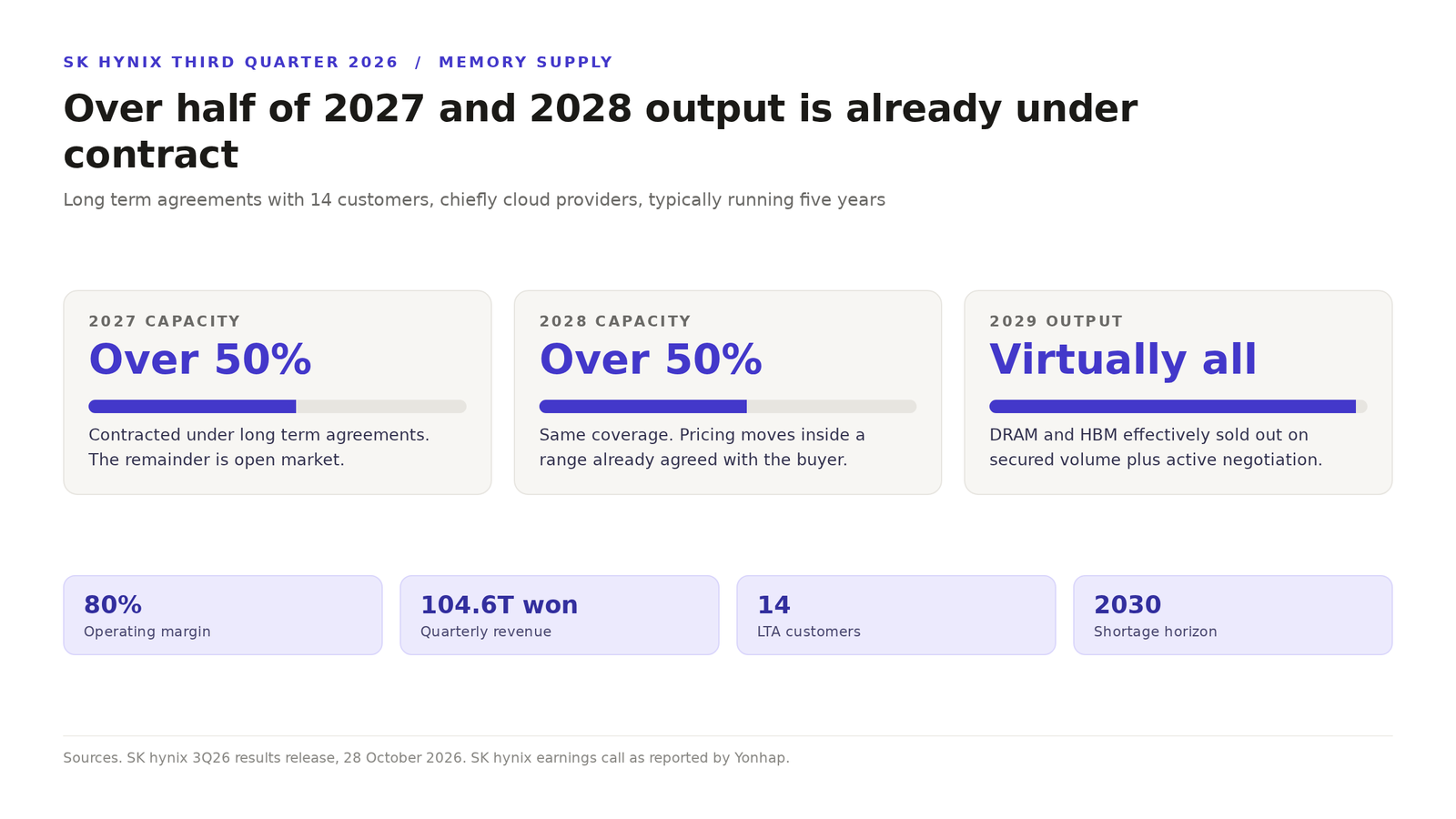
Those agreements carry a pricing mechanism that reflects market conditions inside a range agreed with the customer. Read that from the buyer’s side. It is a floor with some give, not a ceiling. SK hynix has secured volume and protected margin in both directions, and the customer has traded the chance of a price collapse for guaranteed delivery.
On the earnings call the company went further and said its DRAM and HBM capacity for the next three years, through 2029, is virtually all sold out on secured volume plus demand under active negotiation. Yonhap reported that line.
So an operator planning a 2028 cluster is not shopping in a market. It is asking a systems vendor or cloud provider to carve off part of an allocation that was committed years earlier. The conversation is about access, and the price reflects scarcity rather than cost.
What an Operator Does With a Sold-Out Calendar
First, buy the memory conversation before the accelerator conversation. A GPU order without a matched memory commitment is a purchase order with no delivery date. Ask each vendor where its DRAM and HBM allocation comes from, and how far forward it is contracted in writing.
Second, rebuild the cost per token model. Capital has been the named constraint for months. Memory is now a second, harder floor underneath it. If the memory line in a serving node is repricing upward inside a five year agreement, the cost curve flattens. Run it again with a flat memory component and watch payback.
Third, treat existing hardware as deployed capacity rather than legacy. NVIDIA has been prepaying suppliers for capacity that ships in 2028. When new supply is allocated years ahead, the gear in your racks is the only capacity you can switch on this quarter.
The company also said it will return roughly 100 trillion won to shareholders this fiscal year and dropped its review of a Solidigm IPO, funding expansion from cash instead. It ended the quarter with 98.7 trillion won of net cash. It can be patient about when it adds capacity. Its customers cannot.
The question for this week is not whether memory gets cheaper. It is who in your supply chain already holds the contract, and whether your 2028 plan depends on them choosing to share it.
Three questions for your own estate. Where does your DRAM and HBM allocation come from, and is it contracted or hoped for? If your main vendor cannot say in writing, what is your fallback for 2028? And if memory costs stay flat, which AI services stop paying for themselves?
Get the next one before it is old news
Independent analysis of cloud-native infrastructure, Kubernetes and data center economics. No vendor spin.
[…] The point for an operator is that a GPU order without a matching memory allocation is a purchase order with no delivery date. Ask the vendor where the allocation comes from and how far forward it is signed. Read the full analysis. […]