

Executive Summary
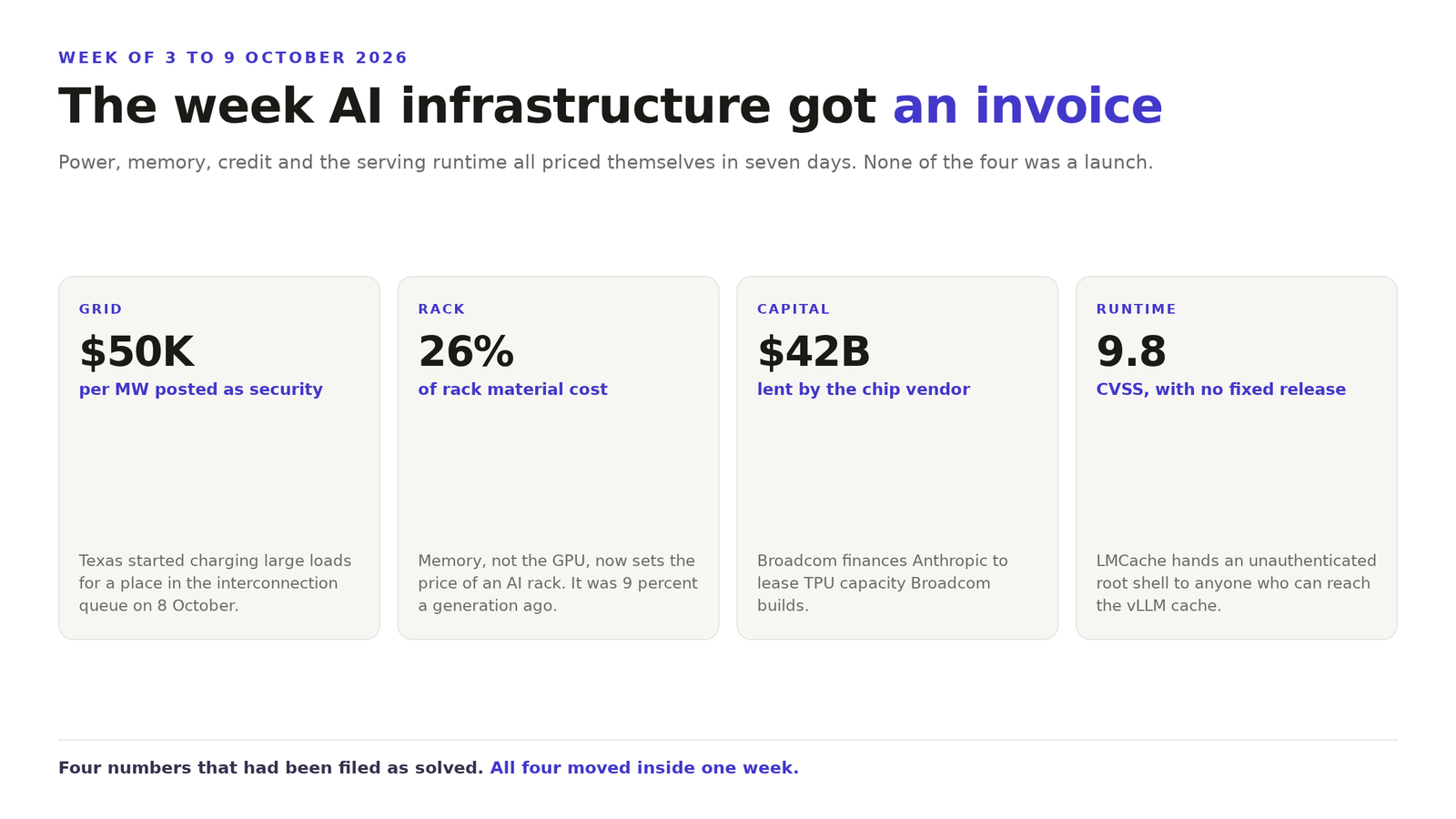
Four constraints tightened inside seven days, and every one had been filed as solved. Texas started charging large loads for a place in its interconnection queue on 8 October, when a site drawing 75 megawatts or more began owing a $100,000 study fee plus $50,000 of security for every megawatt it requests. Meta’s Hyperion campus in Richland Parish needs 4,500 megawatts, and that number reached the public only under questioning at a Louisiana Public Service Commission hearing on 7 October.
The cost basis of the rack moved in the same week. Memory now takes about 26 percent of an AI rack’s material cost, up from 9, and Intel raised processor prices for the third time in a year on 5 October. The capital came from the seller. Broadcom agreed to lend Anthropic up to $42 billion so the lab can lease TPU capacity Broadcom builds. The serving runtime was the soft spot. LMCache scored 9.8 for a flaw that hands an unauthenticated root shell to anyone who can reach a vLLM cache, and no fixed release exists.
AI infrastructure costs moved on four fronts this week, and none of them was a chip. Power, memory, credit and the serving runtime all repriced themselves in seven days.
The grid charged for the queue and then named the load
Texas closed the free option on 8 October. The Public Utility Commission of Texas adopted large-load standards in September under Project No. 58481, and they took effect this week. A single site at 75 megawatts or more now owes a $100,000 study fee and posts $50,000 per megawatt of requested peak demand before ERCOT begins its study. A one gigawatt campus puts up $50 million before anyone models the upgrades it needs.
That sorts serious projects from press releases quickly. A board approves $50 million of collateral. A website does not. The same push is national now. The Senate permitting deal from 30 September would make data centers pay all associated transmission costs, and reporting on 8 October put the threshold at 20 megawatts.
Louisiana supplied the load that Texas was pricing. Meta’s Hyperion campus will draw 4,500 megawatts, more than four times the peak demand of New Orleans at about 1,100 megawatts. The number sat in a MISO interconnection report since 8 September and became public only when Entergy Louisiana’s chief executive confirmed it under questioning. We walked through the hearing record and the confidential filings, and separately through what the Texas fee does to project economics.
The lender and the customer became the same company
Anthropic’s IPO prospectus discloses that Broadcom agreed to lend the AI lab up to $42 billion to finance the infrastructure Broadcom supplies. The convertible notes cover about one third of a $125.2 billion commitment Anthropic has made to lease tensor processing unit capacity over five years. The capacity starts coming online in 2027, and the filing itself flags potential conflicts of interest.
A supplier that lends its customer money to buy its product is running a credit desk with a chip attached. Broadcom guides AI semiconductor revenue near $115 billion for fiscal 2027, and it is assembling debt packages above $50 billion for OpenAI custom silicon.
Two delivery tests landed in the same stretch. Lambda is raising up to $4 billion at a $14.5 billion valuation on a backlog that went from $15 billion in June to $50 billion in September, with roughly $35 billion of that from a single Anthropic contract. We broke down the round and the one customer carrying it. Firmus failed the harder test. It withdrew a $5 billion listing after a delivery partner stepped back, with 42 megawatts built against a 1.6 gigawatt plan.
The cheapest path to root was the cache in front of the model
Two serving-layer flaws landed two days apart, and both sit under the model rather than inside it. JFrog published CVE-2026-105192 for LMCache on 7 October and scored it 9.8. The decode path sends bytes from an unauthenticated socket straight into pickle.loads, and the advisory proof of concept is a single line of output, uid=0(root).
The mistake shipped in October 2025. It is still present in version 0.5.5, in the 0.5.6 release candidates, and on the development branch. There is no fixed release, so anyone who can reach a vLLM cache server owns the host. We went through what the flaw hands over and why no patch exists.
The second flaw is quieter and wider. NVIDIA DCGM Exporter answers on port 9400 with no authentication, so a scan found roughly 2,100 hosts publishing GPU metrics to the open internet, reporting more than 12,000 unique GPU IDs and about $100 million of hardware. CVE-2026-47483 is rated 8.2 and can turn one of those endpoints against the node it reports on. The fix is version 4.8.2 or later.
Related reading. The interconnect layer inside the rack opened too, with Arista putting open Ethernet where NVLink was the only option. Broadcom’s partner purge kept rerouting accounts instead of losing them, as IBM sold its VMware Cloud customers to 11:11 Systems. And Nvidia moved to invest in an inference rival rather than try to beat it.
Get the next one before it is old news
Independent analysis of cloud-native infrastructure, Kubernetes and data center economics. No vendor spin.
[…] reading. The week’s roundup tracks how every constraint in AI infrastructure now arrives as a budget line. And the biggest data […]