

Executive Summary
Memory pricing has stopped being an AI server story. Intel raised PC processor prices by roughly 10 percent on October 5, its third increase in under a year, and told partners it cannot fill more than half the processor orders it receives. AMD is passing on a roughly 10 percent foundry cost rise across its data center accelerators, consumer graphics and chipsets from the fourth quarter.
The chain behind both moves is short and visible. DRAM and NAND prices sit five to seven times higher than they did a year ago, TSMC raised wafer quotes about 10 percent, and the fabless vendors passed the full amount downstream. The finding is that general compute now carries the AI memory bill. If your budget buys processors, storage or cloud capacity on a schedule, your cost of goods is being set by a market you never joined.
Intel’s third CPU price increase in a year took effect on October 5. DIGITIMES reported the roughly 10 percent move and The Verge corroborated it, and the reason Intel gave is the same one the rest of the industry is using. Memory costs went up, so the price of everything built around it goes up too.
The size of the memory move is what separates this from a normal cycle. Intel chief executive Lip-Bu Tan put DRAM and NAND prices at five to seven times their prior level and said the company can fill no more than half the processor orders it receives. That is rationing, not pricing power, and it is happening at a company that spent a decade fighting for volume.
The increase did not stop at the accelerator rack
AMD sent partners a similar notice. From the fourth quarter it will raise supply prices by roughly 10 percent across three lines, the Instinct data center accelerators, Radeon graphics cards and motherboard chipsets. AMD owns no fabs, so the TSMC wafer quote increase lands directly on its gross margin, and it chose to move the whole amount downstream rather than absorb any of it.
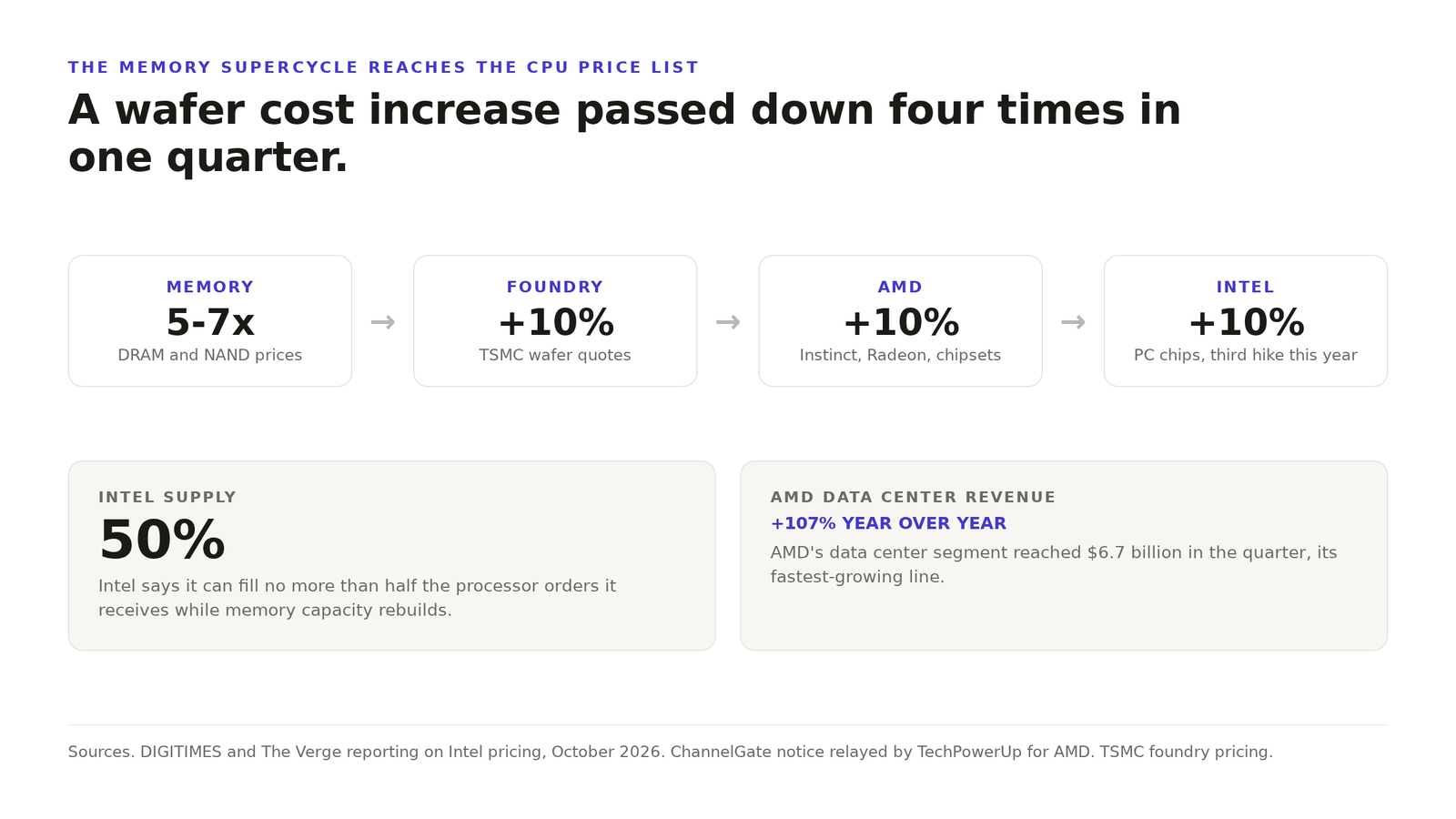
Put the two notices side by side and the pattern is plain. The memory shortage has reached the CPU, and the CPU sits in every machine, not only the accelerator rack in the back of the hall.
Rationing shows up as price, not as a backlog
A vendor that cannot fill half its orders has two choices. Discount to hold share, or raise price and let margin do the work. Intel chose the second and is retiring its low-margin small-core line rather than defending it on volume.
That choice says something about how long this lasts. Memory capacity grows 20 to 30 percent a year while AI demand for it keeps doubling, and Micron has said the squeeze tightens through 2028. A price increase with a multi-year supply gap behind it is closer to a reset than a spike.
The second-order effect lands on the mid-market. Consumer graphics cards, workstation chips and the flash inside a laptop all carry the same memory input, so the increases show up in hardware that never touches a data center. Vendors with thin margins pass the cost on first, and they pass it on fastest.
Three questions for your own budget. Which line items quietly contain memory, and when did you last reprice them? Does your cloud contract pass through component costs, or is that risk sitting with you? And if processor and storage prices stay elevated through 2028, which projects stop making sense first?
Related reading. The rack-level version of this story is in our piece on GPU rental prices going up while token prices do not, and the production side is in our look at Vera Rubin NVL72 reaching production inference racks.
Get the next one before it is old news
Independent analysis of cloud-native infrastructure, Kubernetes and data center economics. No vendor spin.
[…] Watch whether the increases hold once memory capacity catches up. The cost has moved off the AI rack and onto the general compute bill. Full breakdown. […]