


Executive Summary
Oracle has agreed to subscribe to 125 to 250 megawatts of output from the Point Beach nuclear plant in Wisconsin, and to absorb roughly $300 million in rising fuel costs that would otherwise fall on more than a million We Energies customers. The commitment is tied to Project Lighthouse, the $15 billion data center campus Oracle is building in Port Washington with OpenAI and Vantage Data Centers.
The finding is that the cost of new AI data center power now includes the cost of political permission. The Point Beach agreement is the single largest driver of a proposed $176 million We Energies rate increase for 2027, and it has been landing on household bills. By volunteering to take that cost off the rate base, Oracle removes the sharpest objection to its own build and turns a public fight into a filing. Wisconsin regulators still have to approve it. That approval is the point.
The pledge went public on October 2. Oracle presented it as community goodwill. Read it as a filing strategy.
Behind the number is Project Lighthouse, a campus planned for a 1.3 gigawatt load and a 2028 start. That is a lot of load in a state where the utility is already under pressure over this exact plant. The problem underneath the project is not the chips. It is the contract that feeds them.
Point Beach is a stranded cost the utility cannot escape
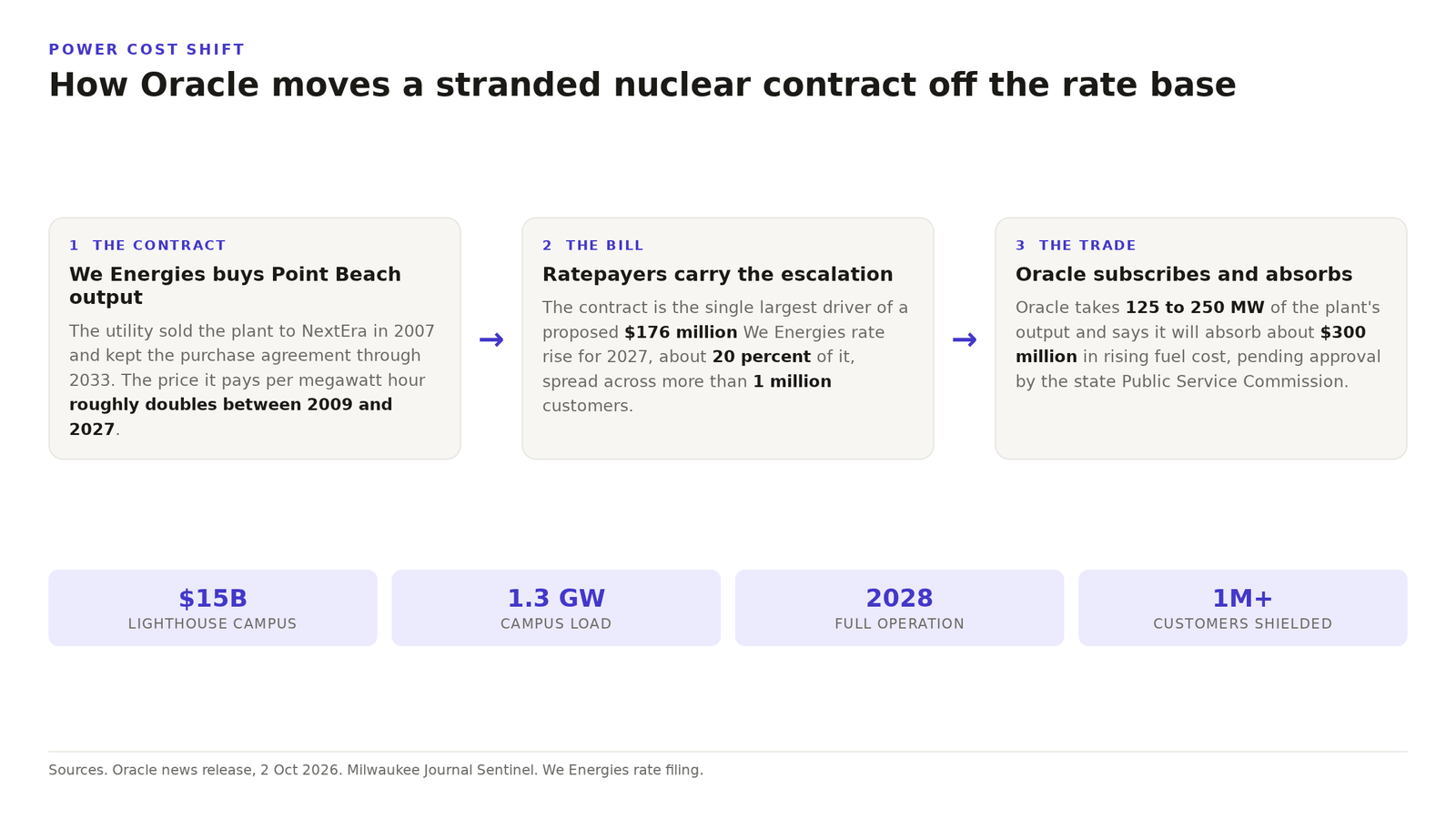
We Energies sold the Point Beach plant to NextEra Energy in 2007. It kept the purchase agreement to buy most of the output anyway, and that agreement runs to 2033. The price it pays per megawatt hour will roughly double between 2009 and 2027. The increases late in the contract run 6 to 8 percent a year.
Point Beach is 60 years old and produces just over a gigawatt. It is the state’s largest single generator, and the electricity it makes costs more than the alternatives. We Energies has already agreed to keep buying about 86 percent of its output into the 2050s.
The utility passes the cost on to customers. The Point Beach agreement is the single largest driver of the proposed $176 million rate rise, about a fifth of it, spread across more than a million homes and businesses. No utility wants that fight in public. No data center developer wants to be the reason it happens.
Oracle is buying the objection, not the electrons
By subscribing to part of the plant’s output, Oracle takes a slice of the expensive side of the deal off the rate base. We Energies says the move would spare other customers about $300 million in fuel costs. Oracle says it will also fund the campus’s own energy costs in full.
Mahesh Thiagarajan, an executive vice president at Oracle Cloud Infrastructure, said the commitment will “directly benefit more than 1 million Wisconsin utility customers.” That is true. It is also the cheapest line in a $15 billion project. The subscription covers 125 to 250 megawatts, roughly 10 to 20 percent of the campus load. The plant does not carry the campus. The gesture clears the path.
The deal still needs the Public Service Commission of Wisconsin to approve it. Oracle expects to file by the end of the year. It will walk into that review with the ratepayer objection already answered, and it gets to say so at every hearing. That is what $300 million buys when the alternative is a delay measured in years.
The template is becoming the cost of entry
This is the shape of capacity in 2026. Grid queues run years. Communities that watched bills climb after a data center arrived are saying no, and states are tightening the rules for large loads. So operators are learning to buy the part of the problem that makes headlines. Oracle took the nuclear bill. Others are moving generation behind the meter, or paying for local roads, water and schools to stay welcome.
We Energies also wrote a special electric rate for large data centers, meant to keep their costs off other customers. Oracle’s pledge is the same idea, put in a news release instead of a tariff.
The number to watch is not the $300 million. It is how many projects will need a version of it before the switch is flipped. When the first line of a data center budget is political, siting math changes for everyone.
Three questions for your own build. Which local cost will your project be blamed for, and can you absorb it? What does the regulator need to hear before it approves you? Is a goodwill payment cheaper than a two year delay?
Related reading. Oracle has already shown how quickly a power problem becomes a construction problem. Its New Mexico campus drew a force majeure notice when a gas pipeline route was rejected. That analysis is here.
Get the next one before it is old news
Independent analysis of cloud-native infrastructure, Kubernetes and data center economics. No vendor spin.