

Executive summary
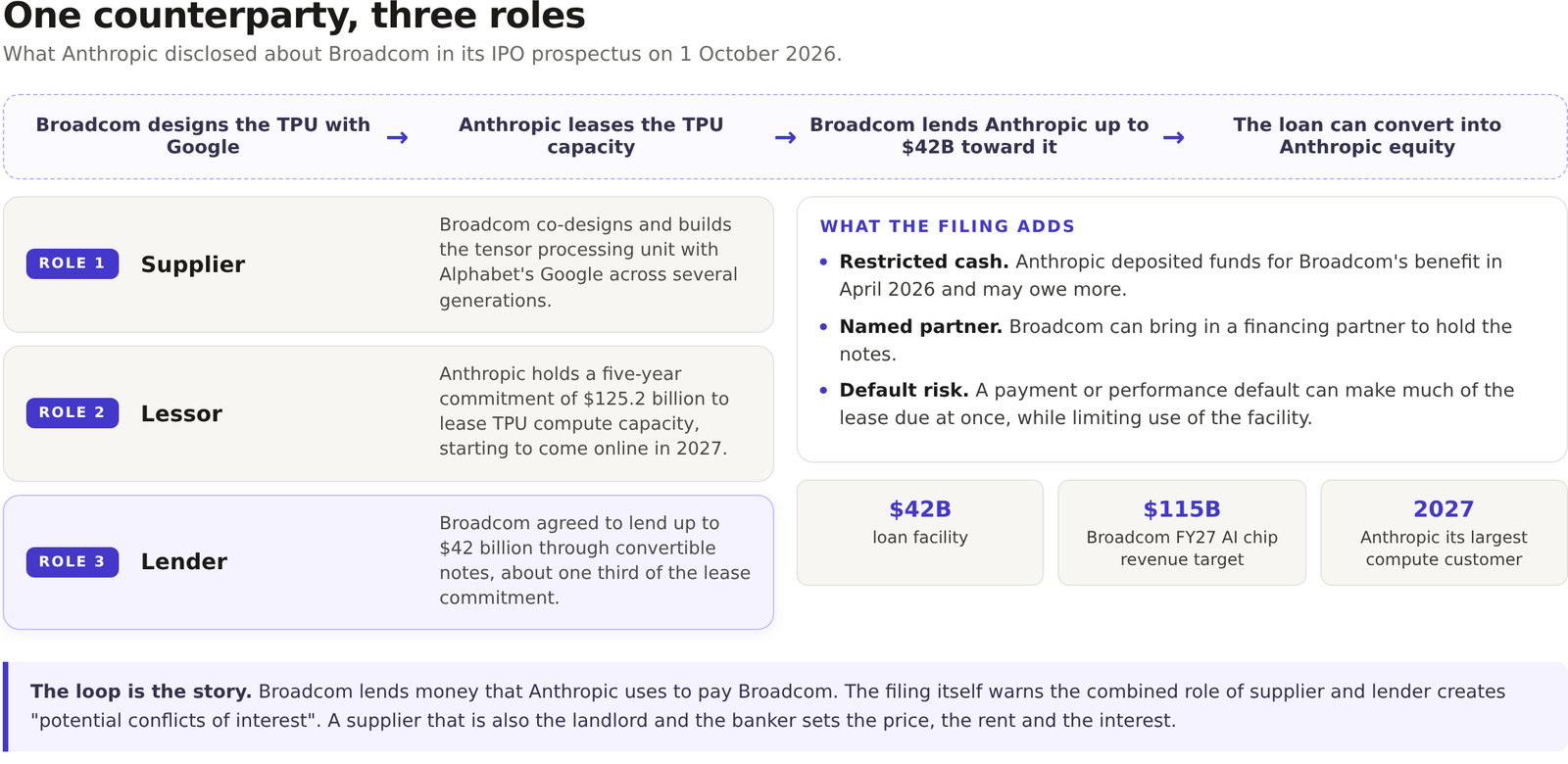
Anthropic’s IPO prospectus discloses that Broadcom agreed to lend the AI lab up to 42 billion dollars to finance infrastructure spending, sized to cover about one third of a 125.2 billion dollar commitment to lease TPU capacity over five years. The notes can convert into Anthropic equity, and Broadcom can name a financing partner to hold them.
The structure is the finding. One supplier now designs the chip, leases the capacity and funds the purchase, and Anthropic’s own filing flags the “potential conflicts of interest” that creates. Broadcom projects AI semiconductor revenue near 115 billion dollars in fiscal 2027, with Anthropic becoming its largest compute customer. Watch whether the loan-to-lease model spreads to other chip vendors, and whether the customers still paying Broadcom for virtualization support notice whose buildout their money underwrites.
Anthropic’s IPO filing disclosed something larger than a loan. The Broadcom Anthropic financing it lays out lets the chip designer lend the AI lab up to 42 billion dollars to pay for the very infrastructure Broadcom supplies, and the filing itself warns the arrangement creates “potential conflicts of interest”. One counterparty now sits on the chip, the lease and the debt.
Reuters reported the terms from the prospectus. The convertible notes cover about one third of a 125.2 billion dollar commitment Anthropic has made to lease tensor processing unit capacity over five years. Broadcom designs those TPUs with Alphabet’s Google, and the capacity starts coming online in 2027. The notes can convert into Anthropic shares, and Broadcom can bring in a financing partner. Anthropic said it does not expect any notes to be sold before the offering closes.
The supplier became the landlord and the banker
Chip vendors have financed customers before. What is new here is the loop closing inside one company. Anthropic deposits cash into a restricted account for Broadcom’s benefit, leases capacity from Broadcom, then borrows from Broadcom to cover part of that lease.
A default shows why that matters. A payment or performance default can make much of the lease obligation immediately due while limiting how much of the facility Anthropic can draw to pay it. The escape hatch narrows exactly when it is needed most.
Read the deal the way a buyer reads any bundle. When the supplier also holds the note, the buyer’s position weakens. The price of the chip, the terms of the lease and the cost of the money get negotiated against one counterparty. The comparison that matters is Amazon, which is a large Anthropic investor and its main cloud partner, and whose role is supply and distribution. Broadcom’s role is supply, equipment leasing and lending. That is the difference between a partner and a landlord.
Anthropic wrote the warning itself
The unusual part is who named the risk. Anthropic, not a critic, wrote that Broadcom’s double role as hardware supplier and financing partner creates “potential conflicts of interest” that could affect the company’s access to the computing power it needs. The filing adds that Broadcom’s decisions on pricing and hardware could limit how much infrastructure Anthropic can buy.
That is the honest version of the deal. A 42 billion dollar facility sounds like capacity. It is closer to a dependency. What Anthropic secures is not silicon it owns. It is capacity it rents from a company that also holds its notes.
Bloomberg reported in August that Broadcom was assembling more than 60 billion dollars of debt to fund chips for Anthropic and other AI companies. The prospectus confirms the shape of that plan rather than only its size. It is the clearest statement yet that AI compute is now financed by the people selling it.
The VMware base is underwriting the AI bet
Broadcom does not report VMware revenue on its own. VMware sits inside the Infrastructure Software Group, which generated 8.75 billion dollars in the third fiscal quarter of 2026, up 29 percent year over year. That cash and the AI lending share one balance sheet. The enterprise customers still paying Broadcom for virtualization support are, in a literal sense, helping fund the compute financing arm.
That is the seam worth watching. Gartner’s distributed hybrid infrastructure research carries a planning assumption that by 2029, 55 percent of enterprises will start proofs of concept for alternatives to their VMware-based deployments, up from 25 percent in 2026. Gartner does not endorse any vendor. If that migration speeds up, the software cash that helps underwrite Broadcom’s AI lending thins out at the same moment the AI forecast needs it most.
Three questions for anyone holding a Broadcom contract. Is your renewal priced against the value you get or against a forecast you now help fund. What is your exit cost if the customer concentration the filing describes turns into a credit problem. And if the vendor is also your lender, who holds the right to reprice.
Related reading. We covered Anthropic’s other compute deal, an 11.6 billion dollar bet on CPUs rather than GPUs, and the deauthorization of one of Broadcom’s own top VMware partners.
Sources. CNBC carried the Reuters report, and the original Reuters report ran via Channel News Asia. Background on the April expansion of the Broadcom, Google and Anthropic partnership, plus the Anthropic and Broadcom sites and the Google Cloud TPU documentation.
Get the next one before it is old news
Independent analysis of cloud-native infrastructure, Kubernetes and data center economics. No vendor spin.