

Executive Summary
Legrand now models installed data center IT load rising from 80 gigawatts in 2025 to 180 gigawatts by 2030. Against that it sets 420 gigawatts of announced projects. In the same week, Digital Realty said renewal spreads on leases above a megawatt topped 60 percent, a record, and Iron Mountain said its energized pipeline fell from about 450 megawatts to 325 because tenants leased faster than utilities could connect.
The finding is that announced megawatts are marketing and energized megawatts are the actual product. Landlords who already hold powered, wired halls can reprice every lease roll, while equipment makers wait on the grid. The verdict for buyers is blunt. Capacity you can see on a roadmap is not capacity you can run on, and the price of the difference now shows up in renewals, not in procurement.
The scarcest asset in AI infrastructure is not a GPU. It is a megawatt a utility has already switched on. Three disclosures in one week put a price on it, and the price is going up.
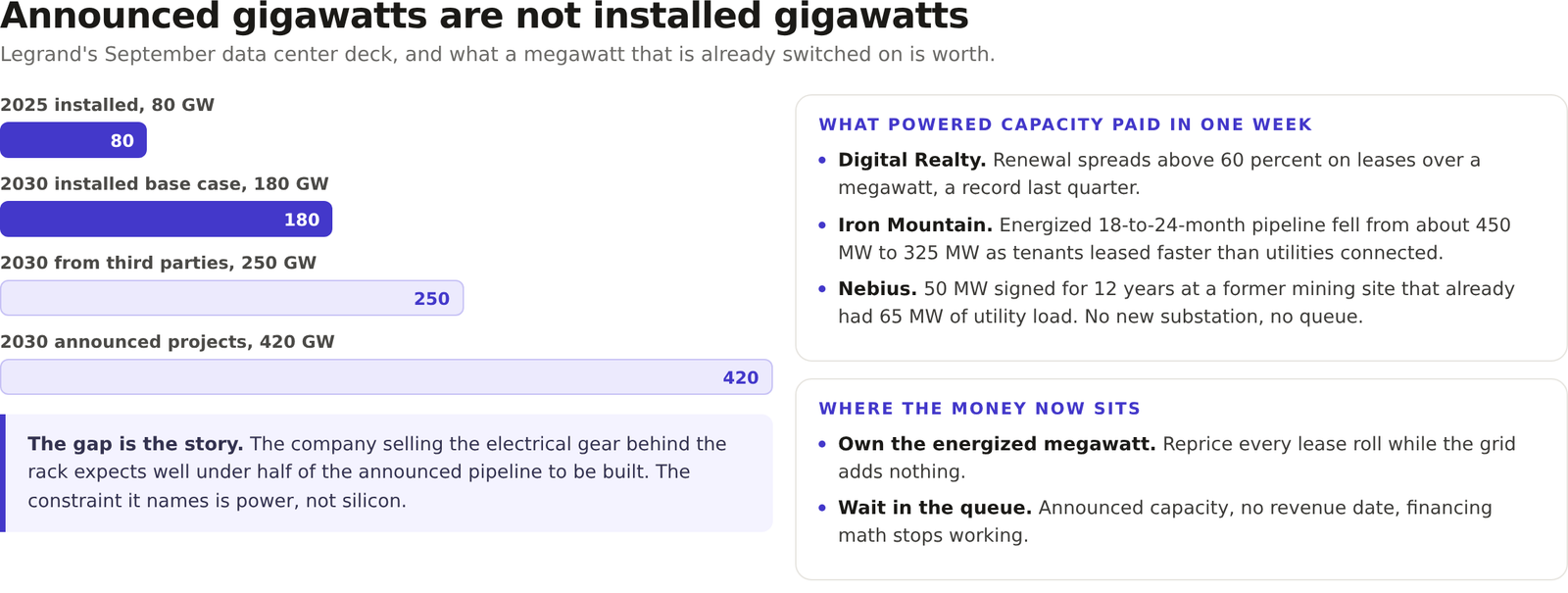
Legrand now models installed data center power rising from 80 gigawatts in 2025 to 180 gigawatts by 2030. Against that it sets 420 gigawatts of announced projects, and a further 250 gigawatts it expects from third parties. The company sells the electrical gear behind the rack, so it has every reason to talk up the buildout. It still expects well under half of what has been announced to get built.
The suppliers are betting that most announced capacity never gets built
Legrand’s own capital plan calls for annual additions climbing from about 12 gigawatts in 2025 to about 30 gigawatts in 2030. That is roughly two and a half times today’s pace, delivered by utilities Legrand does not control. The gap between 180 and 420 is not a forecast of failure. It is a forecast that the grid cannot connect what has been announced.
Legrand is not the only one saying it. Digital Realty runs about 3 gigawatts today and holds land for 7 more. Its chief financial officer told investors in September that bringing power online has rarely been harder, with permitting tightening across several US metros.
The rent follows the energized megawatt, not the announced one
The consequence showed up in price. Digital Realty said renewal spreads on leases above a megawatt topped 60 percent last quarter, a record, while smaller leases stayed healthy. A landlord that can lift rent by more than half on renewal owns something tenants cannot find elsewhere.
Iron Mountain showed the same scarcity from the other side. Its pipeline of capacity energized within 18 to 24 months fell from about 450 megawatts to 325, because tenants leased roughly 125 megawatts faster than utilities could replace it. More than 90 percent of that leasing came from investment-grade hyperscalers on 10 to 15 year terms. Those tenants are buying power, not space.
Small agentic workloads landed in halls that were already powered
There is a second signal in Digital Realty’s numbers. Its zero-to-one-megawatt business, which the company ties to early agentic AI demand, set records for three straight quarters. Typical deployments there grew from 300 kilowatts or less to between 500 kilowatts and a megawatt. Workloads that size fit inside colocation halls that are already energized and already wired.
So agentic AI is being sold out of existing capacity, not out of greenfield builds. That favors incumbents with dense, powered campuses, and it shows up in their income statements years before it shows up in new-build megawatts.
The clearest proof came the same week. Nebius signed a binding 12-year agreement for 50 megawatts at a former Bitcoin mining campus in the southeastern United States. The site already carried a 15-year electric service agreement for 65 megawatts of utility load and needed no significant electrical upgrades. No new substation, no queue. That is why the tenant picked it.
Three questions for your own capacity plan. Do you count megawatts with a signed interconnection date, or megawatts on a slide. If you renew a powered lease this year, have you modeled the repricing that powered landlords are now setting. And does your inference placement follow cheap compute, or does it follow where the power is already live.
The pattern to watch is Iron Mountain’s rolling floor. It has promised to keep more than 300 megawatts of energizable capacity available on an 18 to 24 month horizon. If that floor breaks, the grid is losing the race, and the powered landlords pull further ahead of everyone selling into the buildout.
Related reading. Oracle’s force majeure notice was about power, not construction, and Washington is buying 23 gigawatts out of wires already in the ground.
Get the next one before it is old news
Independent analysis of cloud-native infrastructure, Kubernetes and data center economics. No vendor spin.