

Executive Summary
Oracle sent a force majeure notice to Blue Owl Capital over Project Jupiter, the 2.45 GW campus in southern New Mexico being built to serve OpenAI. The notice is not an exit from the lease. It is a payment deferral, exercisable if the campus misses its 2028 start date.
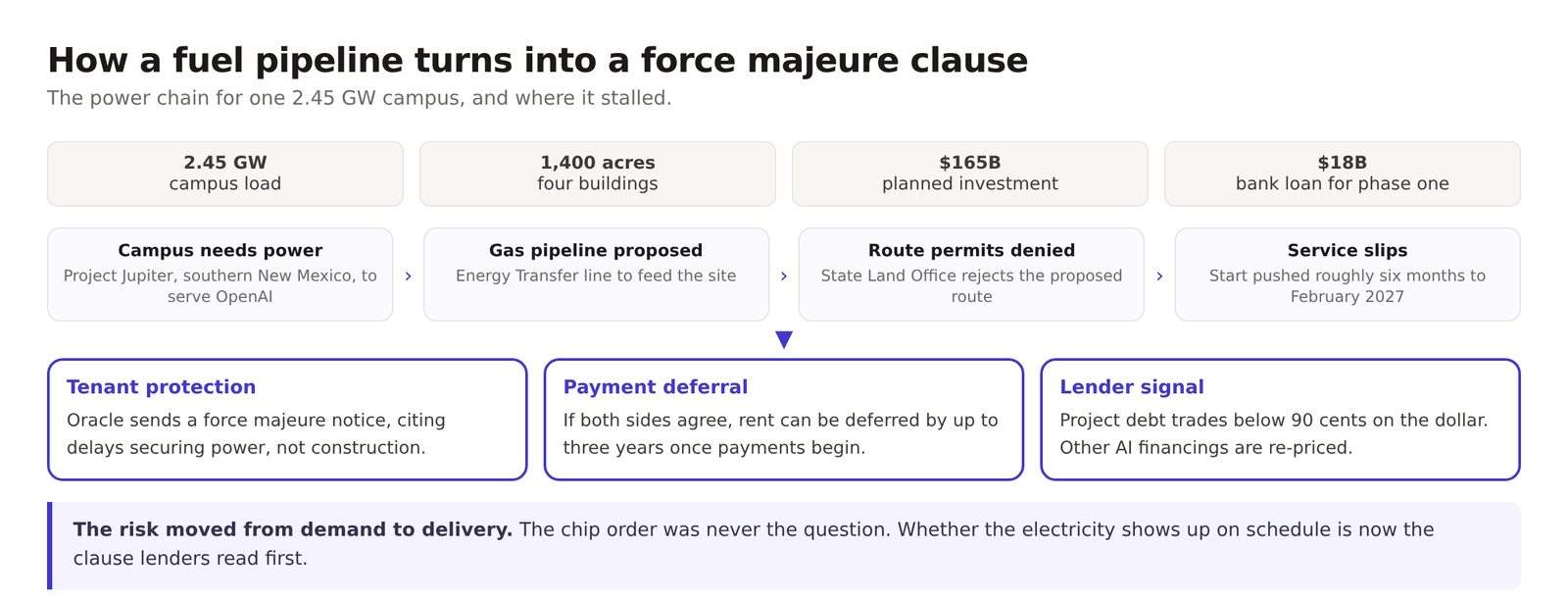
The trigger is the instructive part. The clause is not about construction cost. It is about electricity. New Mexico’s State Land Office rejected the route for the natural gas pipeline meant to feed the site, and service slipped roughly six months to February 2027. Lenders read that as a signal rather than an isolated incident. Debt on the project trades below 90 cents on the dollar, and a second OpenAI campus financing in Ohio delayed its listing this week. Capital is plentiful and sites are plentiful. The binding constraint is power delivered on a schedule. The verdict is that AI capacity is now gated by interconnection and fuel supply, not by chip allocation.
A force majeure clause frees a party from an obligation when something outside its control gets in the way. The phrase is common in energy and commodities contracts. It is now turning up in data center development agreements, and lawyers say the trend is accelerating.
Oracle’s notice went to the developer of Project Jupiter, a unit of Blue Owl Capital, according to reporting first published by Bloomberg and summarised by Data Center Dynamics. Oracle is not trying to walk away as the campus’s main tenant. It wants the option to defer payments if the site fails to open in 2028.
Force majeure has become a power delivery clause
The mechanism is worth spelling out, because it tells you where the money thinks the risk sits. A hyperscale tenant commits to a campus years before it exists, and rent starts on a date that assumes the power is already there. When the electricity slips, the tenant owes rent on an empty shell. Force majeure defers that clock.
If both sides agree that a force majeure event tied to meeting power commitments occurred, Oracle could defer rent by up to three years once payments begin. It would still owe the full rent across the lease term and cover other costs in the interim. That is a narrow protection, and it is the difference between a delay and a write-down.
The power chain broke at the permit stage
Project Jupiter is a 1,400 acre campus planned for four buildings at 2.45 GW, with up to $165 billion of investment announced between Stack Infrastructure and BorderPlex Digital Assets. Oracle was named as the tenant in January 2026. It sits in southern New Mexico and is meant to serve OpenAI.
The fuel plan ran into a route. Energy Transfer was to build a natural gas pipeline extension to the campus, and the state land office rejected the proposed route. Service moved to roughly 1 February 2027, a slip of about six months. Oracle pressed federal regulators to fast-track the review so the line could enter service by mid August, after an initial application was denied in March. Separately, the company put out a request for proposals to develop 2 GW of new renewable capacity in the state, and backed research into carbon capture.
None of that is a story about chips. The accelerators were never the question. The question is whether roughly 2.5 GW of firm electricity can reach a specific patch of desert by a specific year, and right now that depends on a pipeline route and a permitting calendar.
Why lenders are reading it as a pattern
The financing stack explains the sensitivity. Around 20 banks provided an $18 billion loan for the first phase, and Blue Owl holds roughly $3 billion of equity. Debt tied to the development has traded below 90 cents on the dollar. Oracle’s credit risk gauge hit a record high on the same day its shares fell about 6 percent, extending a year to date decline of roughly 31 percent.
The ripples reached other deals. SB Energy, which is developing an Ohio campus to serve OpenAI, decided this week to delay its listing. The background is a capital plan that keeps getting bigger. Moody’s projects AI related capital spending by the six largest US technology companies at around $1 trillion in 2027, which raises a real question about whether the market can absorb that much issuance without wider spreads. On top of that, Data Center Watch counted at least 45 projects worth $68 billion facing community opposition in the second quarter of 2026, after 75 projects worth about $130 billion were disrupted the quarter before.
So the constraint is not demand, and it is not capital. It is delivery. Three questions any infrastructure leader should be able to answer. Which of your AI capacity commitments depend on a fuel or transmission project that has not yet been permitted? What is your contractual protection if that project slips by a year? And if the power arrives late, who absorbs the cost while the racks sit empty?
Related reading. Texas paused new data center permits pending a grid audit, the same permitting pressure arriving through a different door. Our AI data center power commitments tracker follows the gigawatts behind these announcements.
Get the next one before it is old news
Independent analysis of cloud-native infrastructure, Kubernetes and data center economics. No vendor spin.
[…] Read the full analysis […]
[…] reading. Oracle’s force majeure notice was about power, not construction, and Washington is buying 23 gigawatts out of wires already in […]
[…] Related reading. Oracle has already shown how quickly a power problem becomes a construction problem. Its New Mexico campus drew a force majeure notice when a gas pipeline route was rejected. That analysis is here. […]