


Executive Summary
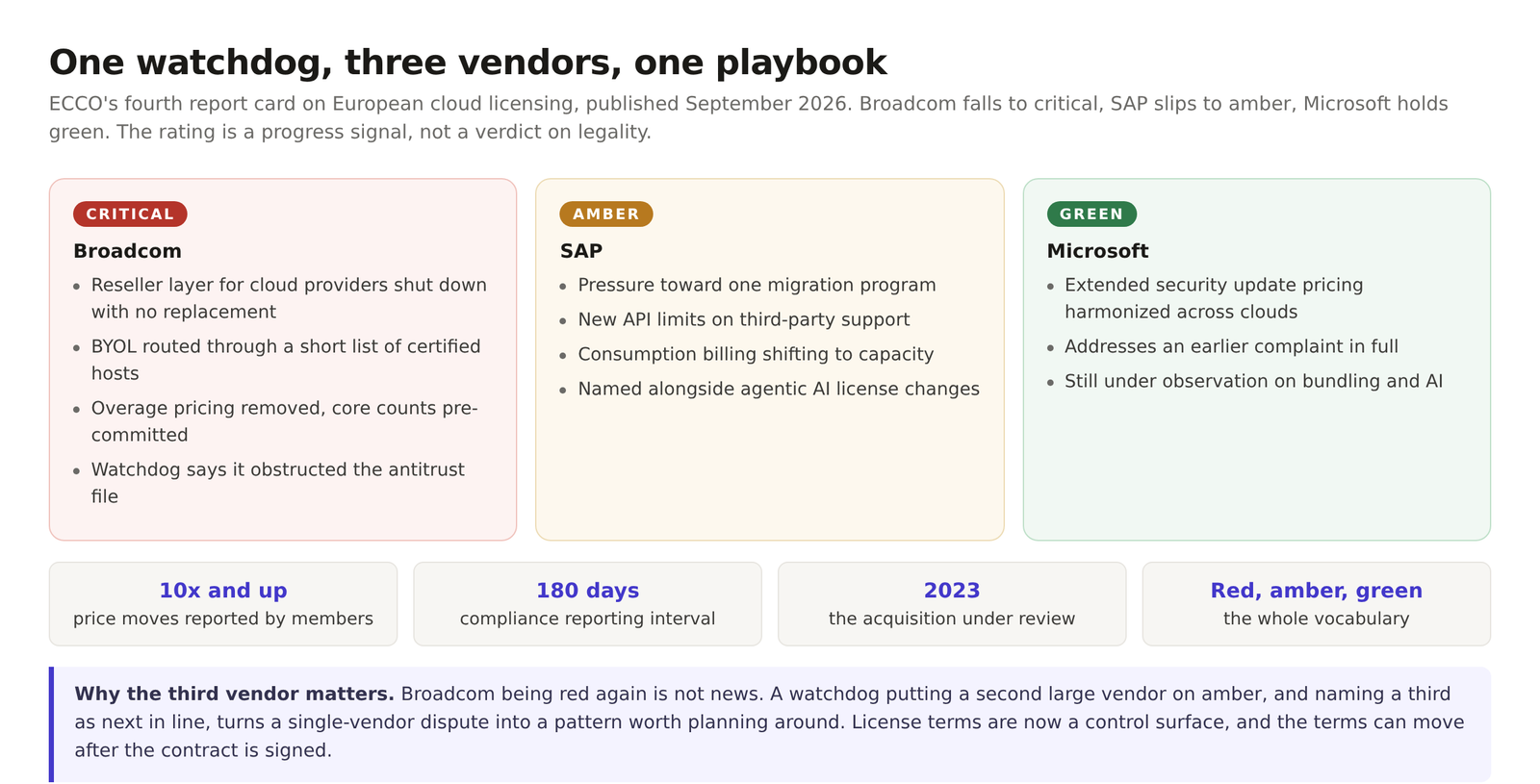
The fourth report from the European Cloud Competition Observatory rates Broadcom critical, the lowest of its three grades, and says its conduct has deteriorated since October 2025. Broadcom closed the reseller layer that European cloud providers used to sell hosted VMware services, narrowed bring-your-own-license to a short list of certified hosts, and removed the overage pricing that let providers scale and settle later. CISPE members report price moves of ten times or more against pre-acquisition terms.
The second name on the report card is the finding worth keeping. SAP moved to amber on new API limits, pressure toward one ERP migration route, and a billing shift toward capacity. Microsoft held green after harmonizing extended security update pricing. One vendor in the red is a dispute between two parties. Two vendors under scrutiny, with a working remedy sitting in plain view on the third, is a market condition that belongs in renewal planning.
Europe keeps a scorecard for software licensing, and Broadcom is at the bottom of it again.
The European Cloud Competition Observatory published its fourth report in September. The observatory is run by CISPE, the trade group for European cloud providers, and it grades vendors red, amber, or green. Red means the group sees no meaningful progress toward fair terms. Broadcom is red, where it has sat for a year, with the report describing its VMware licensing conduct as having deteriorated markedly since October 2025.
The individual changes matter more than the grade
Broadcom shut down the reseller program that European cloud providers used to offer hosted VMware services. The observatory describes the result in stark terms. A large share of Europe’s cloud provider base lost access to a product with no immediate substitute, in a single move, with no transition route.
Bring-your-own-license changed as well. Those workloads now have to run through a short list of Broadcom Certified Cloud Services. Where that list is thin, hosting concentrates into what the report calls mini-monopolies, which leaves buyers with fewer credible options on price.
Overage pricing is gone too. Providers used to provision ahead of demand and settle for the extra cores afterward. They now commit to core counts in advance, which raises the cost of holding spare capacity.
Price is the figure readers will remember. CISPE members report increases of ten times or more against what they paid before Broadcom bought VMware in 2023. That is a member-reported number from a trade group, not an audited market rate.
One claim in the report needs a caveat. The trade group says it has confirmed reports of a mechanism in Broadcom’s licensing systems that degrades or blocks a customer environment when reporting obligations are missed. Broadcom requires compliance reporting every 180 days. Treat that as a claim in dispute, and one Broadcom has not confirmed in public.
SAP on amber is the part to plan around
The report moves SAP to amber. The worries have the same shape as Broadcom’s. Customers report pressure toward a single migration route for on-premise ERP, new limits on third-party API access, and a billing shift from consumption to capacity that raises the cost of hosting SAP software outside SAP’s own cloud. The observatory argues those terms could close off competition in enterprise AI, where the same buyers are making their next platform decision.
Microsoft held green, and the reason is specific. It harmonized the cost of extended security updates regardless of which cloud a customer picks, which settled an earlier complaint in full. That contrast is the useful part. The observatory rewards terms that move when buyers push, and it keeps the file open until they do.
What to do with a rating like this
Nothing in the report changes a contract you have already signed. All of it changes the risk you assign to renewal language. A term that can move after signature, such as a license list you turn out not to be on, is worth negotiating before it does.
Watch the enforcement track rather than the scorecard. Broadcom has challenged the European Commission’s information requests, and the General Court has so far backed the Commission on how far it can reach. CIO reported the findings, and The Stack followed the partner program angle. The report’s language about obstruction reads like a plea for interim measures, not for a fine at the end.
The pattern is the story. Licensing terms turned into a control surface across enterprise infrastructure, and the vendors holding customers with expensive switching costs are using it. A second vendor on amber tells you where that pressure heads next.
Related reading. Europe’s Regulators Are Now Broadcom’s Biggest VMware Problem covers the Commission’s evidence request. Broadcom Cut Off the VMware Tool That Migration Vendors Depend On explains the VDDK change. Decoding Broadcom’s 2026 VMware Licensing Maze maps the current bundles.
Get the next one before it is old news
Independent analysis of cloud-native infrastructure, Kubernetes and data centre economics. No vendor spin.
[…] The useful signal is the second name. One vendor in the red is a dispute. Two vendors under scrutiny, with a working remedy visible on the third, is a market condition. Read the full analysis. […]