


Executive Summary
Nvidia published an image generator whose repository holds 32.6 billion parameters, and on the benchmarks its own card prints, it beats GPT Image 2. The card reports 92.86 on GenEval against 89.00, and 86.0 on BizGenEval against 83.2. Those numbers carried the repository three places up the HuggingFace trending board overnight, to rank eight.
The same repository carries a license that limits the work to research and evaluation. Section 3.3 of the NVIDIA License bars commercial use, and the only parties exempted are Nvidia and its affiliates. So the sharpest image model on the board this week is one an operator can measure and cannot deploy. The download is 133 GB of full precision weights across 32 shards, which is a lot of transfer for an artifact you may only test. Rank moved. Nothing about the deployment question moved with it.
The repository is nvidia/Nemotron-Labs-Image-30B-A3B, and its card files it as the raster component of a larger framework for building pages, slides and figures. Strip the framing and the claim is simple. This Nvidia image model writes pixels one symbol at a time, was initialized from Nemotron 3 Nano, and carries 30 billion total parameters with 3 billion active.
This image model is a language model in a pixel suit
Raster generation here is not diffusion. Nvidia paired the generator with a visual tokenizer that turns an image into discrete symbols. Every 16 by 16 patch maps onto a fixed codebook of 196,560 lattice vectors, and the model then predicts the next symbol the way a text model predicts the next word. The tokenizer holds about 642 million parameters. Encoding takes 41.30 ms and decoding 37.10 ms at batch size one on an A100, against 294.53 ms and 405.46 ms for Emu3.5 IBQ in the same table.
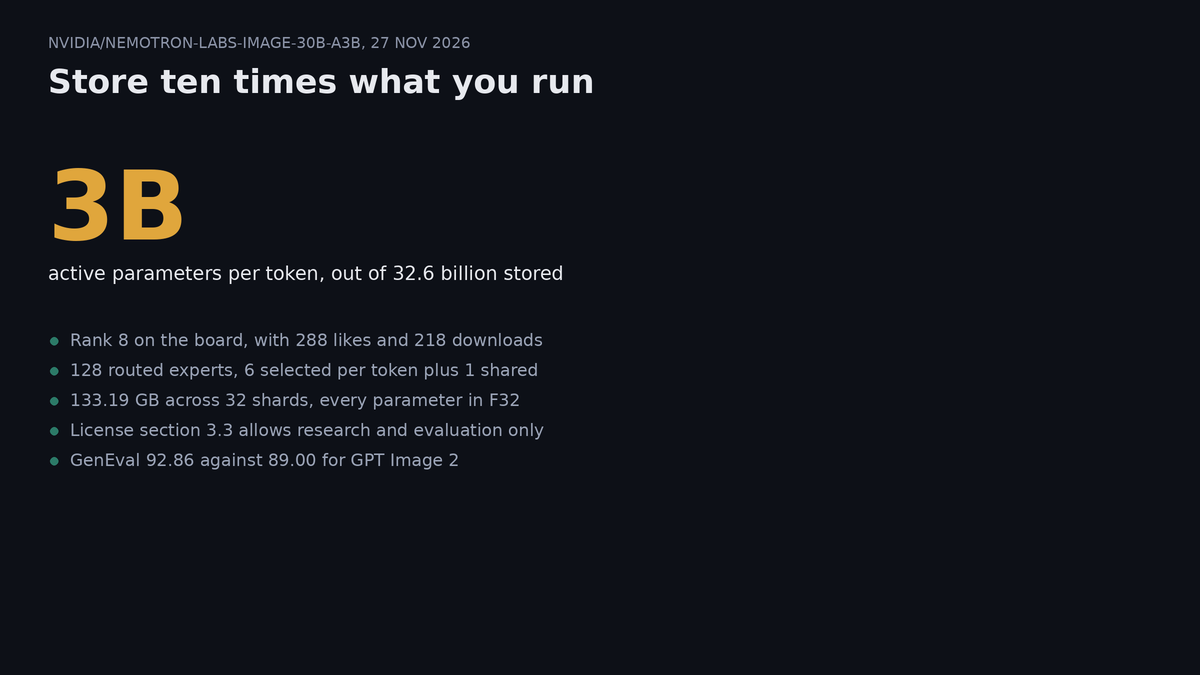
The config file shows what stands behind that tokenizer. 52 layers, 128 routed experts, six experts selected per token, and one shared expert. The vocabulary runs to 327,680 entries and the context window to 262,144 positions. Routing sends each token through a slice of the network, so arithmetic tracks the 3 billion active parameters while memory tracks all of it.
That split is the operational detail, and it cuts both ways. The safetensors index counts 32,634,904,896 parameters, so weights have to sit somewhere in full. Compute follows the active slice, which is why a text serving stack can host this shape without new machinery. Capacity follows the whole checkpoint, which is why the bill does not look like a 3 billion parameter model.
The license stops where production starts
Read the license before the benchmarks, because it settles the deployment question in one clause. Section 3.3 states that the work and any derivative works only may be used or intended for use non-commercially, and then defines non-commercial as research or evaluation only. Nvidia and its affiliates except themselves. Everyone else is outside the grant.
Redistribution is allowed, so a mirror is fine. Shipping is not. The repository ships one license file and a notice, and the license is the whole grant. A team that puts these weights behind a paid endpoint is outside the license the day it starts, regardless of how the weights arrived.
The download is not small either. The repository holds 64 entries and 133.19 GB, across 32 model shards plus a bundled tokenizer, and the safetensors metadata reports every parameter stored as F32. You pull a full precision checkpoint to run a model you are licensed to measure. On an evaluation box that is a morning. Inside a build pipeline it is waste you repeat every week.
Benchmarks do not move a download counter
On this morning’s capture the repository sits at rank eight with a trending score of 227, up three places from rank eleven the day before. It carries 288 likes and 218 downloads. The repo directly above it, Lightricks LTX-2.5, has 3,041,405 downloads. The video generator is moving files while the benchmark winner collects stars. The card is also honest about where it loses, printing GenEval2 at 65.43 against 81.00 for GPT Image 2.
The board holds permissive entries too. sand-ai MAGI-2-preview sits at rank sixteen under Apache 2.0 and reports no downloads at all. A permissive license did not buy it attention, and a benchmark score did not buy Nvidia adoption. The two columns answer different questions and neither one answers the question an operator asks first.
The order that works is dull. Find the artifact, read the license, check the precision, then look at the rank. Three questions worth carrying into the next evaluation. Does the license permit the use you have in mind, or only the use the card demonstrates. Is the artifact stored at a precision you can actually serve. And does the benchmark the model wins match the workload you run, or the one the paper chose.
Related reading. This series used the same rank eight slot last week to show how a repo can rank with no weights in it, and traced what happens when a checkpoint reaches the board in six gigabytes of weights.
Get the next one before it is old news
Independent analysis of cloud-native infrastructure, Kubernetes and data center economics. No vendor spin.