Executive Summary
China’s domestic training stack has crossed from a proof point to production scale, and the report that says so is unusually candid about what each step cost. The systems engineering is quantified increment by increment. Model quality is not quantified at all, and nothing in the release hands a reader a number to check.
That pairing is the story. A lab that can pretrain 285 billion parameters without Nvidia no longer has to prove it can do the work. What remains sits downstream in serving, where a 521 GiB artifact under the loosest license available still needs a rack nobody has bought. Watch whether the trillion parameter run the authors say is underway ships scores next to the weights, because that is when the domestic stack stops being a demonstration.
China Telecom’s research arm published a technical report for a 285 billion parameter model trained end to end on 8,192 Huawei Ascend 910C chips. No GPUs. No CUDA. Most coverage led with that.
The line worth more attention sits lower in the card. The attention mechanism was borrowed from another lab.
Xing4.1-Preview went out on 23 November under Apache 2.0. It is a sparse mixture of experts, 285 billion parameters total against roughly 17 billion active per token, so about 6 percent of the network fires on any one token. Forty five layers, 256 routed experts, 8 selected per token, and a native one million token context. The technical report was revised on arXiv the same day the weights landed.
Neither publishes a benchmark score. A model billed as frontier agentic ships with nothing to check it against.
The Chip’s Thin Units Chose the Attention Layer
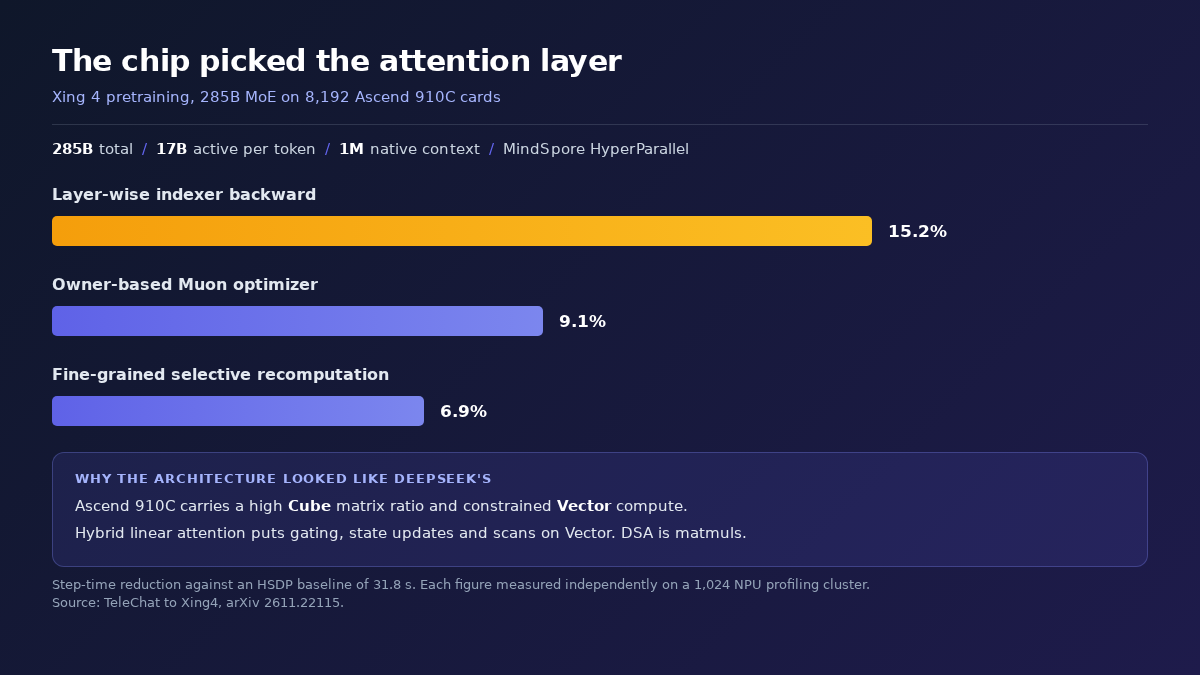
Ascend 910C is not an H100 with a different badge. The report is blunt about the shape of the part. It carries a high ratio of Cube, the matrix multiplier, and constrained Vector compute and HBM bandwidth.
That asymmetry made the architecture decision, and the company’s own docs say so. “DSA relies primarily on matrix-multiplication operations, which are better aligned with the Cube compute units.” Hybrid linear attention of the KDA and GDN kind looks cheaper for long sequences on paper. It also puts gating, state updates and scans onto Vector units, which is where this chip is thin.
DSA is DeepSeek Sparse Attention, published in DeepSeek’s V3.2 release and paired here with multi head latent attention. A Chinese state telecom operator’s flagship runs on a rival lab’s attention design, because that design fits domestic silicon.
That is the part with a life beyond this release. A model now carries a record of the accelerator it was trained on inside its architecture. If controls keep Nvidia parts out of China, the attention designs that suit Ascend travel out with the chips.
Eight Thousand Cards Bought a Nine Percent Win
The systems numbers are the credible half of the release. Pretraining ran on MindSpore’s HyperParallel stack, with topology aware hybrid sharding across a two tier network. Fine grained traffic stays inside an Ascend SuperPoD, coarse reduction crosses between them, and the layout let the run execute without pipeline stages.
Against an HSDP baseline of 31.8 seconds per step, three fixes each cut step time on their own. The layer wise indexer backward by 15.2 percent, owner based Muon execution by 9.1 percent, fine grained selective recomputation by 6.9 percent.
Those are low double digit gains, and they earn it. The baseline was already HSDP with Muon, and the authors say the measurements came from a 1,024 NPU profiling cluster, not the 8,192 card production run.
The Weights Are Free and Nothing Is Serving Them
Apache 2.0 is the loosest license any large Chinese release has carried this month. The files are 521.4 GiB in BF16, split across 261 shards of about 2 GiB each, and SGLang or vLLM will serve it if you own the hardware. That is a rack, not a download.
Hugging Face shows 0 downloads in the last month on the Transformers repository and 22 on the MindSpore one. The GitHub repo carries 4 stars. The inference provider row reads “not deployed by any Inference Provider”, which is not a lag artifact. Nobody has put it behind an endpoint.
The scores are the bigger gap. The card says full benchmark results will publish with the official report, notes harness runs inside Codex, OpenCode and Claude Code, and asks readers to treat third party numbers with caution. Three days on, the report is public and the numbers are not.
Ant Group hit the same wall with a 560 billion parameter medical model under MIT and an eight GPU floor in its own quickstart. For Ant, the hardware was the paywall.
The final paragraph is the one to watch. The authors say they are already training trillion parameter models in the Xing 4 series on Ascend. If that holds, the domestic stack moves from a 29 billion parameter open member to the trillion tier inside one product cycle.
Three questions for your own fleet. Can you tell from a release note which hardware a model was trained on? Does a model shaped around another chip’s weaknesses change what you can run? And if training moves onto domestic silicon while inference stays open, which half does the control reach?
Related reading. Tencent put a revenue gate on open weights, and the gate reaches everyone downstream.
Get the next one before it is old news
Independent analysis of cloud-native infrastructure, Kubernetes and data center economics. No vendor spin.