

Executive Summary
Korea’s stack is being assembled in two layers that arrive years apart, and only one of them is real today. The inference software is finished, tuned for NVIDIA B200 GPUs and claimed at up to twice the baseline performance. The domestic accelerator has a 2028 deployment year, no price, no stated volume and no published efficiency figure. Buyers are being asked to treat those two things as a single program, which is the part worth arguing with.
The structural finding is harder to wave through. Joining NVLink Fusion buys a Korean chipmaker a seat inside the rack and buys a buyer nothing on exit, because the scale-up fabric, the rack design and the reference systems stay with one vendor. Sovereignty that depends on someone else’s interconnect is a hedge, not a substitute. Watch the benchmark and the exit cost, not the memorandum.
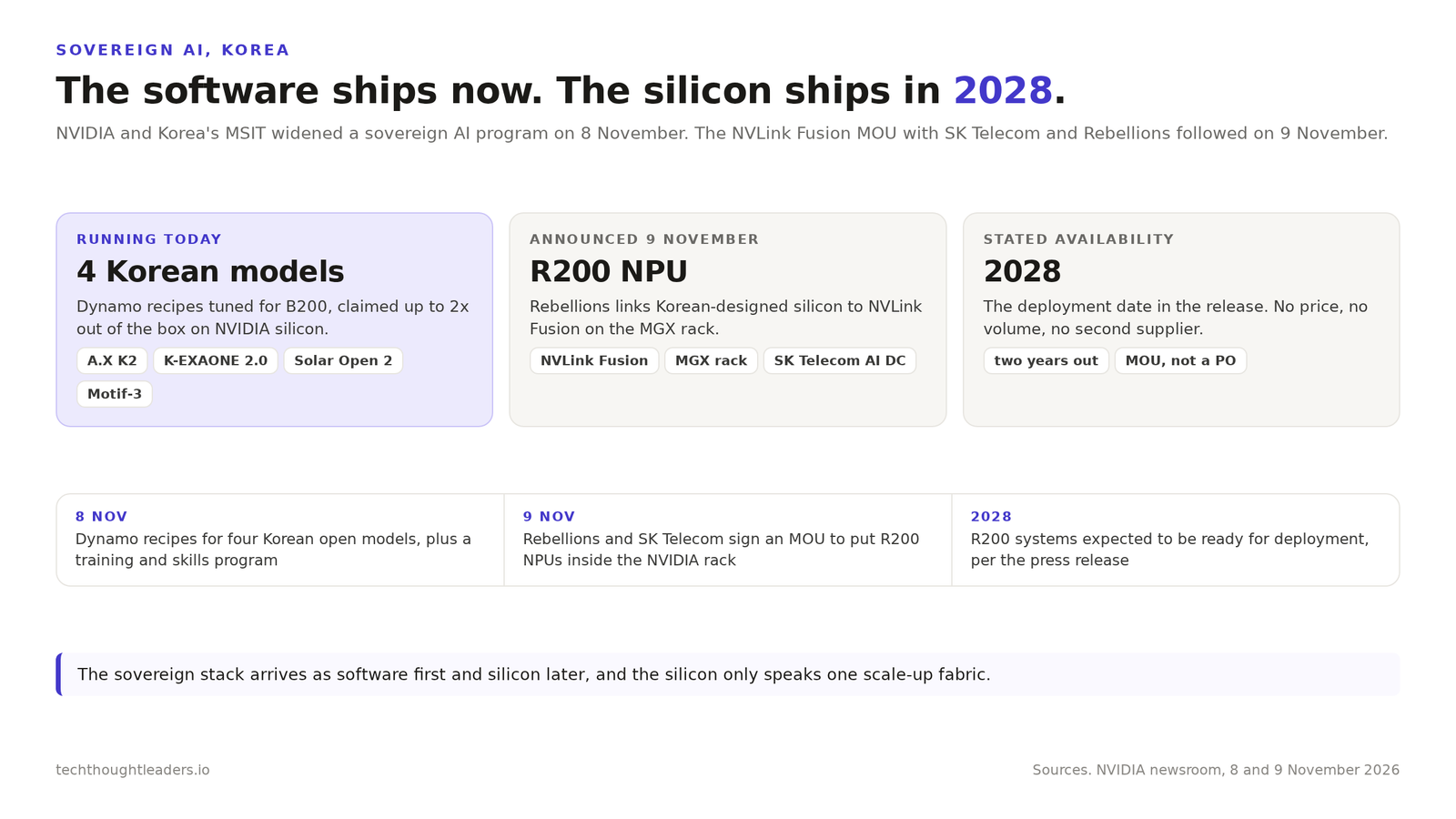
Korea wants models that answer in Korean, on servers the country controls. Its sovereign AI program got two pieces of that this week. A set of tuned deployment recipes for four Korean models, and a memorandum placing a Korean chipmaker inside NVIDIA’s rack-scale interconnect. Only one of those pieces has a date. The memorandum says 2028.
The recipes came first, on 8 November. NVIDIA published Dynamo configurations for SK Telecom’s A.X K2, LG AI Research’s K-EXAONE 2.0, Upstage’s Solar Open 2 and Motif Technologies’ Motif-3. The recipes are optimized for B200 GPUs and the post claims up to twice the performance out of the box. That is the half that works today, on NVIDIA silicon, in NVIDIA’s open source inference server.
A day later the silicon half got signed. NVLink Fusion will connect Rebellions’ R200 neural processing unit into the NVIDIA platform, and the systems will be built on the MGX rack. SK Telecom plans to deploy them in its AI data center. Korea’s Ministry of Science and ICT is supporting the work, and the agreement is a memorandum of understanding rather than a purchase order.
The models are shipping. The silicon is a memo with a date.
Read the two documents together and the shape is clear. The inference software is finished, benchmarked on hardware that exists, and pointed at a public program that will serve citizens. The domestic chip is a future product with a deployment year instead of a benchmark.
That gap matters because accelerators change faster than procurement cycles. A 2028 NPU will land into a rack design, a power envelope and an inference stack that NVIDIA will have revised several times by then. The R200 is described as built for low-latency, energy-efficient inference on mixture-of-experts models in the trillions of parameters. Worth having. Also worth noticing that the target keeps moving while the chip is designed.
There is a second gap, and it sits inside the word sovereign. Sovereignty in infrastructure usually means control over where workloads run and who can be compelled to hand them over. A domestic model plus a domestic accelerator is one way to get that. A domestic model on imported accelerators is a weaker version of the same promise, and it is the version shipping first.
NVLink Fusion hands over a seat, not a way out
Start with the mechanism. A rack of accelerators behaves like one large machine only because a scale-up fabric connects the chips at high bandwidth and low latency. NVIDIA’s version of that fabric was closed to other vendors. NVLink Fusion opens it to custom silicon, so a third-party chip can join the same scale-up domain and share the rack with NVIDIA parts.
That is a real concession. It is also the price of entry. Rebellions competes on efficiency inside NVIDIA’s architecture, against a moving target, while the interconnect, the rack design and the reference systems come from the same vendor. The Korean chip gets distribution and an integration path. It does not get an independent stack, and it does not by itself give a buyer an exit if licensing or supply changes.
An exit looks different. It is a serving layer that runs the same model on several accelerator families without a rewrite, plus benchmarks a buyer can audit. Dynamo is open source and already spans multiple backends. Portable inference is the lever. Joining someone else’s fabric is the shortcut.
Three questions for anyone buying sovereign compute
Ask what the workload runs on the day the contract is signed, and who can change that. Ask what the escape costs if the fabric vendor changes terms, in engineer weeks rather than in principle. And ask which benchmark the domestic alternative was measured on, on what model, at what batch size. If the answer to the third one is a slide instead of a number, the sovereignty is in the press release.
Korea is not doing this badly. It is doing what every government does under time pressure, buying the part that ships now and promising the part that does not. Two years is enough time to fix a chip, and enough time to notice that the software under it never moved.
Related reading. Nvidia Is Letting Rivals Into Its Rack. That Is the Point. and Brookfield Will Own Korea’s AI Factory. Naver Will Rent It.
Get the next one before it is old news
Independent analysis of cloud-native infrastructure, Kubernetes and data center economics. No vendor spin.