

Executive Summary
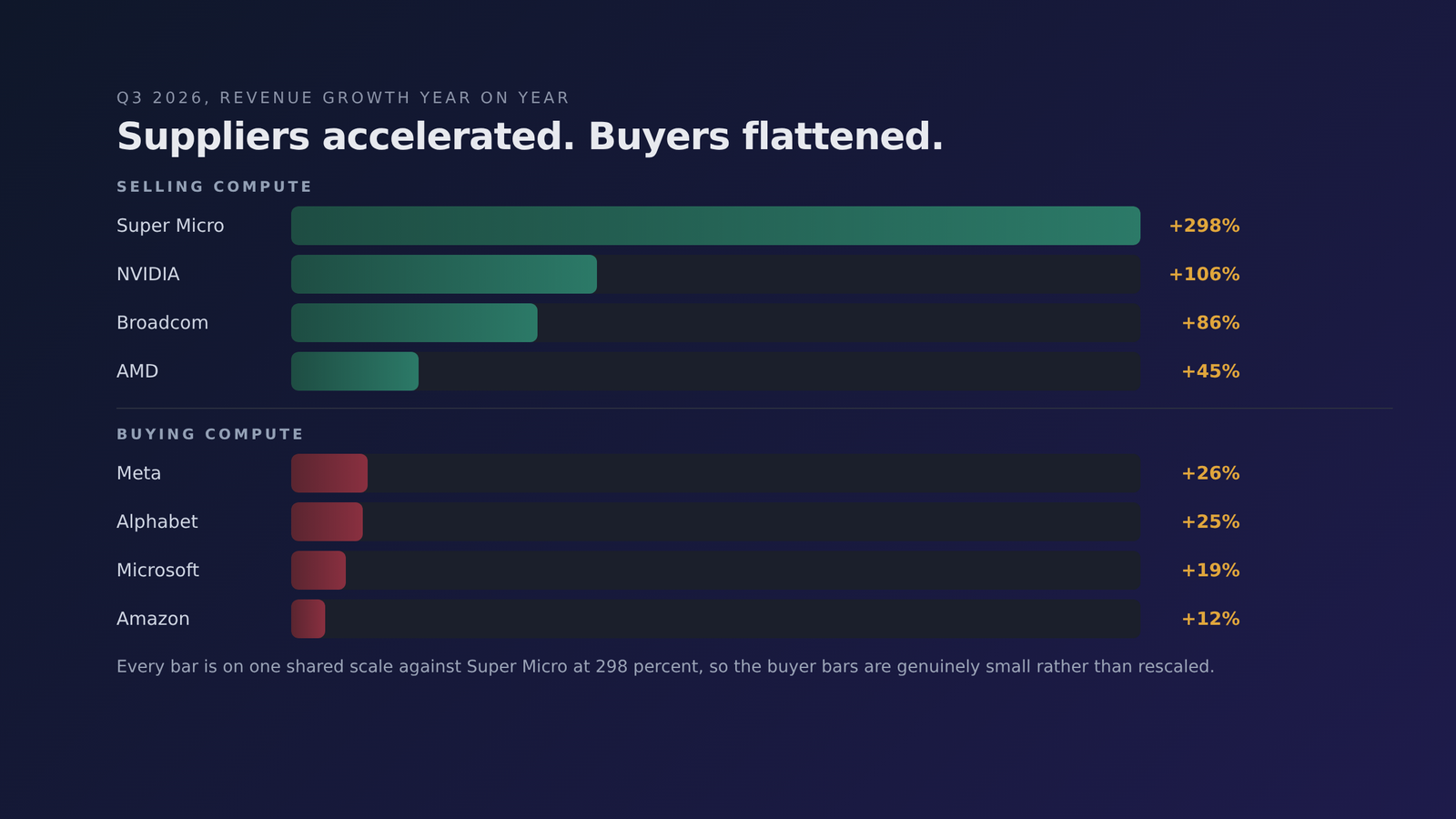
Ten weeks of earnings split the AI infrastructure trade in two. Every company selling compute, memory or networking beat and most raised guidance. The four companies buying it mostly stopped raising budgets, and three of them reported negative free cash flow.
The reason is not falling demand. Microsoft and Alphabet both missed capex estimates because third party capacity arrived late, not because they changed their minds. The constraint has moved from whether anyone will buy to whether the power and the buildings can be delivered, and the market is now paying for capex that converts to revenue on schedule. The margin tells the second half of the story. Super Micro sold 19.95 billion of servers at 12.7 percent gross margin while Micron posted 87 percent, so the value is in design and memory rather than assembly. And with three of four hyperscalers burning cash, the buildout has quietly moved from internally funded to capital markets funded.
Start with the suppliers, because they are unambiguous. NVIDIA grew revenue 106 percent to 96.22 billion dollars. Broadcom grew 86 percent to 29.59 billion and told investors its AI revenue would reach 115 billion in fiscal 2027 and 230 billion in fiscal 2028. Super Micro grew 298 percent to 19.95 billion. Micron grew nearly fivefold on 87 percent adjusted gross margin.
TSMC is the cleanest read because it sits underneath all of them. Third quarter revenue was 46.7 billion at a 66.4 percent gross margin, and it raised its full year dollar revenue growth forecast to 44 percent while leaving capex at 60 to 64 billion. Growth guidance went up and spending guidance did not. That tells you the limit is not TSMC’s appetite.
The buyers stopped raising and the reason is delivery
Alphabet held 2026 capex at 195 to 205 billion and lost 13 percent on 29 October, its worst day since the 2004 IPO, on a revenue miss and 9.07 billion of negative free cash flow. Meta held capex at 135 to 145 billion and fell 7 percent. Amazon held at 220 billion with trailing twelve month free cash flow of negative 42.4 billion.
Microsoft was the one that cut, from 175 billion to 170 billion. Amy Hood attributed part of the miss to third party GPU provider delays pushing capacity into the first half of 2027. Alphabet’s finance chief said outside compute came online only at the very end of the quarter.
Both companies missed the same way for the same reason. They could not take delivery. Microsoft still guided the current quarter above 50 billion and Jassy said Amazon expects to spend meaningfully more in 2027. Nobody is retreating.
Where the margin actually lands
Super Micro sold 19.95 billion of servers at a 12.7 percent gross margin. That is up from 9.3 percent a year earlier and down from 17.5 percent the prior quarter. Assembling racks is a thin business even when volumes triple.
The margin sits one layer up in memory. Micron posted an 87 percent adjusted gross margin. Broadcom generated 13.7 billion of free cash flow, 46 percent of revenue, because custom accelerators and networking carry software economics. NVIDIA held 75 percent.
So the value is in design and memory. Assembly earns a distributor’s return on a manufacturer’s balance sheet, and that is unlikely to change while three vendors can build the same rack.
The buildout changed who pays for it
This is the part the stock reaction is really about. On current guidance the four largest buyers will spend roughly 730 billion on capex in 2026. That has moved from internally funded to capital markets funded.
Microsoft priced 25 billion of bonds on 29 October, its first sale since 2017, and announced buyouts for up to 60,000 staff. Alphabet raised 41 billion in the quarter. Meta is preparing a stock sale of up to 97.5 billion, and its five year credit default swap spread hit an all time high.
When a buildout is paid for out of operating cash, the market judges demand. When it is paid for out of debt and equity, the market judges delivery and repayment. Those are harder questions and the answers arrive later.
Watch Vertiv rather than the GPU commentary. It grew 61 percent, saw organic orders more than double, and took 4.1 billion in customer prepayments, 3.6 times the prior year, because buyers are paying in advance to hold a place in the queue. That is what a physical constraint looks like from the inside. Our analysis of where the constraint moves next follows the same thread.
GPU supply is loosening, which is why AMD could guide 27 percent sequential growth. Power, shells and HBM are not. Until those ease, expect more quarters where suppliers beat and buyers miss.
Get the next one before it is old news
Independent analysis of cloud-native infrastructure, Kubernetes and data center economics. No vendor spin.