


Executive Summary
HuggingFace trending has a new leader and it is nineteen times smaller than the model it replaced. LiquidAI’s LFM3-1.7B took first place on 3 November with a score of 789, up 62 percent in five days. Nanbeige4.3-33B held first place on 1 November at 804 and finished fifteenth at 268, a 67 percent drop in 48 hours. Nanbeige’s downloads still rose 76 percent across the same five captures, so the fall was attention, not demand.
The mechanism is the cost of a first evaluation. A 1.73B model loads in about 1 GB at 4-bit. A 33B needs roughly 66 GB in bf16, which is a multi-GPU booking rather than a laptop. Six of the thirty trending slots now belong to a single LiquidAI family, so one evaluation decision feeds five related checkpoints. The board is pricing the first hour of use, not the final bill, and that gap is where procurement teams still misread it.
Model size used to predict where a model would land on a trending board. This week it told you the opposite. The 1.73 billion parameter model at rank one loads in about a gigabyte. The 33 billion parameter model at rank fifteen needs sixty-six gigabytes in bf16 to run the way its authors published it.
That is not a quality story. Nanbeige4.3-33B scores 80.9 on Terminal-Bench 2.1 against 73.0 for Qwen3.8-27B, and its own model card claims the strongest agentic results among open models near thirty billion parameters. It is the better model on the evidence available. It is also the more expensive one to find that out about.
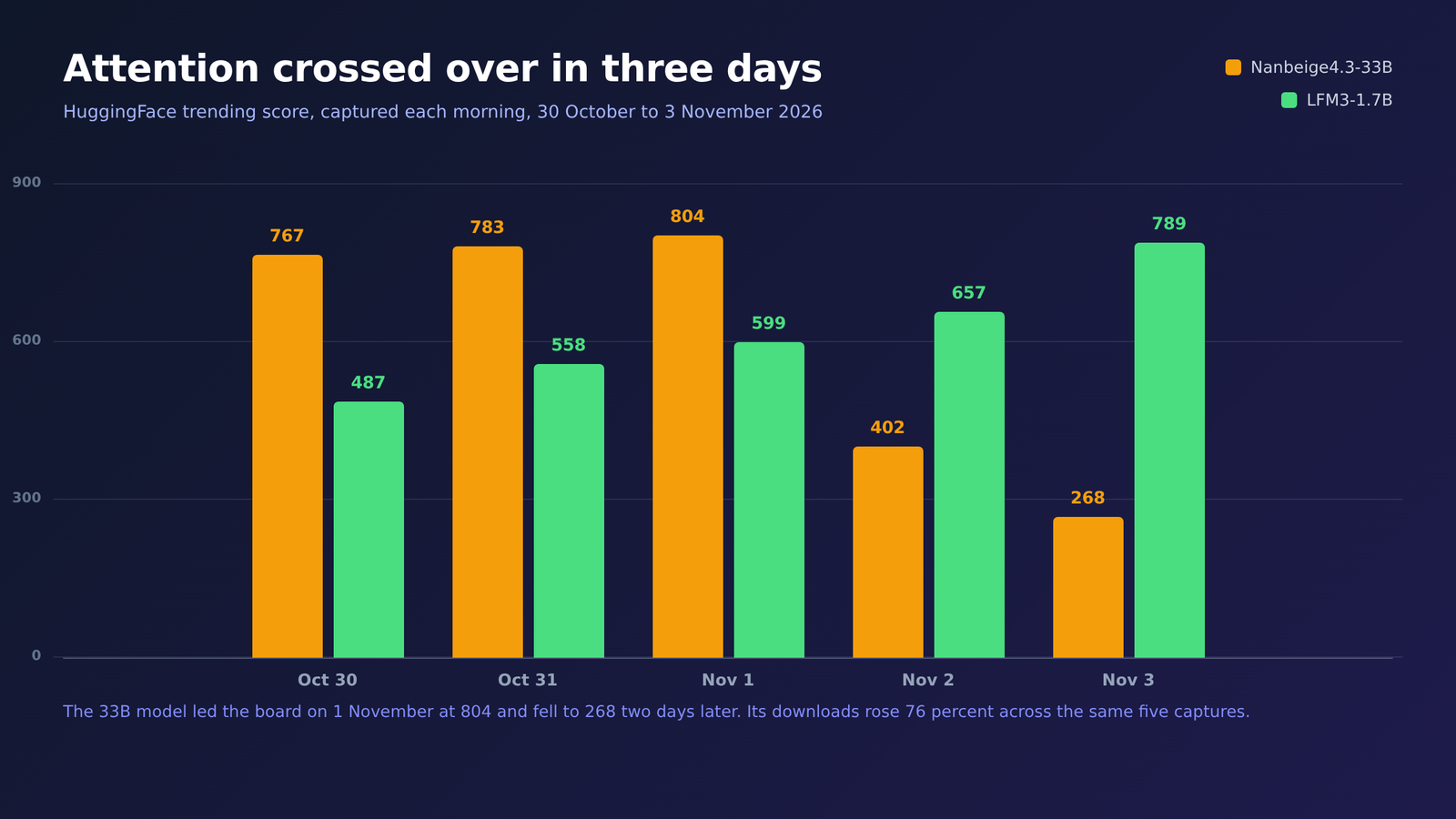
The HuggingFace trending score is a momentum number, not a quality number. It tracks how fast attention arrives, which means it prices whatever a person must spend before they can form an opinion.
Nanbeige built a teacher and the board charged it for that
The 33B is described as the flagship teacher for the Nanbeige4.3 series, built to anchor distillation of agentic behavior into smaller models, with Nanbeige4.3-3B named as the target. The 33B is not the product. It is the factory for the product, and the product is not on HuggingFace yet.
The board rewarded that arrangement for three days. Rank two, rank two, rank one. Then on 2 November the score fell from 804 to 402, and the next morning to 268. Downloads kept climbing the whole way, from 9,655 on 30 October to 16,976 on 3 November, a 76 percent gain. The fall was novelty, not demand.
One lab is holding six of the thirty slots with a single family
LiquidAI had three models on the board on 30 October. By 3 November it had six. LFM3-1.7B, its GGUF build, LFM3-Omni-2B, LFM3-VL-2B, LFM3-Audio-2B and d1-2B. The family shipped on 27 October, so the oldest member was a week old at the last capture.
The lead checkpoint went from 487 to 789, a 62 percent gain, and its downloads went from 15,885 to 42,384 across the same five mornings. The other five climb with it, because a search for the text model surfaces the audio, vision and omni variants.
Six of thirty is twenty percent of the visible board from one publisher. That is a distribution result more than a capability result. The family shares one architecture and one story, so attention on any single member lifts the rest. A lab that ships a family each quarter can hold a presence on a board that is rewritten every few days.
The board prices the first hour and nobody budgets for the last one
Consider who actually moves a trending score. It is not a benchmark reader. It is someone with a GPU and an afternoon who wants to watch the thing answer a question. A 1.73B model in 4-bit is one command and about a gigabyte. A 33B is a booking, a quant, or a remote endpoint, and each is a decision before you are allowed an opinion.
That is why the ranking inverts. The lowest cost experiment wins, and the lowest cost experiment is not the best model. LiquidAI says so itself. The LFM3-1.7B card declines to recommend the model for agentic coding or complex multi-step reasoning, and points you at retrieval instead.
For anyone buying infrastructure the read is narrower than the headline. A top trending position means a model is deployable by one person, which is a real signal about the shape of demand and a weak signal about capability. The two numbers that decide your bill are the memory floor and the context window, and the board shows neither.
Even the incumbent is leaking attention. DeepSeek-V4.1-Flash-1017 fell from 872 to 663 over the five captures, down 24 percent, while adding 46,000 downloads. Nothing about it got worse. The news cycle moved on.
Three questions worth asking of your own pipeline. Can an engineer stand up a candidate model and form an opinion without filing a capacity request? When a model tops a board, does anyone check its memory before its score? And if the first answer is no, what is your evaluation capacity measuring?
Related reading. We wrote about the gap between the board and the downloads on 1 November, and about the document parser that led the download race the next day.
Get the next one before it is old news
Independent analysis of cloud-native infrastructure, Kubernetes and data center economics. No vendor spin.
[…] reading. We wrote about the 33B model that fell fifteen places in two days on 3 November, and about the document parser that led the download race the day […]
[…] Related reading. We covered the week video and 3D models took three of the top seven slots, and the day a 1.7B model took the lead from a 33B one. […]