
Executive Summary
Naver signed a $9 billion computing infrastructure agreement with Brookfield on 27 October, clearing the last condition on Nvidia’s $1 billion equity investment. The capacity sits in a special purpose vehicle Brookfield controls, which buys the GPUs and the data halls and supplies compute to Naver Cloud, which then sells it.
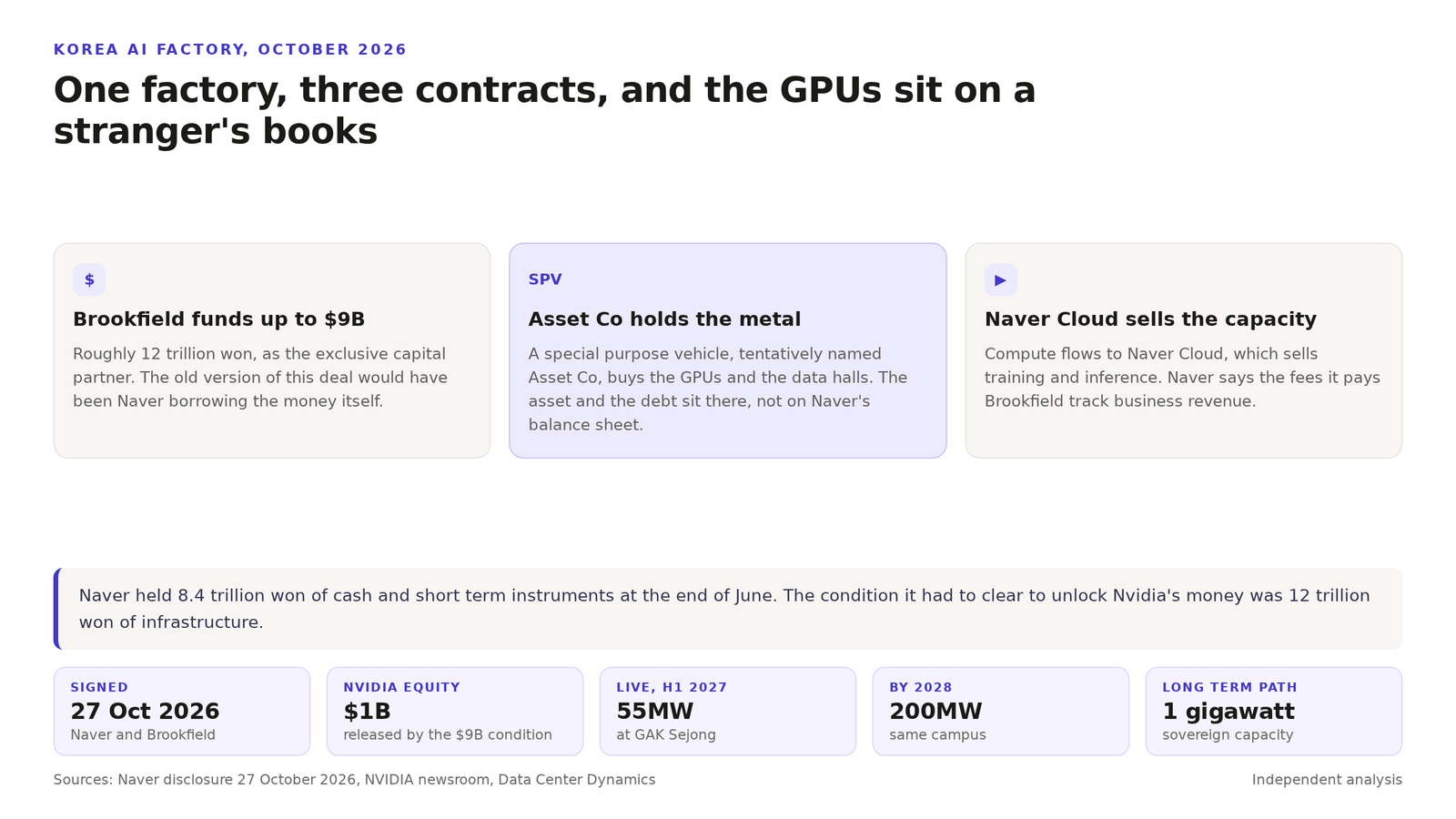
Nvidia set that condition in July and it was larger than Naver could fund from its own pocket. Naver held 8.4 trillion won of cash and short term instruments at the end of June. The requirement was roughly 12 trillion won of infrastructure. The first 55MW goes live in the first half of 2027 and the plan reaches 200MW in 2028. Korea keeps the site, the power and the operators. The metal that produces the compute sits on somebody else’s books, which is the trade small economies are now making to get sovereign AI infrastructure built at all.
Naver needed to put $9 billion of computing infrastructure on the table to unlock Nvidia’s money. It put somebody else’s money on the table instead.
The Korean company signed the agreement with Brookfield on 27 October, and the shape matters more than the number. Brookfield funds up to $9 billion, about 12 trillion won, through a special purpose vehicle tentatively named Asset Co. That vehicle buys the GPUs and the data halls. Compute then flows to Naver Cloud, which sells training and inference to customers.
The condition was bigger than the balance sheet
Nvidia’s $1 billion was never unconditional. The July agreement tied it to Naver securing at least $9 billion of computing infrastructure on top of Nvidia’s own equity. The full project is costed at $10 billion, with Brookfield as the exclusive capital partner, Nvidia putting in $1 billion and Naver funding the rest.
At the end of June, Naver held 8.4 trillion won across cash, cash equivalents and short term financial products. The condition asked for 12 trillion won of infrastructure. Filling that from the balance sheet alone was not really available, so Naver found a partner that treats GPUs as an asset class rather than a vendor financing problem.
The owner and the operator are now different companies
Brookfield is not lending here. It is buying. The firm runs more than $1 trillion in assets and its model is owning real assets and renting them out, which is what a data hall already is. GPUs depreciate faster than a building does, so the underwriting is unusual, but the structure is not.
Naver brings the part Brookfield cannot buy. It has built and run large GPU clusters at GAK Chuncheon and at GAK Sejong, the campus where this capacity lands. Naver Cloud operates the factory and sells the output. Naver says the arrangement cuts its upfront outlay and that the fees it pays track business revenue, which is a very different instrument from a fixed lease.
Sovereign compute is a contract, not an address
The delivery schedule is fast for this industry. The first 55MW goes live in the first half of 2027, scaling to 200MW in 2028, with a long term path to a gigawatt of sovereign capacity. GAK Sejong covers 290,000 square meters and is planned for 270MW and up to 600,000 servers.
All of that is Korean. The land, the grid connection, the operating team and the customers are Korean. The asset that produces the compute belongs to a global alternative asset manager, and the chips inside it belong to whoever ends up on the other side of Nvidia’s allocation.
It is also the cleanest answer yet to a problem the neoclouds have not solved. Those companies borrow to buy GPUs while carrying no investment grade rating, and lenders have started pulling back. Brookfield raises capital at a very different price and does not need this factory to be its only business. Moving the asset to that balance sheet keeps the build moving when the middle layer stalls.
Three questions follow from the structure. If the owner and the operator are different companies, who carries the residual value of a GPU cluster in year four. What happens to Korean sovereign capacity if the asset owner sells the vehicle. And does a revenue linked fee still protect the operator when model prices fall faster than the hardware depreciates.
Related reading. Broadcom became the backstop on its own silicon covers the last special purpose vehicle on this beat and why its terms were brutal. Spain raised the threshold tenfold shows what governments do when the power, not the money, is the constraint. Anthropic’s 20 year compute leases carry an uncapped fuel bill is the contract risk on the other side of the table.
Get the next one before it is old news
Independent analysis of cloud-native infrastructure, Kubernetes and data center economics. No vendor spin.