


Executive Summary
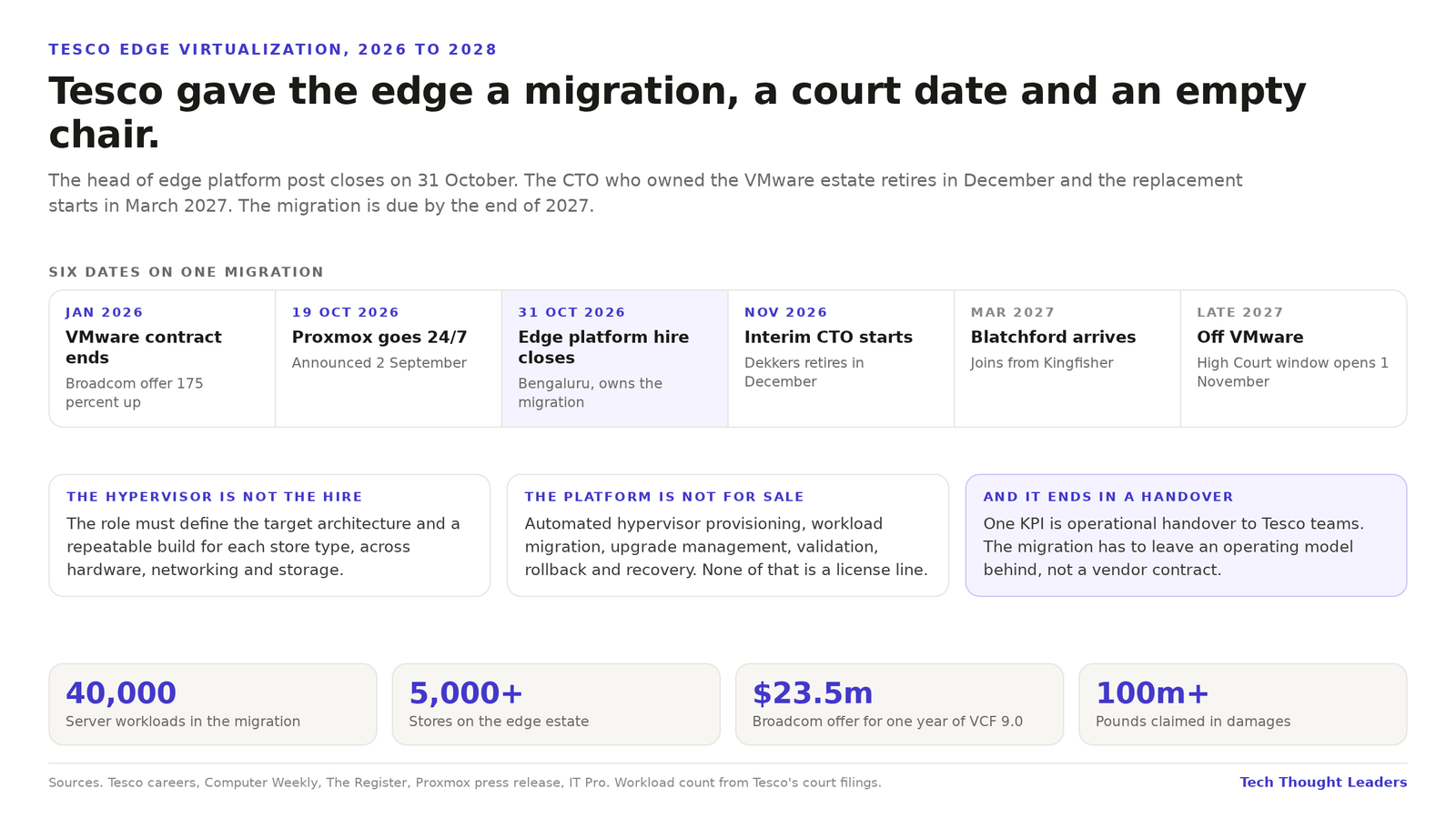
Tesco is hiring a Head of Software Engineering for its Edge Platform in Bengaluru, and the posting names two priorities. The first is moving the store estate off VMware and onto Proxmox. The second is building the platform that provisions, monitors and maintains systems across thousands of shops. Applications close on 31 October. Tesco runs more than 5,000 stores, is suing Broadcom over a 175 percent increase on a one-year renewal, and has 40,000 server workloads in migration with a target of leaving VMware by the end of 2027.
The Tesco Proxmox migration is not a license swap wearing a modernization costume. It is an operating model being assembled by hand, because the hypervisor has become the cheap layer and everything around it is the expensive one. Proxmox switched on around-the-clock support on 19 October, so the old objection about calling Austria at 3am is dead. The role still expects a repeatable build per store type, automated rollback and a formal handover, none of which arrives with a subscription. Put that headcount in the case before you put the savings in the deck.
The most detailed public statement about Tesco’s VMware exit this year is a job posting. It runs to one page, it is written in HR voice, and it describes a migration of the company’s entire store estate plus the platform work needed to make the migration stick.
The listing sits under Head of Software Development on the Tesco careers site, and the role itself is Head of Software Engineering, Edge Platform. It is Bengaluru, hybrid, permanent, and applications close on 31 October.
The job ad is a project charter
Start with what the Edge Platform is. Tesco describes it as the computing environment underneath checkout, payments, stock management and the applications colleagues use on the shop floor.
The person hired defines the target architecture and a repeatable build for each store type, covering hardware, networking and storage. They validate every platform variant before a progressive rollout, automate provisioning, workload migration, upgrade management and rollback, then hand the whole thing to Tesco teams with documentation and knowledge transfer.
The named success measures are a safe and predictable migration and effective operational handover. That is the language of a platform program, not a support contract. No hypervisor vendor sells you your store build matrix.
Proxmox closed the support gap, not the operating gap
Proxmox did its part in September. It announced 24/7 enterprise support on 2 September, live from 19 October, covering Virtual Environment, Backup Server and Datacenter Manager. The install base it cites is 2.3 million active Proxmox VE servers. Chief operating officer Tim Marx called it one of the last reasons to hesitate about open source at the core of production.
That is a real change, and it landed nine days before the Tesco posting appeared. It also answers a different question. Support responds to a ticket about a node. It does not decide what a standard store looks like, or who signs off a rollback at 6am.
That gap is why the license line keeps looking better than the plan behind it. Independent analyst Michael Warrilow told The Register that supermarkets are ripe for this kind of move because VMware faced more competition and less differentiation there. Read that twice. The edge is the tier where the hypervisor was closest to a commodity.
The clocks do not line up
Tesco’s technology leadership is moving at the same time as its hypervisor. Guus Dekkers retires in December after eight years as chief technology officer. Technology director Jane Mustoe becomes acting CTO from the start of November, and Chris Blatchford joins from Kingfisher in March 2027.
The new edge platform lead reports into an interim technology chief for five months, on a migration that must land by the end of 2027 to hit Tesco’s own earliest date. Court filings put the High Court window for the Broadcom case between 1 November 2027 and 25 February 2028, so the migration and the litigation run in parallel.
None of that means the migration fails. It means the program runs slower and costs more than a slide deck suggests.
The reporting that surfaced the posting read it as Tesco picking an open-source hypervisor. The ad is narrower than that. Tesco is buying the right to stop paying a vendor for a layer it intends to own, and paying for it with a senior hire and two years of engineering.
If you are planning the same move, the question is not whether Proxmox can run your virtual machines. It can. The question is who writes the build matrix, who owns rollback, and whether that headcount sits in the business case. Tesco put it in a job ad because it could not buy it.
Three questions for your own exit plan. What does a standard site build look like, written down, for each of your site types? Who is answerable when an upgrade fails at 6am with no engineer on site? And if your vendor stopped bundling management tomorrow, which role would you hire first?
Related reading. The VMware exit has a shortlist covers where displaced customers went. A full VMware exit costs more than three years of Broadcom’s bill puts numbers on the migration.
Get the next one before it is old news
Independent analysis of cloud-native infrastructure, Kubernetes and data center economics. No vendor spin.