


Executive Summary
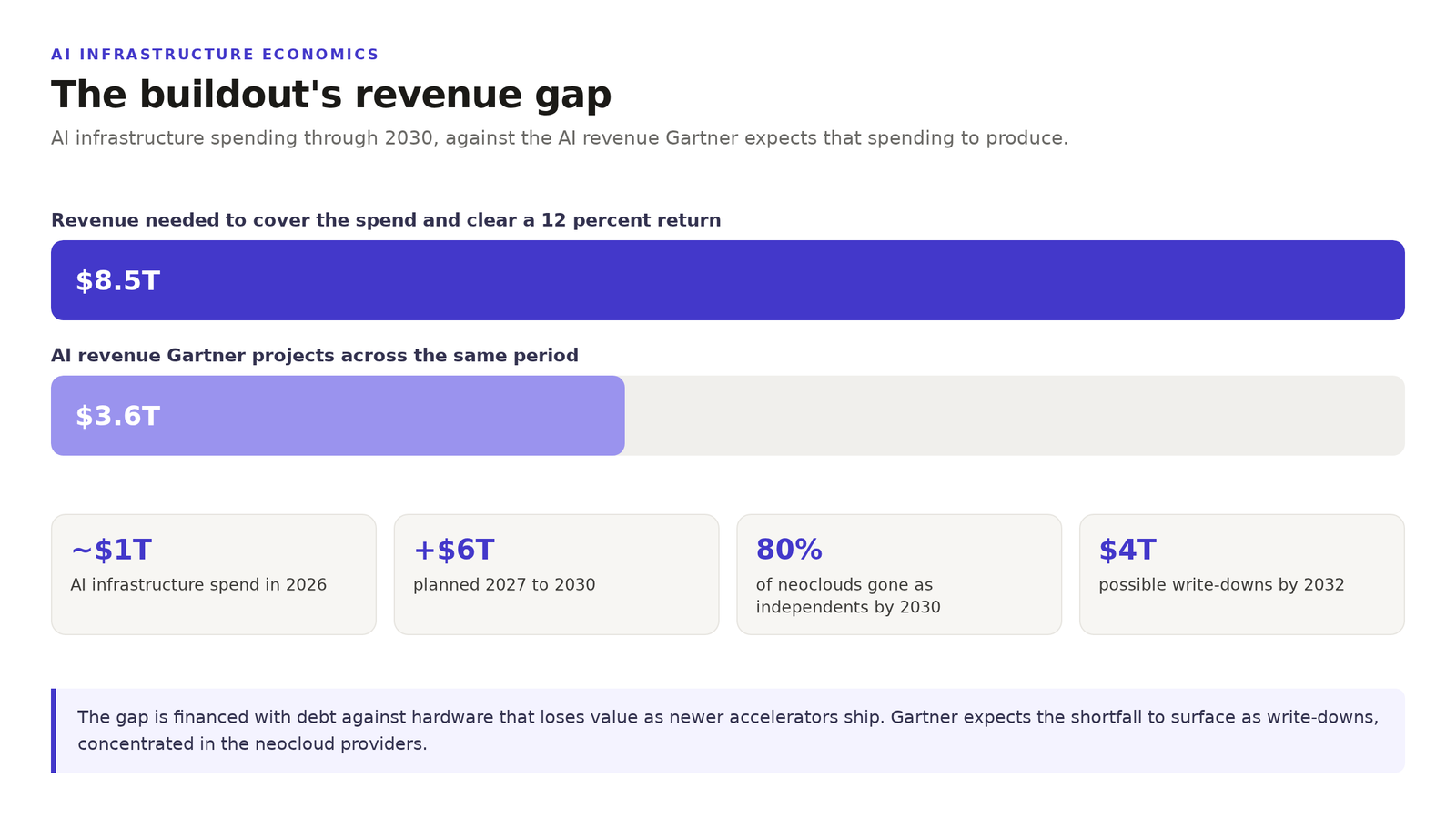
AI infrastructure spending is now forecast to exceed the revenue it can generate, and the gap is large enough to force a reckoning. Gartner expects about one trillion dollars of spending in 2026 and another six trillion between 2027 and 2030. Covering that spending and its financing while clearing a twelve percent return needs eight and a half trillion dollars of AI revenue. Gartner’s own projection is three and a half trillion.
That gap is a financing problem before it is a demand problem. The neocloud operators built their fleets on debt, and on Wednesday that debt was repriced, with one CoreWeave bond now yielding about fifteen percent. Gartner expects eighty percent of the neoclouds to stop existing as independent companies by 2030, with write-downs that could reach four trillion dollars by 2032. AI demand is not the question. Whether the hardware outlives the loan is.
For two years the argument about AI infrastructure was about demand. Would the workloads arrive? On Wednesday the argument moved to the balance sheet. Shares of the debt-heavy AI names fell hard after a hotter-than-expected inflation print, with CoreWeave down about fifteen percent and Nebius off roughly a tenth. The cost of insuring that debt against default hit record highs, according to S&P Global Market Intelligence data, as CNBC reported. September headline inflation ran at 3.7 percent, and traders pushed the odds of a rate hike this month to about 37 percent, up from 18 percent a week earlier.
The spending forecast outruns the revenue forecast by five trillion dollars
Gartner laid out the arithmetic in a September report, and The Register carried it on Wednesday. The firm expects AI providers to spend nearly one trillion dollars on infrastructure in 2026, then another six trillion through 2030. To cover that spending and its financing while clearing a twelve percent return, operators would need eight and a half trillion dollars of AI revenue. Gartner’s projection for enterprise and consumer AI revenue over the same period is three and a half trillion.
The five trillion dollar shortfall is where the write-downs come from. When newer accelerators displace older ones, the operators holding the older hardware cannot recover what they paid for it. Gartner puts the possible write-down at four trillion dollars by 2032 and expects most of it to land on the neocloud providers. It expects eighty percent of them to be gone as independent companies by 2030. The hyperscalers, with revenue outside AI, are expected to absorb the same shift more easily.
The collateral depreciates faster than the loan matures
Here is the part the headline numbers hide. A GPU-as-a-service provider borrows against a fleet of accelerators. The loan runs for years on a fixed repayment schedule. The accelerators lose value on a faster clock, because every new generation makes the previous one cheaper to run and cheaper to buy used.
The debt is large and public. CoreWeave has issued twenty-two billion dollars of bonds and twenty-six billion dollars of loans. A bond it sold in June at a yield of 9.625 percent now trades near fifteen percent. When an issuer has to promise more interest to borrow, the market is saying it doubts the assets behind the debt will hold their value long enough to repay it.
The lease terms show the mismatch. The capacity contracts signed with the labs run for years, sometimes decades, while the hardware inside is replaced on a much shorter cycle. Broadcom chief executive Hock Tan said this week that access to capital could become the industry’s next constraint. Wednesday suggested he is right, and that the constraint is already being priced.
None of this says AI demand is evaporating. It says the industry financed the supply on terms that assumed today’s accelerators would stay valuable, and the market has started to charge for the chance that they will not.
Three questions before the next capacity deal
Ask what useful life you assumed for the hardware, and whether the contract term runs past it. Ask who carries the residual value if a newer generation lands on schedule. Ask what your cost of capital is today, and whether the deal still clears if it moves three hundred basis points. If the third answer is no, the deal depends on cheap money returning, not on the workload paying for itself.
Related reading. For the memory wall that is the same economics one layer down, see HBM Cannot Hold the Context Window. For how the orchestration layer changes the utilization math, see our look at NVIDIA Run:ai going open source.
Get the next one before it is old news
Independent analysis of cloud-native infrastructure, Kubernetes and data center economics. No vendor spin.