

Executive Summary
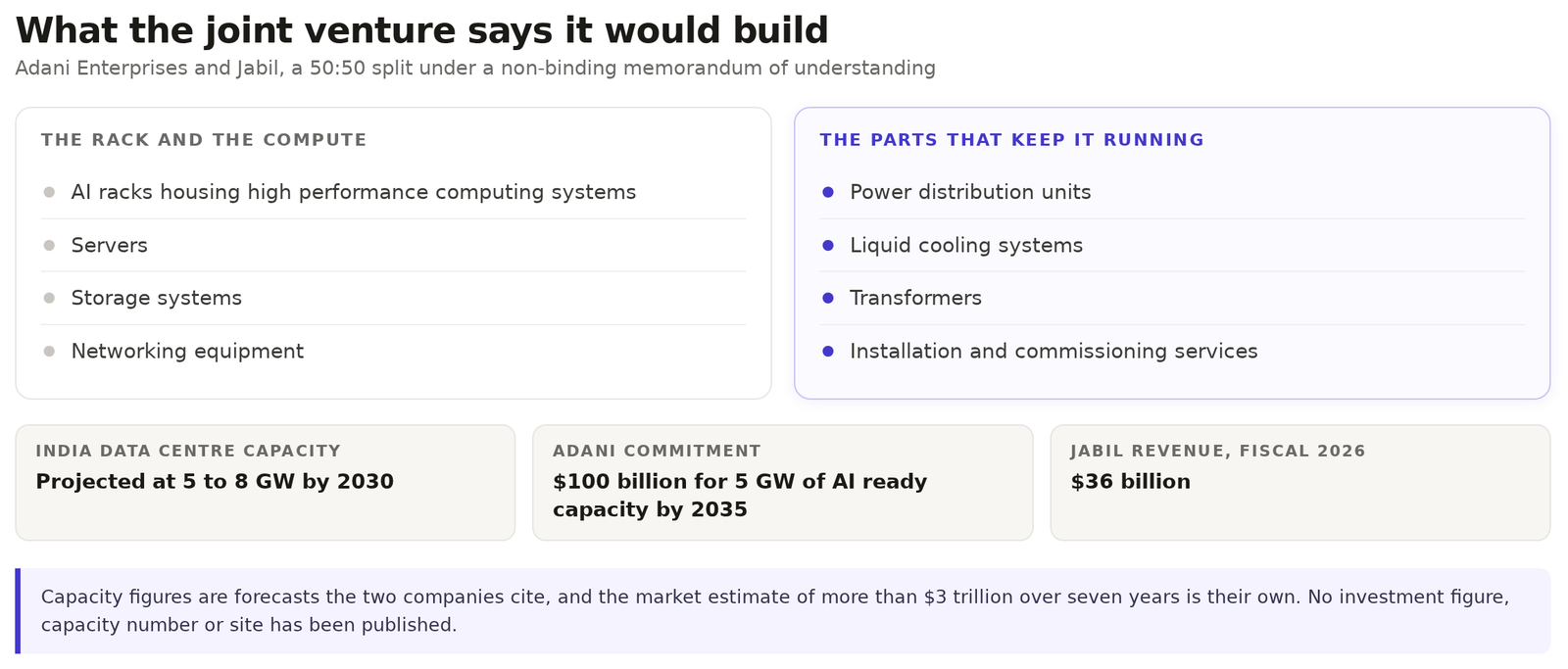
Adani Enterprises and Jabil have signed a non-binding memorandum of understanding for a 50:50 joint venture that would make AI and data center hardware in India. The paperwork is early. The scope is not. The venture would build racks, servers, storage and networking gear, plus the power distribution units, liquid cooling systems and transformers that keep them running.
The demand behind it is supply side. India’s data centre capacity is projected at 5 to 8 gigawatts by 2030, with more than $50 billion of planned hyperscaler spending. Adani has committed $100 billion to 5 gigawatts of its own AI ready capacity by 2035. Jabil reported $36 billion of revenue in fiscal 2026 and has already bought a critical power business and a liquid cooling business. A manufacturer is moving onto the part of the stack that used to arrive from someone else.
The joint venture has not built a single rack and may never build one. What Adani Enterprises and Jabil signed is a non-binding memorandum of understanding, which is an agreement to keep talking with a scope attached. The scope is the story, because it names the parts of an AI data center that stopped being generic.
An AI rack stopped being a box of chips
Compare an AI rack with the general purpose servers it replaced. The rack now carries cold plates, coolant manifolds and a distribution unit that keeps rack coolant separate from the building’s water loop. A transformer sits upstream of all of it. The shared facility document that AMD, Google, Meta and NVIDIA published together sizes those requirements in numbers, including a blended power density of 25 kilowatts per foot of row, 350 kilowatts per foot at peak IT density, a 100 inch rack height and a design target of 8,000 pounds for the heaviest single rack. Those are design targets, not measurements of a built site.
The electrical standard is changing at the same time. A 1 megawatt rack on the legacy 54 volt direct current busbar can need up to 200 kilograms of copper, which is why the industry is moving to 800 volts direct current. That change reaches the transformer, the switchgear and the busbar, not just the rack.
Whoever owns the line owns the schedule
Designing a rack is not the constraint. Buying one is, and the parts with the longest lead time are the electrical ones. Jabil’s own recent purchases say the same thing. It bought Hanley Energy Group for critical power and energy management, and Mikros Technologies for liquid cooling in high performance computing. Those are the two component businesses an AI rack now depends on.
For India the calculation is not a cost arbitrage. A domestic line shortens the distance between a hyperscaler order and a delivered rack, and it keeps the power and cooling components in the same country as the campus. Adani has already leased 240 megawatts of Indian capacity to CoreWeave, so the demand side of that equation is not hypothetical. The same transformer bottleneck applies, and the electrical redesign is what makes a new line worth building rather than retrofitting.
The honest weak link is the word non-binding
There is no investment figure, no capacity number, no site and no timeline. The two companies describe multi-gigawatt AI rack manufacturing capacity without saying which gigawatt or where. The 5 to 8 gigawatt figure for India is a projection the companies cite rather than an audited number, and the estimate of more than $3 trillion of global market opportunity over seven years is their own. Treat the release as a statement of intent, not a schedule.
It is worth watching anyway. Manufacturing capacity in the AI stack has been the scarce input all year, which is why money keeps moving toward whoever can deliver hardware rather than design it. Memory reset the price of a rack. Power equipment is resetting the schedule.
Three questions for your own procurement. Which single component in your next refresh has the longest lead time, and does it sit on the critical path of your capacity plan? If your rack supplier does not build its own power and cooling, who does, and where? If the answer is a joint venture with no signed agreement, what is your fallback date?
Get the next one before it is old news
Independent analysis of cloud-native infrastructure, Kubernetes and data center economics. No vendor spin.