


Executive Summary
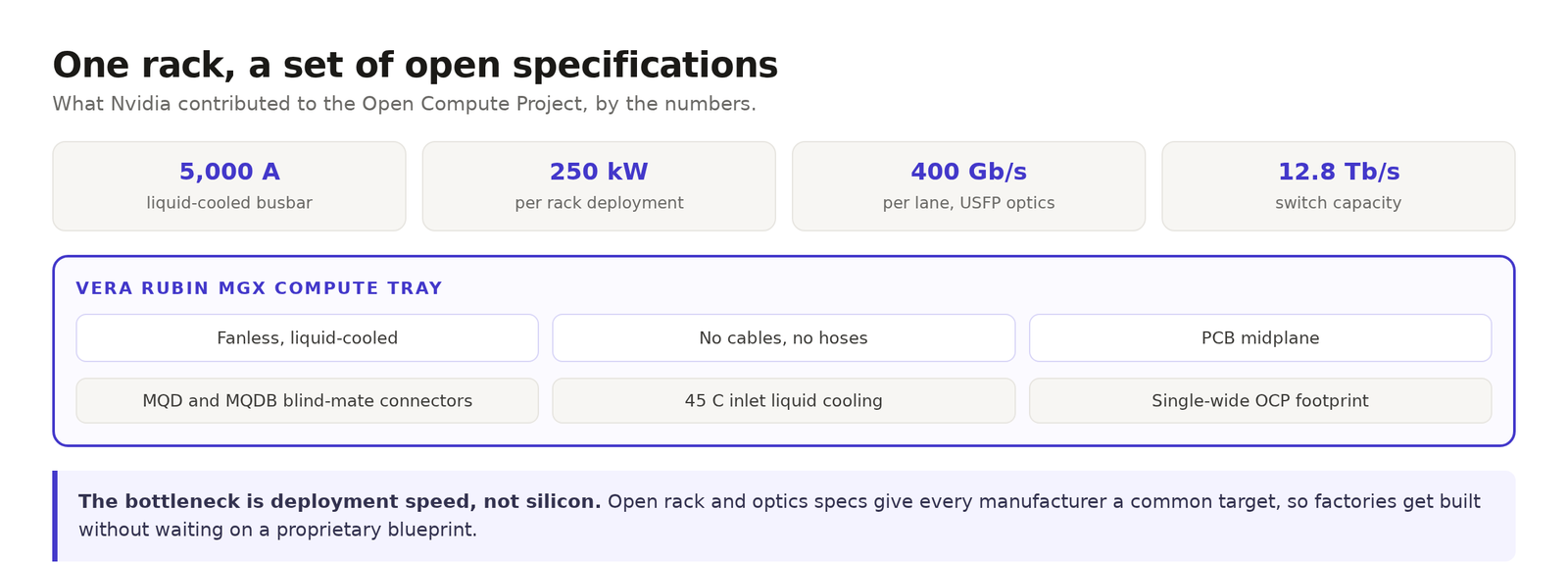
Nvidia contributed the rack and compute-tray designs for its Vera Rubin MGX systems to the Open Compute Project on October 12. The third-generation MGX design is fully liquid-cooled, drops the cables, hoses and fans from each tray, and puts 5,000 amps through a liquid-cooled busbar. A single rack deployment now reaches 250 kilowatts. With Cisco, Nvidia also described a pluggable optical module called USFP that doubles bandwidth per lane to 400Gb/s and reaches 12.8Tb/s per switch.
The verdict is about where the constraint sits. Nvidia says the limit for the industry is how fast AI factories can be manufactured and deployed, not how fast the silicon runs. Publishing the rack blueprint gives every manufacturer a common target, so factories get built against an open specification instead of a proprietary one. For operators, the rack becomes a commodity layer, and the real competition moves to power, cooling and the network.
Nvidia contributed its Vera Rubin MGX rack and compute-tray designs to the Open Compute Project on October 12. It also introduced an optical module built with Cisco, and helped publish an open specification for the building that houses the whole thing. The stated reason is blunt. The bottleneck is no longer the chip. It is how fast a factory can be built.
The rack is now the unit of design
The third-generation MGX design puts each compute tray on a printed-circuit-board midplane, so there are no cables, no hoses and no fans inside the tray. Liquid cooling reaches the busbar, which carries 5,000 amps without making the rack bigger. Assembly and service time, not peak throughput, drove the change.
Nvidia says the tray goes together in minutes rather than hours. Two blind-mate connectors, MQD and MQDB, let field staff swap a cold plate without spilling coolant. The design keeps the single-wide OCP footprint and cools to a 45C inlet, which lowers the chiller load. A single rack now reaches 250 kilowatts, and more than 50 partners build against the same footprint.
Optics decide how many systems fit behind one switch
More accelerators need more fabric, and fabric has a ceiling. When a switch fills up, the next step is another switch layer, which adds latency, power and cost. Nvidia and Cisco designed the Ultra-Dense Small Form Factor Pluggable module to push a lane to 400Gb/s, double the current 200Gb/s figure, and reach 12.8Tb/s per switch without adding a tier.
The module packs 16 full-duplex lanes into an OSFP-sized package and dissipates up to 100 watts without a separate cooling circuit. Nvidia says it is about 1.3 times more power-efficient per bit. The company is working with TE Connectivity and Amphenol to make the parts, and plans an open specification for the form factor. Meta, meanwhile, is adopting Nvidia’s Spectrum-6 switches for its Vera Rubin deployments.
Open specs move the fight to power and cooling
The rest of the contribution is about the building. Nvidia, AMD, Google and Meta published an open data center specification for facility design, covering power architecture, cooling and layout. A separate grid specification from Google, Meta, Microsoft and Nvidia sets how large AI sites behave during a grid disturbance, staying connected and returning to near-full load in under two seconds.
That is the part operators should watch. When the rack, the optics and the building are open, no single vendor sets the blueprint, and manufacturers build for a target the whole market shares. Nvidia’s own framing is that deployment speed is the limit now. Open the blueprint, and more factories get built in the same year.
Three questions for anyone planning AI capacity. Is your rack design a published spec or a lock-in? Do you know the watts your fabric costs per bit moved? And when the grid dips, does your site ride through or trip?
Related reading. Nvidia already stopped selling GPUs and started selling the rack. AMD’s agent rack packs 32,768 CPU cores. And a 1 MW rack broke the 54-volt bus, which is why 800 volts DC keeps coming up.
Get the next one before it is old news
Independent analysis of cloud-native infrastructure, Kubernetes and data center economics. No vendor spin.
[…] the full analysis for the three questions to ask before buying AI […]