


Executive Summary
Broadcom and Intel used the same word this week for the thing that could stop the AI buildout, and the word was not silicon, memory or power. Both chief executives pointed at capital. Broadcom’s Hock Tan said financing could become a bigger obstacle than any physical shortage. Intel’s Lip-Bu Tan said the near-term challenge is capital and the cost of capital, with returns still unproven over the long run.
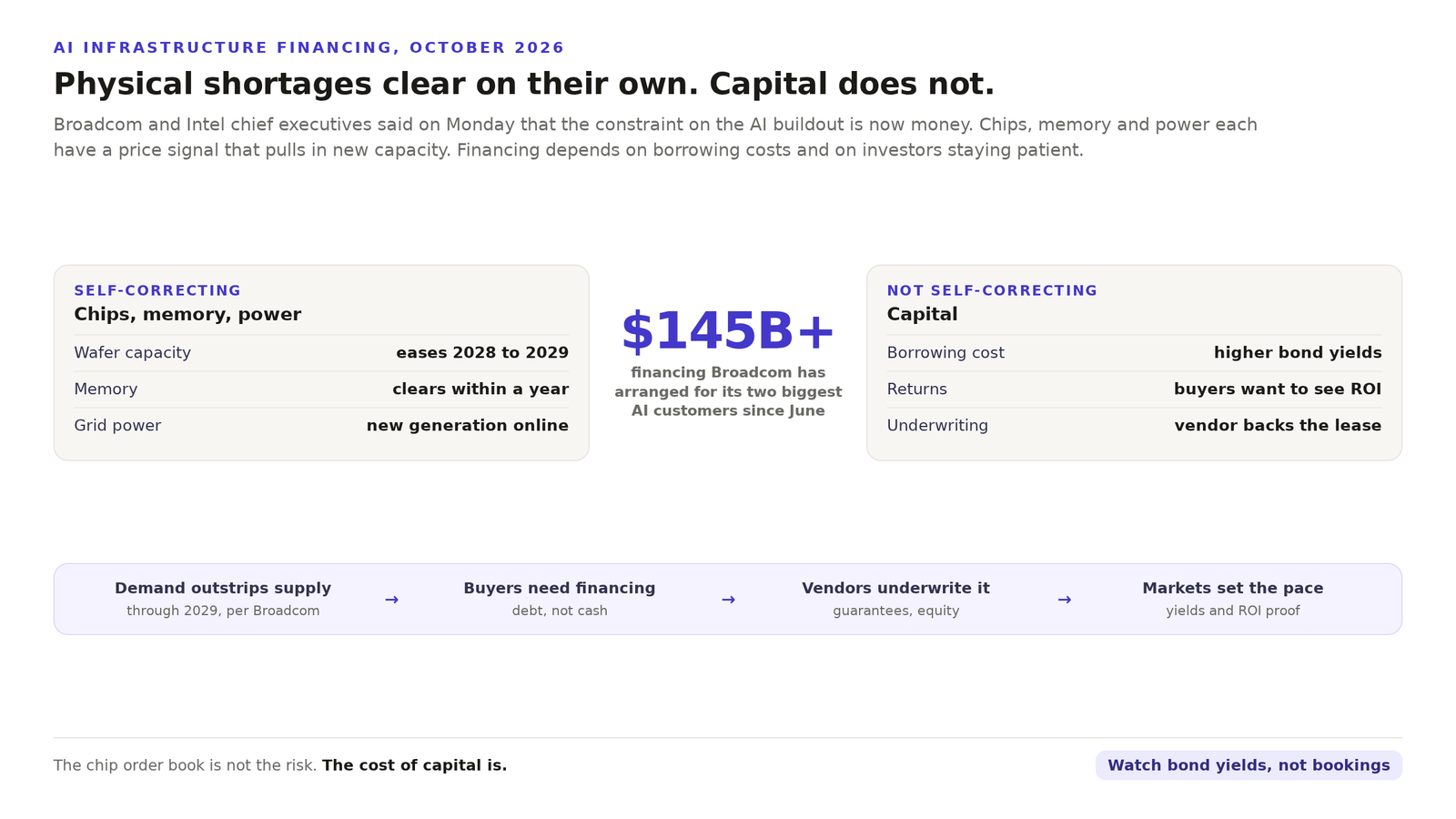
The money behind the claim is already large. Broadcom has arranged more than $145 billion of AI infrastructure financing for its two biggest chip customers since June, including a reported package above $50 billion for OpenAI’s custom accelerators. Broadcom also says demand for compute still outstrips supply through 2029. The finding is that the next limit on AI capacity is not what fabs can produce but what lenders will fund. Watch the cost of capital, not the order book.
Two chip CEOs named the same wall
Hock Tan runs Broadcom. Lip-Bu Tan runs Intel. They are rivals who share a surname, and on Monday they gave the same answer to the same question while speaking in Singapore.
“I think might be the biggest constraint is capital,” Broadcom’s Tan said, according to CNBC. Intel’s Tan split it in two. “If there’s any challenge in the front, it’s capital and the cost of capital, and then the other part is in the longer run, people want to see the ROI.”
Read the two halves together and you get the mechanism. A chip shortage punishes buyers with price, and price pulls in capacity. A memory shortage does the same. Grid power is slower, but a substation and a gas turbine are things someone can build. Capital is different. It prices on bond yields and on the patience of whoever holds the debt, and neither of those responds to a purchase order.
Broadcom is already underwriting its own customers
Broadcom’s own balance sheet shows how far this has gone. The company has arranged financing for both of its biggest custom-chip customers. In June it closed a $35 billion package with Apollo and Blackstone for Anthropic. By early October, banks were syndicating a $60 billion package for Anthropic, split into $42 billion of senior debt that Broadcom backs and $18 billion of junior debt it does not. Bank of America, Citigroup and Morgan Stanley are syndicating that package, with Blackstone leading the junior tranche and committing about $9 billion of its own capital. Now Broadcom is working on more than $50 billion for OpenAI’s custom accelerators, with Apollo and Blackstone again among the lenders in talks, per the Wall Street Journal report.
Add those up and the total tops $145 billion. The chip is no longer the only thing Broadcom sells. It sells the chip and the debt that pays for it. Nvidia runs the same playbook, with a program above $500 billion aimed at third-party capital. Oracle is in talks of its own.
The money does not buy chips for Anthropic to own. A special purpose vehicle buys them and leases them to Anthropic, lease payments service the debt, and those payments begin when the hardware delivers in 2027. Broadcom may also lend Anthropic up to $42 billion through convertible notes that can convert into equity, which would cover close to half of a five year $125.2 billion lease commitment for Google tensor processing units.
The number to watch is the cost of capital
None of this means demand is about to fall. Hock Tan said demand for compute infrastructure outruns supply, and that the gap could hold through 2029 and into 2030. He expects wafer shortages to ease by 2028 or 2029 and memory to loosen within a year.
The risk he named is second order. If borrowing gets more expensive, the projects that lean on debt get harder to justify, and that flows straight into what an operator pays for capacity and when new sites go live. A stalled financing round is now a stalled data center.
Three questions to run against your own plan. What share of your AI capacity depends on someone else’s lease guarantee? What happens to your cost per token if the refinancing rate moves two points? And which of your workloads have a payback short enough to survive a year of expensive money?
Related reading. We looked at why the cheapest new AI capacity is the hardware already paid for, and at how the GPU cloud market grew to 323 providers while hourly prices still rose.
Get the next one before it is old news
Independent analysis of cloud-native infrastructure, Kubernetes and data center economics. No vendor spin.
[…] sits in the AMD announcement, The Register and the NVIDIA blog. Related reading. Money, not chips, is the AI bottleneck now and the GPU rental market cover where the spending […]